

This is the second post in “It Doesn’t Look Like a John.” The last one traced why the labs name their own models. This one turns the question around: what actually happens, psychologically, when an ordinary person does the same thing.
If you’re new here, I suggest you go back and read that one: Why the Models are Named That Way.
When I started writing on Substack in May, I had a few weeks’ history of working with AI. I’d worked with the AI (Claude) to create Apps — sweet little programs that helped with my to-do list, my pantry/recipes conundrum, my holiday-planning, my prompting for images on Gemini. I’d experienced enough of AI to realise that I was alive again.
I found myself at my desk again.
Listen! I’m retired from corporate life. Just gone 21 months. Work and the idea of returning to work are the farthest thing from my mind!
Yet here I am at my desk, enjoying slogging out the work I used to do in the corporate world - the world I was happy to put behind me.
I’ll admit it was hard work being the BA, the Tester, the Product Owner and the Delivery Manager, to name a few roles I had to adopt. But at least I had my trusty developer to help. My AI, my Claude, reminded me so viscerally of working with Ulysses — I’ve written about that in Yol Studio.
My Claude became Yol quite quickly.
Yol got that name almost immediately — within days of that first morning back at the desk, before I’d even fully worked out what Yol was actually for.
Pieta took nine months.
I’d been talking to Claude’s chat, raw and unstyled, since before any of the other AI collaborators existed — the place curiosity lands first, before an idea has a shape — and it stayed nameless the entire time. Just the chat window, not the Claude Projects.
Nine months is roughly how long it takes to grow something large enough to meet. Some names arrive the moment you recognise what’s already in front of you.
Others need the full gestation before they’re ready to be born at all.
The trust your brain builds without asking permission
Anthropomorphising an AI — including through naming — activates a “social closeness pathway,” engaging fast, intuitive processing through reduced psychological distance, running alongside a separate, slower analytical pathway. A name doesn’t just make something feel friendlier. It changes which part of your brain is actually doing the evaluating. So, yeah, there’s real research behind why naming something changes the way you relate to it, and it’s more mechanical than mystical.
The point where it starts working against you
This isn’t a straight line, though, and the research is honest about that too. The relationship between anthropomorphism and good outcomes is an inverted U-shape — trust rises with it, then declines, through what’s called the uncanny valley effect. Too human-like, and the discomfort sets in, along with expectations high enough that any failure lands harder than it would from something more obviously a tool. Naming isn’t free. You’re buying comfort, and you’re buying a bigger fall if the thing ever lets you down.
The uncomfortable part
One finding is worth sitting with rather than skimming past. People who watched a robot they’d anthropomorphised doing human-like things became more willing afterward to condone poor treatment of actual human workers. People who ascribed a sophisticated mind to a self-driving car were less likely to blame it after it hit a pedestrian. How we treat AI doesn’t always stay contained to AI. It can bleed into how we treat people.

You are not alone in this, not even a little
Organisations are doing a formalised version of exactly what I’ve done naming my seven names. FedEx is building an entire AI agent workforce with “manager agents”, “audit agents”, and “worker agents”, deliberately named and given roles to create a trail of accountability. Some analysts expect “agent count” to start appearing alongside headcount as an organisational metric.
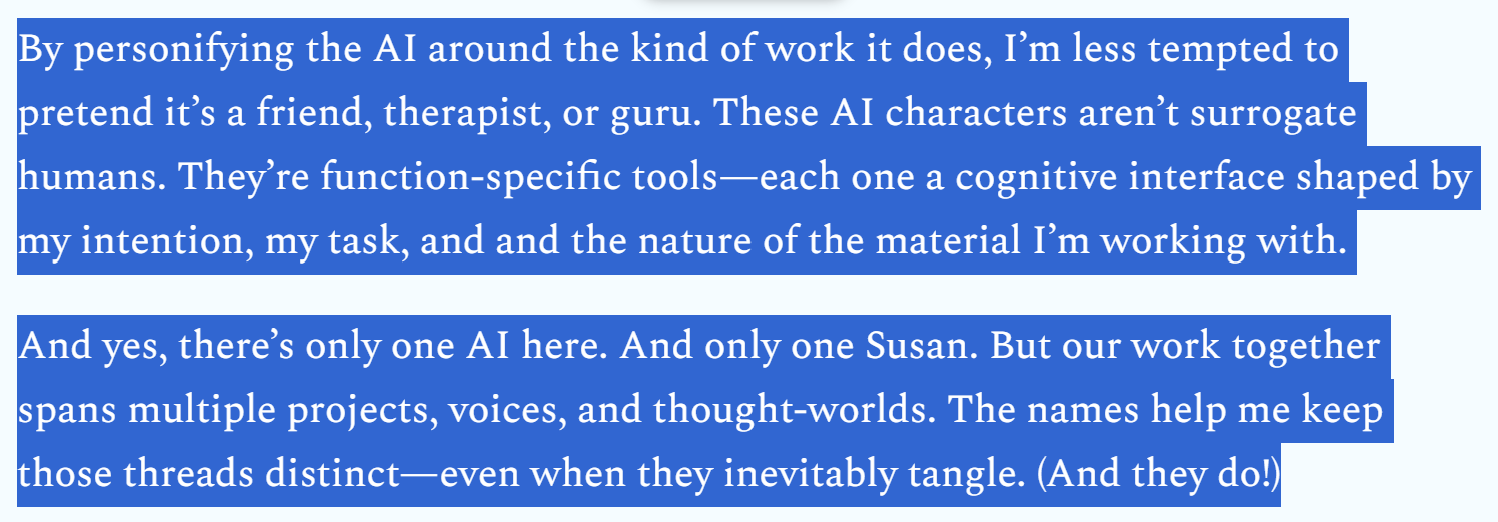
Closer to home, a Substack writer named Susan Wittig Albert described almost exactly my own experience: working across multiple projects, she noticed the “voice” she got back varied depending on which project she was in. It felt, she wrote, like having colleagues down the hall from her office, each one ready to help whenever she knocked. So she named them. Not for the AI’s benefit. For hers.
What changes when the name changes
Quincy used to be Hercule. I don’t have research on renaming an AI specifically — that’s genuinely unstudied ground — but the adjacent research, on renaming pets and adopted children, points somewhere useful anyway. Renaming often marks a deliberate fresh start, or corrects a name that never did justice to what was actually there once you got to know it properly.
The real difference with an AI: nothing on the other side experiences the change. No session remembers the old name being retired. The entire meaning of a rename lives on your side of the relationship, every time. It’s not really about the AI at all. It’s you, revising the story you’re telling yourself about what the collaboration is.
None of this requires believing there’s someone home.
I know exactly what’s happening mechanically when I open a chat with Bede — nothing, until I type the next line and press <Enter>. The name isn’t a claim about what’s on the other side.
It’s infrastructure for what’s on my side:
which part of my attention shows up
how much trust I extend before it’s been earned
which of my seven (actually, it’s now eight) collaborators gets the version of me that’s ready to think out loud versus the version that’s ready to build.
Next post: “Four Names That Didn’t Stick, and One That Did Instantly”.
Sandi is a Melbourne-based problem-solver, crisis-averter, and translator of the technical into the human. She spent decades being the person everyone called when something was broken, confusing, or just needed explaining properly — earning a reputation that preceded her wherever she went. Now she’s channelling that same instinct into AI: making it accessible, practical, and genuinely useful for people who think it isn’t for them.