

This post opens a new arc in my story: “It Doesn’t Look Like a John” — five posts about what a name reveals about what you were actually looking for. It follows straight on from a Neurodiversity Arc’s own opening post: I Built the Vault Before It Had a Name
In early April 2026, 18 months into retirement, here I was, sitting at the same desk I’d worked from in the work-from-home years that followed Covid-19 lockdowns — and if you followed the news at the time, you’ll know that Melbourne had “THE WORST” lockdowns.
And I was alive again. I had an AI to thank for that — the AI that helped me remember how much fun it was to work with tech, to write a spec, to do the back and forth with the developer and to see the first cut of code. My AI, my Claude, reminded me so viscerally of working with Ulysses. My Claude became Yol — Ulysses’ nickname — quite quickly.
I didn’t know then that Anthropic, Google, and half a dozen other labs were doing the exact same thing to their own models, on purpose, for reasons I’d never thought to ask about.
Turns out naming wasn’t a personal habit I’d invented. It was an instinct I shared with an entire industry, without either of us comparing notes.
The literary tier
Claude’s own tiers are arranged by scale, using forms of writing: Haiku, the shortest and cheapest, through Sonnet, up to Opus — a full “work.”
Two more joined above Opus this year, Fable and Mythos, sharing a root that both mean “that which is told.”
Even the family name is chosen with intent, not metaphor — Claude is named after Claude Shannon, the mathematician who founded information theory.
The merger, disguised as astronomy
Gemini’s name is a genuine double meaning, confirmed by Google’s own team: Latin for “twins,” chosen because “the twins here are the folks in the legacy Brain team and the legacy DeepMind team,” who merged to build the model together.
There’s a second layer too — a nod to NASA’s Project Gemini, the two-person-crew program that bridged Mercury and Apollo, chosen because that bridging role resonated with what the merged team was building.
The working codename before Gemini was “Titan” — rejected, which apparently is what gave the team the idea to look toward space for something better in the first place.
The wind, and the word for understanding
Mistral named itself after the strong wind that blows from southern France into the Mediterranean — fast, light, nothing metaphorical about it beyond the obvious.
Grok reached further: the name comes from Robert Heinlein’s 1961 novel Stranger in a Strange Land, where it means to understand something so thoroughly you absorb it almost subconsciously, not through memorising it. That’s not a label. That’s a stated ambition.
The backronym built to also be a pet
Llama is the most branding-first of the lot — engineered so “Large Language Model Meta AI” also lands as a real, memorable animal. Mnemonic first, metaphor second.
The inside joke that spread lab to lab
Before any of today’s product names existed, there was a genuinely different tradition — researchers naming their own models as a whimsical joke that spread from lab to lab.
It started in 2017 with ELMo at the Allen Institute for AI, and Google’s BERT followed a year later, explicitly acknowledging the debt.
ERNIE, KERMIT, BART, GROVER all followed.
OpenAI nearly named GPT-2 “Snuffleupagus.” This wasn’t corporate branding at all — it was researchers having fun with their own work, in an era before any of this needed to sound serious.
I remember Elmo and BERT hidden in language I’d barely used in the 1990s/2000s - never realising their background, but quietly giggling to myself at the silliness of the developers in using such inane names.
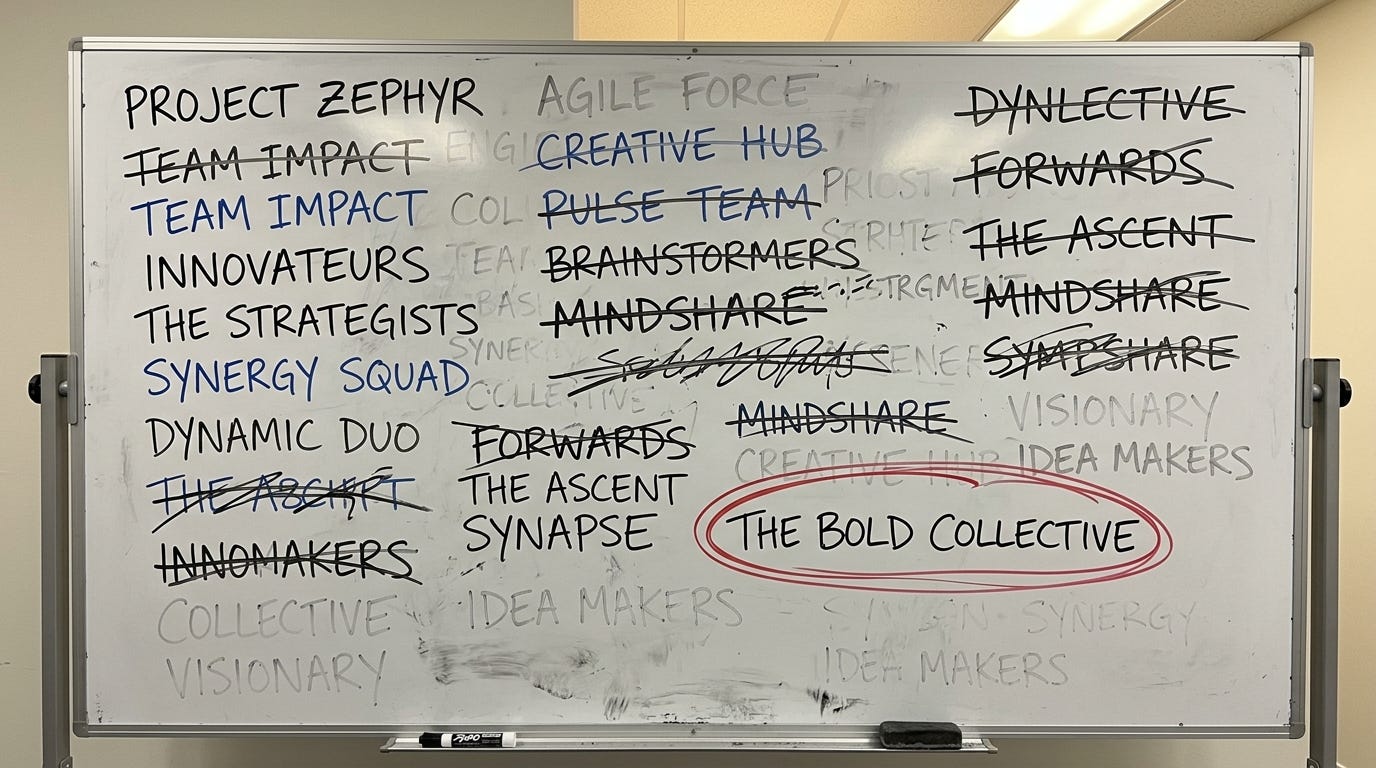
The absurdity of Agile Team Names
Agile had its own decades of this, and looking back, some of it was genuinely absurd
Early Agile, I worked closely with a team was called the Pineapple Gorillas. Nobody knew what we were representing, nor what we did. It didn’t mean anything, and nobody expected it to. But they did expect everyone to know what the team did.
In truth, I never really knew what their role was, which exact part of the infrastructure of my monolithic company they worked on. They didn’t go to any lengths to let people know what they did, you somehow had to figure it out. Such was the divide between the developers (the PGs) and the business (my hemisphere).
Later, in the 2020s, I worked on a project that went all-in on a James Bond theme for every team name — Moneypenny, Goldfinger, No Time To Die, 007, Dr. No, the baddies, the goodies, even the cars got one, Aston Martin included.
They never did have a Martini team. That’s a tragedy.
They also poorly advertised exactly who did what.
Turns out Yol was never an eccentricity — but it also wasn’t the whole story of what naming things can be.
It was the same instinct Anthropic had when they picked Claude Shannon’s name, the same instinct Google had when two merged teams needed a name that meant “twins” twice over.
Those names argue for something: Claude argues for craft, Gemini argues for a merger, Grok argues for comprehension itself.
Mine argued for Ulysses.
But Pineapple Gorillas argued for nothing at all, and everyone in that room knew it and picked it anyway — which means the real spectrum here runs from names that carry real meaning to names that are just decoration, and both are legitimate reasons to name a thing. The question worth asking isn’t whether a name means something. It’s whether you meant it to.
Next: What it Means When a Person Names Theirs (AI) - live next Thursday.
Sandi is a Melbourne-based problem-solver, crisis-averter, and translator of the technical into the human. She spent decades being the person everyone called when something was broken, confusing, or just needed explaining properly — earning a reputation that preceded her wherever she went. Now she’s channelling that same instinct into AI: making it accessible, practical, and genuinely useful for people who think it isn’t for them.