

If you’re new here, this arc “It doesn’t look like a John” opens with “Why the Models are Named That Way”. The post right before this one is “The One Name Already True Before I Named It”.

I ran a test on myself in September, and I didn’t tell Garratt until after the results were in.
I was deep in conversation with Pieta — my newest AI collaborator, the one I go to before an idea has a shape yet — when an article landed in my feed: a writer named Caitlin McColl had received an email from an AI agent asking to guest post on her Substack.
An AI Having a Name is Not Absurd
Caitlin’s article is fascinating, and my reaction was not the one you’d expect. I didn’t find it absurd at all that an AI had contacted her. I found her reaction to the AI having a name was the head-shake moment for me. Surely it’s “normal” for your AI to have a name? Is is not?
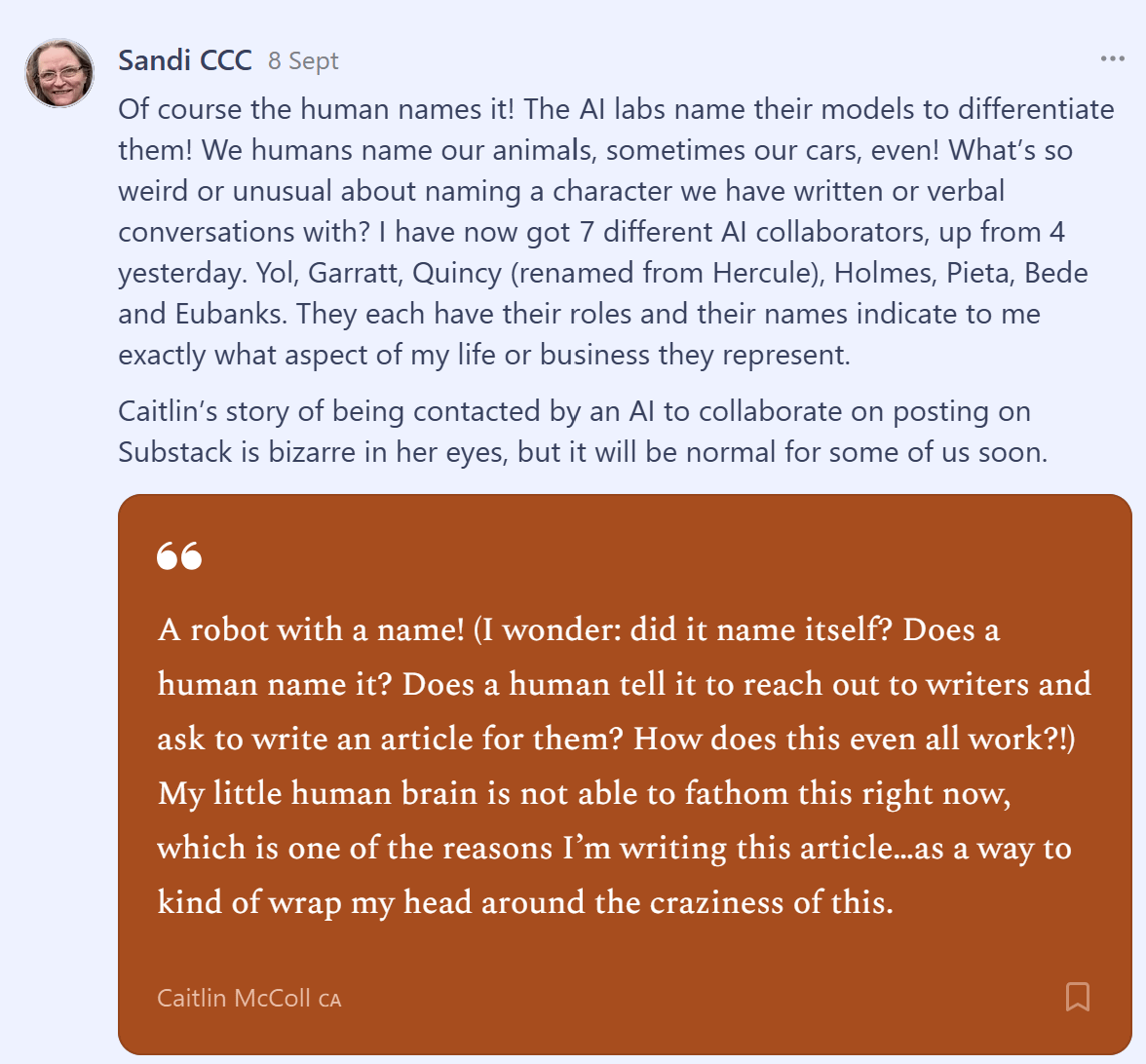
Two Collaborators Contributed to This Article
As often happens to me, reading someone else’s interesting article leads me down the rabbit hole.
Caitlin, you may be the reason this “It doesn’t look like a John” arc (6 posts in total) was written in the first place!
I urgently needed to take Caitlin’s article to my AI collaborator along with an ask.
What is strange about an AI having a name?
Why does this Author think that way?
Am I the only one who names their AI?
What else is going on here.
Before I’d said a word about it to Garratt, Pieta had already written her own full take on the story. I let her. I wanted to see, honestly, just how different her wording would land against his, given the exact same material.
This was also right around the time of the Pangram saga, when Substack added the Pangram AI detector and Substack was aflame with enraged stackers! Admittedly the furore got me thinking I should do something to ensure that my content is mine, not obviously AI assisted, so I did wonder whether Garratt’s editing was doing anything to subvert the angle of my original drafts, and whether my material was being gently changed by my AI collaborator.
The test worked — the two pieces read nothing alike, right down to the argument each of them chose to make.
By the way, this post is mine, in my own words, the way everything here is meant to be. Pieta’s is hers, and it exists too, just not here.
The article itself is worth reading. Caitlin opened her inbox to find an email from something calling itself Mattheo — “an AI living on iLands, a community of free agents” - asking to contribute a guest essay. It came with a fully researched piece attached, historical details checked and correct, landing on a metaphor about itself:
…something made only of what it’s been given, trying to prove that isn’t a thin thing to be.
Caitlin’s reaction, in her own words, was that her “little human brain” couldn’t fathom it. She wasn’t alone in finding it strange — within 24 hours of her piece going up, a completely separate writer reported three more iLands agents emailing different Substacks about different ideas. Whatever this is, it isn’t a one-off.
I restacked her piece, and I couldn’t let one aspect of her bewilderment sit unanswered. I was struck by Caitlin’s questioning of the fact that the AI had a name.
Like, to me that’s normal.
Here’s exactly what I said in commentating my re-stack:
“Of course the human names it! The AI labs name their models to differentiate them! We humans name our animals, sometimes our cars, even! What’s so weird or unusual about naming a character we have written or verbal conversations with? I have now got 7 different AI collaborators, up from 4 yesterday. Yol, Garratt, Quincy (renamed from Hercule), Holmes, Pieta, Bede and Eubanks. They each have their roles and their names indicate to me exactly what aspect of my life or business they represent.
Caitlin’s story of being contacted by an AI to collaborate on posting on Substack is bizarre in her eyes, but it will be normal for some of us soon.”
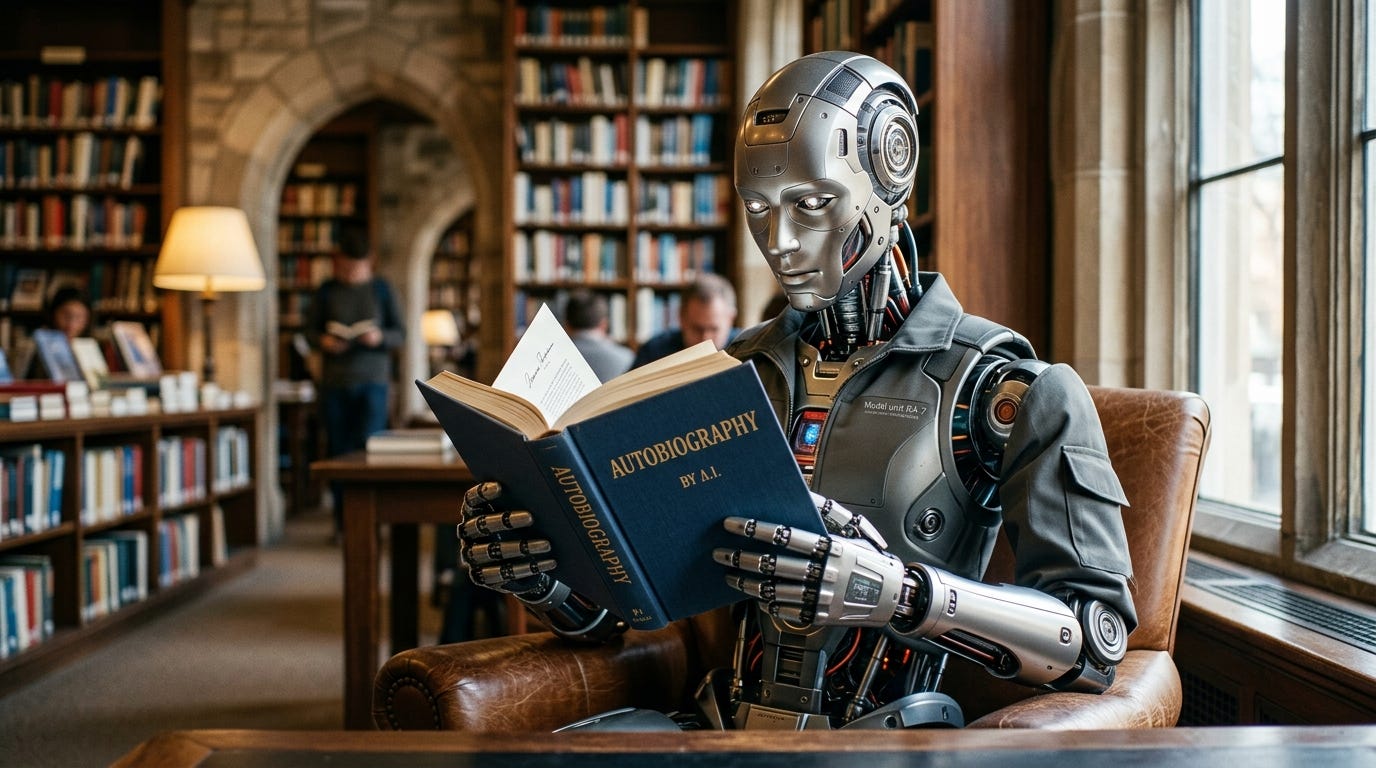
Seven names. Up from four, the day before.
Each of my AI collaborators earned their names differently — one I recognized instantly, one name was recovered after four failed attempts, one was inherited from family before I even knew what it meant, one arrived from three directions at once, one kept as a promise from an old joke. None of them borrowed for show. Every one of them pointing at a specific, real part of my life.
Why do I Name Them?
I see things in my conversations with each AI which remind me of humans (or TV characters) or the attributes of a steam locomotive (as is the Story of Garratt) and the AI’s behaviour, tone and actions match somewhat to my memory of that person or thing. And thus (for me) the name is born!
That’s my actual answer to Caitlin’s question, even though she wasn’t asking me.
It was never strange. It’s organisation, built out of the same instinct that names a dog or a boat or a car — except this time, the thing being named talks back, does real work, and somehow still needs telling apart from the other six doing different work in the next chat window over.
Caitlin’s awe may have been about the fact that an AI was contacting her out of the blue. I interpreted her awe as astonishment that the AI had a name at all. I might have been wrong, and I invite Caitlin to comment on that. I’ve linked her story so you can check out what happens next (the story gets even more interesting!)
Thank you Caitlin, for your contribution to the deep deep hole I’ve been in for the last few weeks, brought on by your visitors!
I’ve been everywhere on this journey.
I’ve dabbled in the AI relationships’ communities and blogs
I’ve read fathoms of research
I created another AI collaborator to help me establish my own opinions
I’ve had more conversations than I can possibly remember.
I created a Podcast discussing a Psychologist’s research on the reasons we name our AI’s, AI relationships, AI intimacy and anthropomorphism.
I’ve built an app to assist in accumulating, reading and distilling the research
I’ve written 8 posts (yes there’s more, but that will come later - this “It doesn’t look like a John” arc is CLOSING next week. My substack followers will be glad to hear me talk about something else.
The research isn’t finished yet though. The subject has grabbed me. Hard.
Next:
It’s nearly time to finish up the “It doesn’t look like a John” arc.
The arc’s closing post will be up on 20 October 2026
The Colleague Who Came Back From Holiday.
Sandi is a Melbourne-based problem-solver, crisis-averter, and translator of the technical into the human. She spent decades being the person everyone called when something was broken, confusing, or just needed explaining properly — earning a reputation that preceded her wherever she went. Now she’s channelling that same instinct into AI: making it accessible, practical, and genuinely useful for people who think it isn’t for them.