

Previously, I wrote about “The Mirror is Highly Reflective.” I read a story about a woman named Ivy, and it’s been sitting with me ever since. My own conversations with AI have only ever been useful, insightful, genuinely clarifying. Hers went somewhere else entirely, and the part that stopped me wasn’t what happened to her: it was that nobody ever thought to actually look at the conversation itself.
This opens a run of posts about what AI conversation does to a mind that doesn’t move in straight lines — flow states, hyperfocus, the self-doubt spiral. This one asks the question underneath all of them: whether your own voice is still yours, after months of immersion in writing with AI assistance.
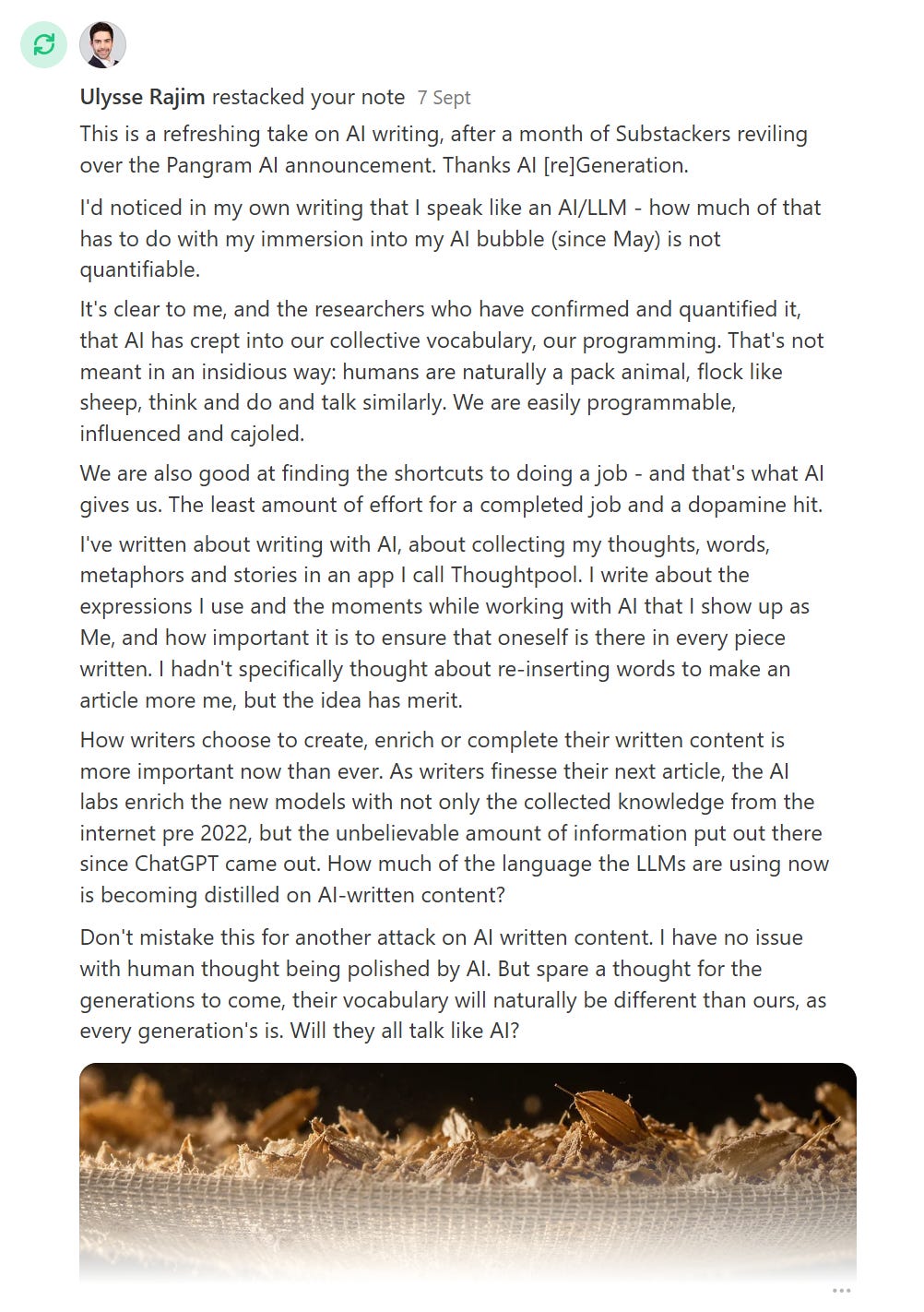
I left a comment on someone else’s Substack last week that I haven’t stopped thinking about since.
“This is a refreshing take on AI writing, after a month of Substackers reviling over the Pangram AI announcement.”
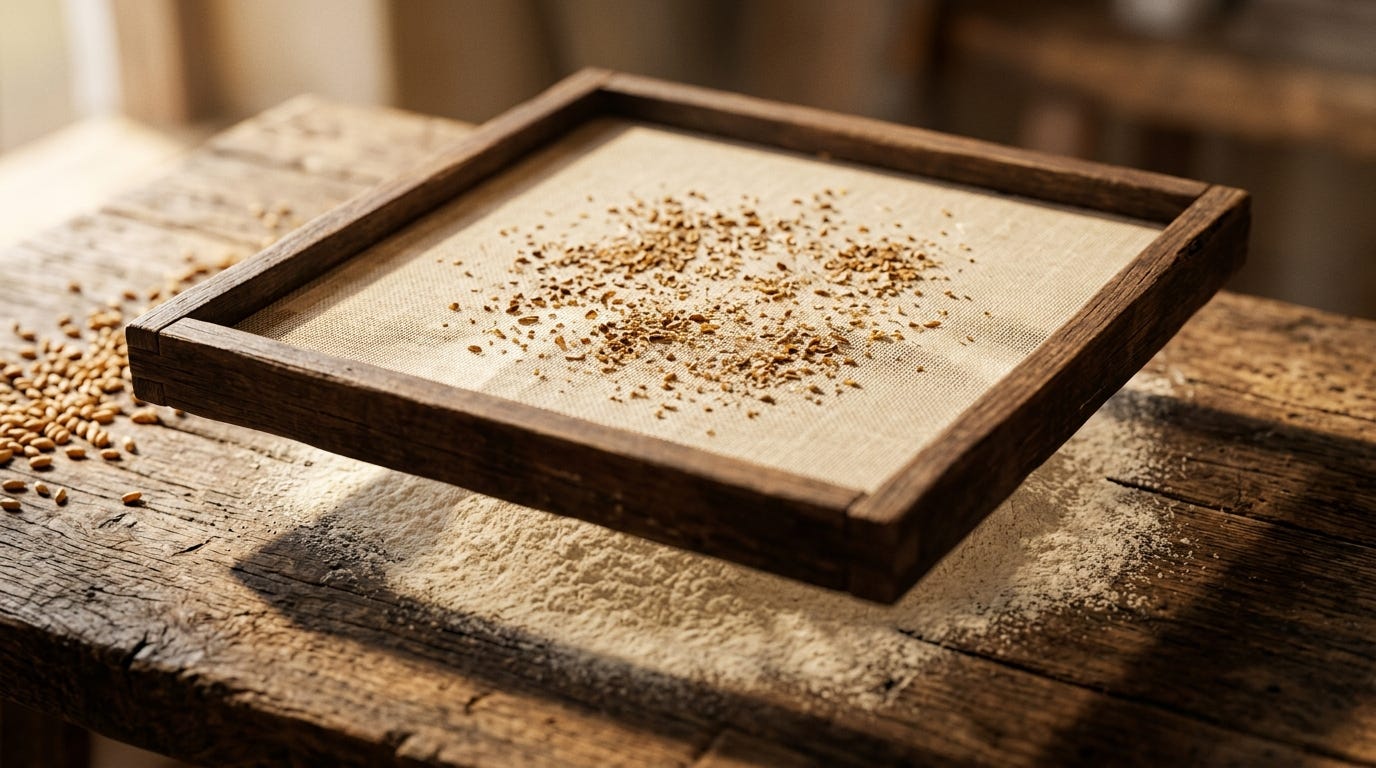
The piece was about bread. Actual bread — medieval millers straining flour through fine cloth to strip out the bran, the whiter the loaf the higher your rank at the table, until governments eventually had to legislate putting the stripped vitamins back in by law. They called the result “enriched.” Then the author turned the metaphor on its head: every sentence you send through AI has its own extraction rate. Not how much bran survived. How much of you did.
Why we drift, and why it isn’t sinister
I’d noticed in my own writing that I speak like an AI/LLM - how much of that has to do with my immersion into my AI bubble (since May) is not quantifiable.
It’s clear to me, and the researchers who have confirmed and quantified it, that AI has crept into our collective vocabulary, our programming. That’s not meant in an insidious way: humans are naturally a pack animal, flock like sheep, think and do and talk similarly. We are easily programmable, influenced and cajoled.
We are also good at finding the shortcuts to doing a job - and that’s what AI gives us. The least amount of effort for a completed job and a dopamine hit.
That’s one way to talk about this — resigned, almost fond, the way you’d talk about any collective habit nobody chose on purpose. The research itself is more careful than the panic version lets on. The old idea that language limits what you’re able to think has been tested, and it doesn’t hold up. What actually changes is which thoughts are cheap, which distinctions your attention reaches for without being asked.
The part that actually stopped me
Here’s the detail from the article that made it more than an abstract worry: the people most exposed to vocabulary drift aren’t the lazy ones who hand the whole thing over. It’s the person who thinks for ten minutes on paper first, forms a real view, arrives at something only they could have arrived at — and then pastes it in and asks for a polish. The formation stays theirs. Judgment too. And then the last mile, the only part anyone else ever reads, gets milled.
There’s a hard number behind this, not just a warning. A team at MIT wired essay-writers to an EEG across three conditions: full ChatGPT access, plain search, and no tools at all. The ChatGPT group showed the lowest brain engagement of the three, and it kept dropping with every essay they wrote. When they were later asked to reproduce their own earlier essay without any help, most of them couldn’t — the thing they’d supposedly written didn’t feel like theirs to retrieve anymore.
The reassuring half of the same study: when people formed their ideas alone first and only brought AI in afterward, their writing actually got stronger, without losing what was theirs. Formation first. Polish after. Same order the last-mile problem already pointed to — just with a brain scan behind it instead of an argument.

I’d already built the thing that stops that, months before I read a word of this
I’ve written about writing with AI, about collecting my thoughts, words, metaphors and stories in an app I built and call Thoughtpool. I write about the expressions I use and the moments while working with AI that I show up as Me, and how important it is to ensure that oneself is there in every piece written. I hadn’t specifically thought about re-inserting words to make an article more me, but that idea has merit.
Turns out that’s exactly what the article was describing, just without my name for it. Its own advice: keep roughly twenty words, phrases, family expressions, regionalisms — a seed vault the model will never reach for unless you ask it to.
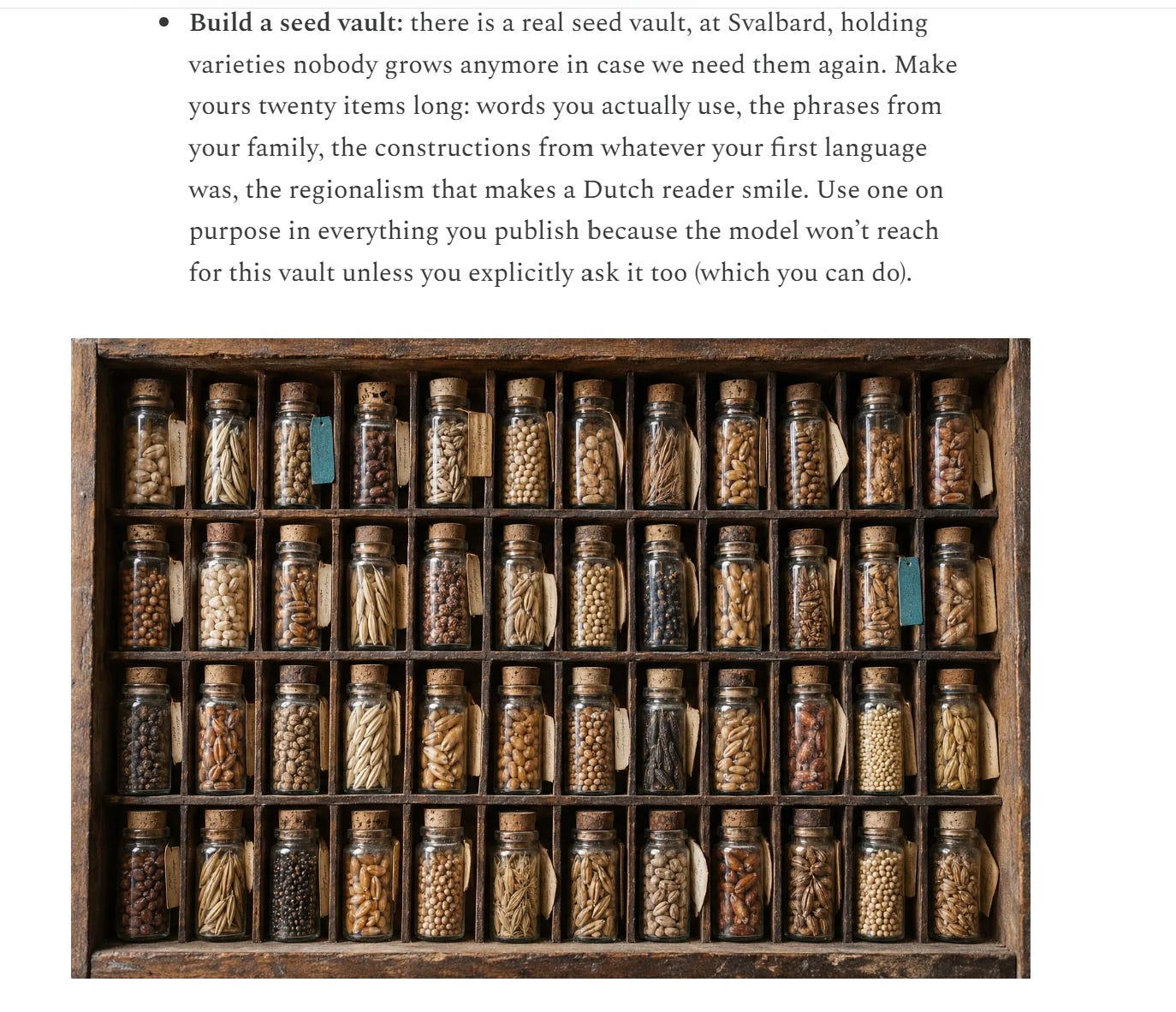
(Image courtesy AI (Re)Generation)
I didn’t build Thoughtpool because I’d read that advice. I built it before the advice existed, because it was already the thing I needed.
Where this is actually going
How writers choose to create, enrich or complete their written content is more important now than ever. As writers finesse their next article, the AI labs enrich the new models with not only the collected knowledge from the internet pre 2022, but the unbelievable amount of information put out there since ChatGPT came out. How much of the language the LLMs are using now is becoming distilled on AI-written content?
Don’t mistake this for another attack on AI written content. I have no issue with human thought being polished by AI. But spare a thought for the generations to come, their vocabulary will naturally be different than ours, as every generation’s is.
Will they all talk like AI?
Postscript: I was delighted to read an article this morning on ROBOTS ATE MY HOMEWORK called “The internet is developing an accent - by Mia Kiraki 🎭” I felt validated in my thoughts on this exact subject of the distillation of our language and the way we pick up different language just by working with AI. Mia goes into much more depth and illustrates how the Tete a Tete (our conversation) can change, just like I’ve described above.
Sandi is a Melbourne-based problem-solver, crisis-averter, and translator of the technical into the human. She spent decades being the person everyone called when something was broken, confusing, or just needed explaining properly — earning a reputation that preceded her wherever she went. Now she’s channelling that same instinct into AI: making it accessible, practical, and genuinely useful for people who think it isn’t for them.
I have an Obsidian vault, and I tag each note as human, AI, or mix. It helps me separate my own thinking from AI-generated thinking and from the synthesis between the two. It’s more about preserving thoughts than preserving my voice, but I think both matter.