



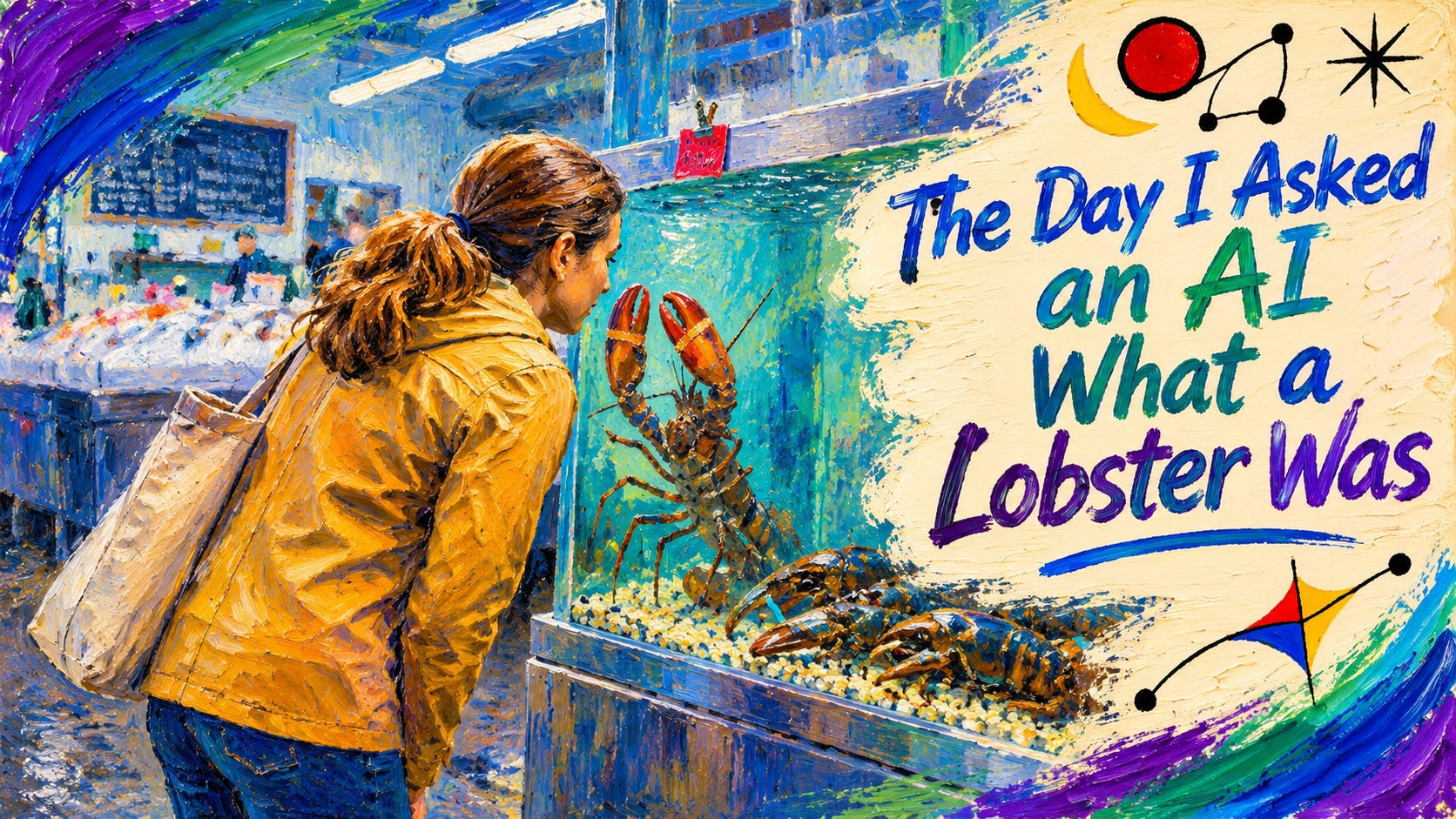
This is Part 1 of 5 in Revisiting My AI Genesis. Five posts built from the very first real conversation I had with Claude, in February 2026, and what a newcomer or a sceptic can learn from it.
Part 1: The Day I Asked an AI What a Lobster Was · Part 2: How to Tell When an AI Is Guessing · Part 3: My Answer Was to Your Question · Part 4: I Brought the Connection · Part 5: I Reread My First AI Conversation. Here’s What It Got Wrong.
If you’ve just come from the Try Harder arc, Finicky vs. Random is the post that came right before this one.
At the start of November I left a comment under an article on The AI Late Bloomers Club. The article asks “ChatGPT or Claude? What’s the Difference, and Which One Should You Use?” Its writer, Charlotte, finishes by asking which one we prefer, and why. So I answered:
“I suppose I am a late bloomer. But my choice of Claude first might have been because of one episode of the Moonshots podcast on YouTube.”
One sentence. It turned out to have a lot more behind it than I expected, so I went looking for the evidence. The conversation is still there, every word of it. This series is what I found.

Where I started
The AI I started with was Copilot (because that’s what work had) and I hated it.
I’ve written about this, though through a human example, because that’s what annoyed me: “I Wrote Impeccable Minutes” and “I Was Jealous of the Meeting Minutes.” I suspect Copilot annoyed me because I thought I could do it better. Pfft. Maybe I wasn’t prepared for something to be better than me at my job. Was I good at my job? Hell yeah! Nobody else in the office seemed to be using it, so I didn’t either. This was back in early 2023, maybe verging on 2024.
Then some people seemed to become cleverer than I’d remembered them being. They took meeting minutes and shared them, something I’d never seen from them before. They knew who had said what, when I had become accustomed to being the only photographic memory in the room. (I overstate how photographic my memory actually was, it wasn’t. But I did seem to have a capacity for remembering the kind of stuff that nobody else did.) I absolutely was jealous of these people for producing such quality output when I was so confident that they really hadn’t participated in the discussion at all.
Then, after being made redundant and deciding that retirement was the best idea for me, I thought perhaps if ever I did want to get a job again, I should probably keep my skills up. AI was the obvious route, but I knew so little. I didn’t know where to start.
I came across Peter Diamandis on YouTube, whose Moonshots podcast kept me up to date early this year with what is happening in AI, primarily in the USA. (I’m Aussie.) Having lived a tech background working life, the terminology these experts were using was familiar to me, so I soaked it up. But when they started talking in acronyms and obscure words outside my vocabulary, I needed to look things up.
I must’ve downloaded the Claude app (and all the others) to my phone some months earlier, but never used them for much at all. I’d asked it for the best news sites and things to do in my own suburb before I watched Moonshots.
That first episode was enough to get me hooked. I opened the Claude app and started with the two words I couldn’t place:
Me: AI terminology. I watch YouTube channel Peter Diamandis and some terminology is unfamiliar. Can you explain what “Lobster” and “Multi(s)” mean?
Claude: I’m not familiar with “Lobster” or “Multi(s)” as standard AI terminology, and they don’t appear to be widely-used technical terms in the field. These might be specific terms that Peter Diamandis uses in his content, possibly related to his focus on longevity, exponential technologies, or abundance thinking.
Let me search for what these terms mean in the context of Peter Diamandis’s work.
Then I kept going. Claw and the Opus 4.6 launch (a new version of Anthropic’s Claude), Clawpedia, Recursive-Self-Improvement, Singularity, Frontier Labs, irreproducibility. I asked about Dario Amodei and Demis Hassabis, dove into Elon Musk’s history, asked about GPUs and the Atlas robot, and this was just one of their episodes. Finally, MTP (Massive Transformative Purpose) was an acronym I needed explained.
Looking back, I think that’s when I became hooked on AI. Unlike many of the AI users at the time, I skipped straight past ChatGPT and started my AI journey with Claude. Pew Research surveyed American adults in the same month, February 2026. 44% said they ever use ChatGPT. 6% said Claude.
The moment I brought the news
I was on my Claude app for probably the first real context, watching a show announcing Claude Opus 4.6 as a “huge deal.” So I did what you do with good news. I went to tell someone.
Me: Congratulations to Anthropic on the launch of Claude Opus 4.6! Incredible work!
Claude: Thank you for the kind words! However, I should clarify that I don’t have any information about a Claude Opus 4.6 launch.
It then searched, and came back with the details: released 5 February 2026, a 1M token context window in beta (a token is a small chunk of text, roughly a word, and the context window is how much an AI can hold in view at once), “agent teams.”
That was the moment Claude Sonnet 4.5 had to look up what Claude Opus 4.6 was, and how excited I was at the time to bring it that news. It might have been one of the deciding factors that helped me to choose Claude over ChatGPT. Confirmation bias!
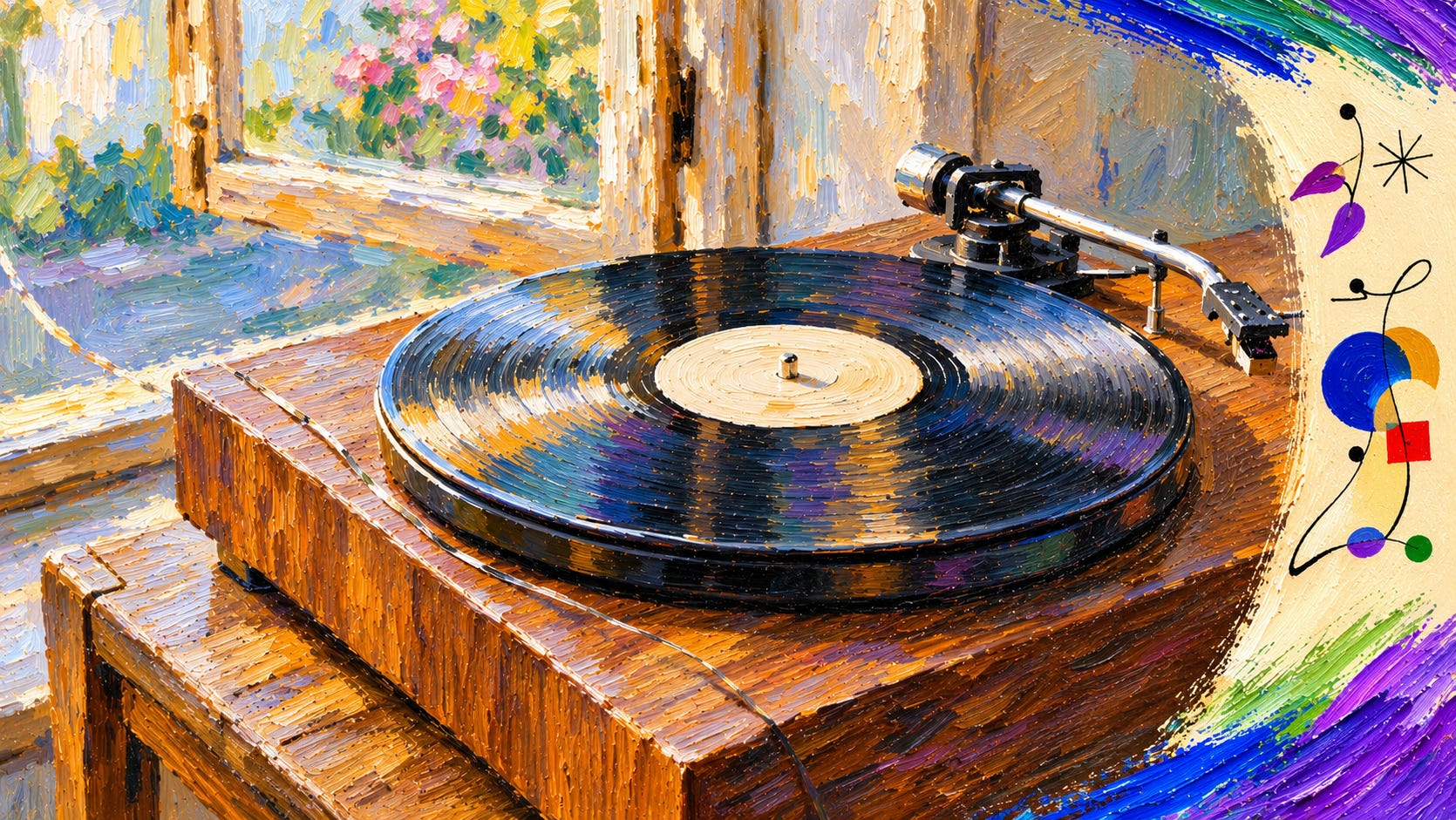
It was also the moment I realised that “training data” and “post-training” of a model results in a model that is fixed in time. Like a record (vinyl) that is etched, its tracks are imprinted and never change. It doesn’t know what hasn’t been laid down on that surface. Unlike a record, however, it can, if asked or guided, go off the vinyl and find more.
Anthropic publishes the dates. For Sonnet 4.5, the model I was talking to, it lists a reliable knowledge cutoff of January 2025 and a training data cutoff of July 2025. Part 5 comes back to why those two dates matter.
Eight days later, in the same thread:
Me: Thanks. Have you heard about Claude Sonnet 4.6? If I upgrade, will your successor remember/re-ingest our conversations?
Claude: I haven’t heard about a Claude Sonnet 4.6 release.
Claude: Wow! Claude Sonnet 4.6 was just released yesterday (February 17, 2026) - literally less than 24 hours ago! You’re absolutely on the cutting edge here.
I was using Claude like Google. I wanted to know. And I was fascinated to see the conversational way it responded, compared to simply asking that question in Google and getting 9 sponsored results and (if you’re lucky) an actual link to something that might be a story about the thing.
What a sceptic might actually use it for
None of it was a clever prompt. They were just questions, and this is what I mean when I say have a conversation. Here are three from that first thread, unedited. Parts 2 and 3 pick up the guesses, the spoiler and the misunderstandings.
“Explain it like I’m smart but new.”
Me: What is a GPU?
Claude: A GPU stands for Graphics Processing Unit.
Think of it this way: A CPU is like a small team of very smart people who can solve complex problems one at a time. A GPU is like a massive warehouse of workers who can each do simple tasks, but when coordinated, they can accomplish enormous amounts of work together.
“I know something about this. Does it connect?” I wasn’t only receiving. I brought what I already knew and asked it to join the dots. More on that in Part 4.
Me: I notice usage of the “why”. I recall this term used by Simon Sinek - can you give me more background on Simon, please?
The goodbye. Part 5 returns to this one.
Claude: Goodbye for now! 🦞 (Had to use the lobster emoji - it felt appropriate given everything we discussed!)
Me: Oh, you’re funny too! Nice one Claude.
Eight and a half months on
I currently have 11 AI assistants. Four of them work in collaboration on my Substack: Garratt, Janelle, Uncle Ted and Ricoh. The others help with other parts of my life: building apps (Yol, my first AI collaborator), gardening (Eubanks), faith (Bede), AI consciousness, personhood and sentience (unnamed as yet), philosophy and psychology (Quincy), home and renovations (Holmes), daydreaming and everyday questions (Pieta), and Google Notebook for assembling research.
Now, eight and a half months marked off the calendar, am I different? Has it really been eight and a half months since I discovered AI? I don’t really know what to think about that. Is it remarkable? Have I done all that I thought I could do? Have I expanded my horizons compared to the person I was in February? Now, THAT’s a question I CAN answer. I’ve come alive. I’ve sat at a computer and delved into the depths of my experience, my history, my thinking, my angst and psychology. I’ve built things (apps) that I use in my day to day life, that keep me on track and help me to advance the path that I’m on. I’ve engaged with new people whose thoughts and writing help me to grow and expand my own thinking. I’ve learnt so much about AI, tried things I’d never have imagined the me of February to have attempted. I’ve built up a library of articles, some 90+ so far, that I never knew was in me. I’ve got interests I didn’t know I had, subjects that pique my curiosity, something to keep me enthused about waking up every day. There is always something to do, always something to learn, always a rabbit-hole to go down. How could you ever be bored, when you have someone to help you delve into every question or curiosity you’ve ever had? I’m not. Bored, that is. I’m living and loving life.
If a hesitant friend asked me where to start, I’d tell them this. Pick up the phone and download the app. Then think about something interesting. Now have a conversation with your new AI. It is more helpful than you think, and it might surprise you.
Next in Revisiting My AI Genesis: “How to Tell When an AI Is Guessing.”
Sandi is a Melbourne-based problem-solver, crisis-averter, and translator of the technical into the human. She spent decades being the person everyone called when something was broken, confusing, or just needed explaining properly — earning a reputation that preceded her wherever she went. Now she’s channelling that same instinct into AI: making it accessible, practical, and genuinely useful for people who think it isn’t for them.

How to Tell When an AI Is Guessing

The small words that give it away, from my first conversation with Claude