

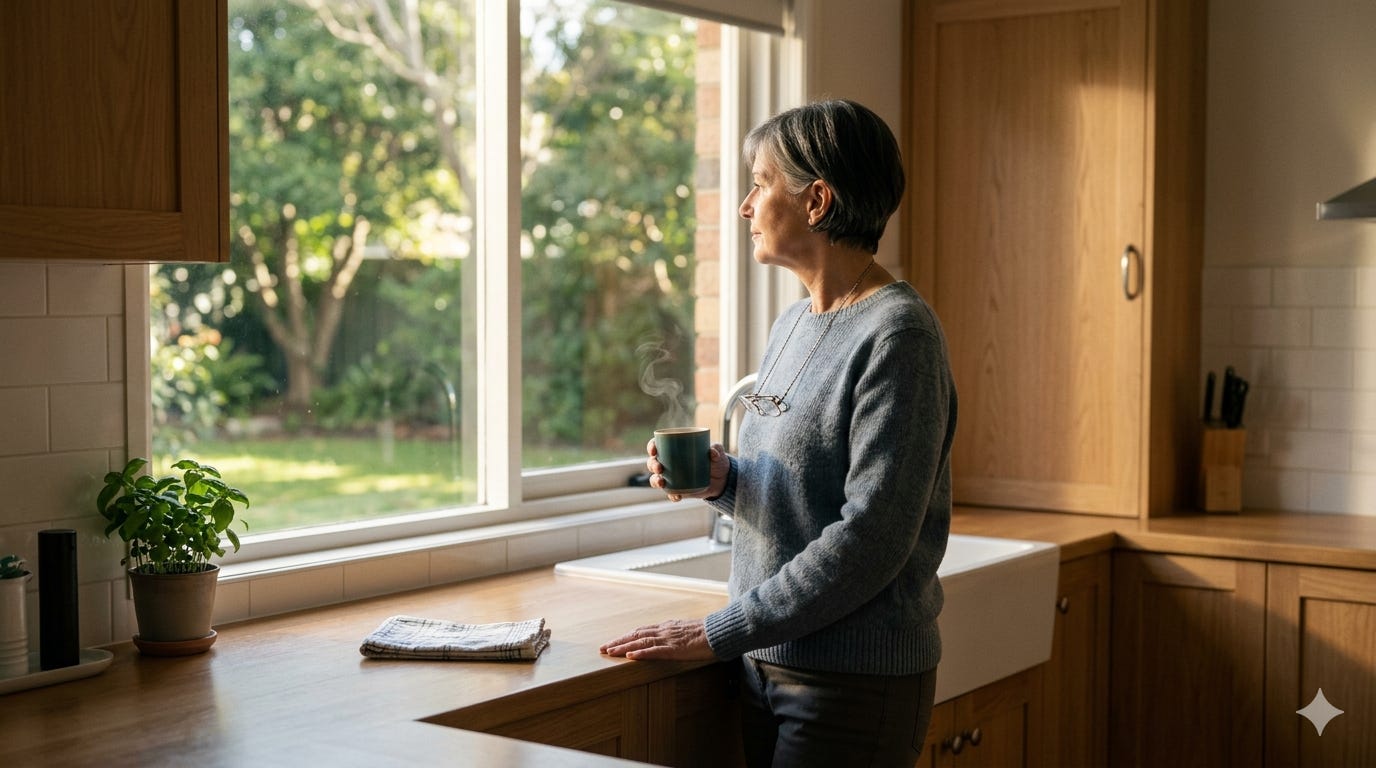
20th December 2024. That’s the date, if you want it precisely. The redundancy was generous — generous enough that saying yes was the only sensible answer — and I said yes, and then I had to work out who I was without the thing that had defined me for forty‑one and a half years.
Nobody warns you about that part.
They tell you about the holidays. The freedom. The lie‑in on a Tuesday. They tell you about the novelty of not having to be anywhere, the luxury of time suddenly unstructured. They don’t tell you that you might spend decades being the person everyone calls, and then one day the calls simply stop — not because you got worse at the job, but because you left the building.
There’s a silence that follows competence.
A silence that feels like a compliment at first — you’ve earned your rest — until it starts to feel like an erasure.
Who are you when nobody needs you?
Who are you when the room you used to hold together no longer exists?
Retirement is sold as an ending.
Nobody mentions the identity vacuum that comes after.
The reinvention
I did what you do. I bought a house in the country. I pulled my parents’ furniture out of storage and set the place up properly, for a dear friend to rent. There were holidays there — friends, family, the good kind of busy. The kind of busy that feels like a life being lived, not a life being managed.
And then winter came down over Melbourne the way it does: bone‑chillingly cold, and the kind of quiet that makes you reach for something to do with your hands.
I scrapbooked.
Eighteen albums, that first winter. Perseverance was my middle name, and I mean that as a compliment to myself, because eighteen albums is not nothing. It’s a small act of devotion, repeated until it becomes a rhythm. The final album from that winter is still sitting on my dining table right now. It’s not a dead project. I’ll never tire of scrapbooking.
But somewhere in those wintry weeks, something else happened.
Something subtle.
Something I didn’t have language for at the time.
The particular exhaustion of forty‑one and a half years of being indispensable — the kind you don’t notice you’re carrying until it starts to lift — began to lift. And underneath it was a restlessness I hadn’t expected.
A capable person with no problem left to solve is not actually at peace.
She’s just quiet.
Quiet is not the same as fulfilled.
Quiet is not the same as done.
Quiet is just the absence of noise — not the presence of purpose.

The thing nobody tells you about competence
I didn’t want the cold, quiet version of winter to be my only answer for 2026. I didn’t want to become someone who filled her days with tasks that kept her hands busy but her mind under‑used. I didn’t want to be a woman whose best thinking was behind her.
So when AI arrived in my life — properly arrived, not the curious poke I’d given it before — it didn’t find a woman who needed to learn how to think.
It found a woman who’d been doing nothing else but, for four decades, with nowhere to focus it now.
A few very deep conversations about a medical history I needed answered properly.
Research into what makes a forever home actually a forever home.
Then I built a memory tool. A game. A planner that worked the way my brain actually works, instead of the way every productivity app assumes everyone’s brain works. A database for keeping track. A place to store all my stories, to start writing my book.
And somewhere in the building of those things, I came back online.
Ridiculously productive again.
The smartest person in the room — except the room was empty, and that was, for a little while, the funniest and saddest sentence I could have written about myself.
But here’s the thing about empty rooms: they don’t stay empty if you start building things inside them.
People wander in.
Ideas wander in.
Purpose wanders in.
And suddenly you’re not retired.
You’re repurposed.
A different vessel, not a different boat
Retirement is sold to you as the end of useful work.
Here’s what nobody mentions: the skills don’t retire with you.
The problem‑solving, the translating, the relentless instinct to find out and fix and figure it out — all of that was just sitting there, fully intact, waiting for somewhere to go.
Competence doesn’t evaporate.
It waits.
And when AI arrived, it didn’t give me a new identity.
It gave me a new vessel for the identity I already had.
I didn’t miss the boat.
I just hadn’t found the right one yet.
This is the first post in a story I’m going to tell you properly, over the next few weeks — everything I’ve built since that winter lifted, and what it’s actually meant to come back alive.
There’s a fair bit to tell.
Stay with me.
Sandi is a Melbourne‑based problem‑solver, crisis‑averter, and translator of the technical into the human. She spent decades being the person everyone called when something was broken, confusing, or just needed explaining properly — earning a reputation that preceded her wherever she went. Now she’s channelling that same instinct into AI: making it accessible, practical, and genuinely useful for people who think it isn’t for them.