


I want to tell you about a colleague.
He wasn’t the most attentive person in a meeting. You’d know this if you’d watched him — the particular quality of his not-quite-presence, the way his eyes moved, the expression of someone whose mind was elsewhere while his body occupied the chair. He was there. He just wasn’t entirely there.
And yet, after every meeting, his notes were immaculate.
Structured. Comprehensive. Capturing not just the decisions but the context around them. The kind of minutes that made you think — did he actually listen better than I gave him credit for?
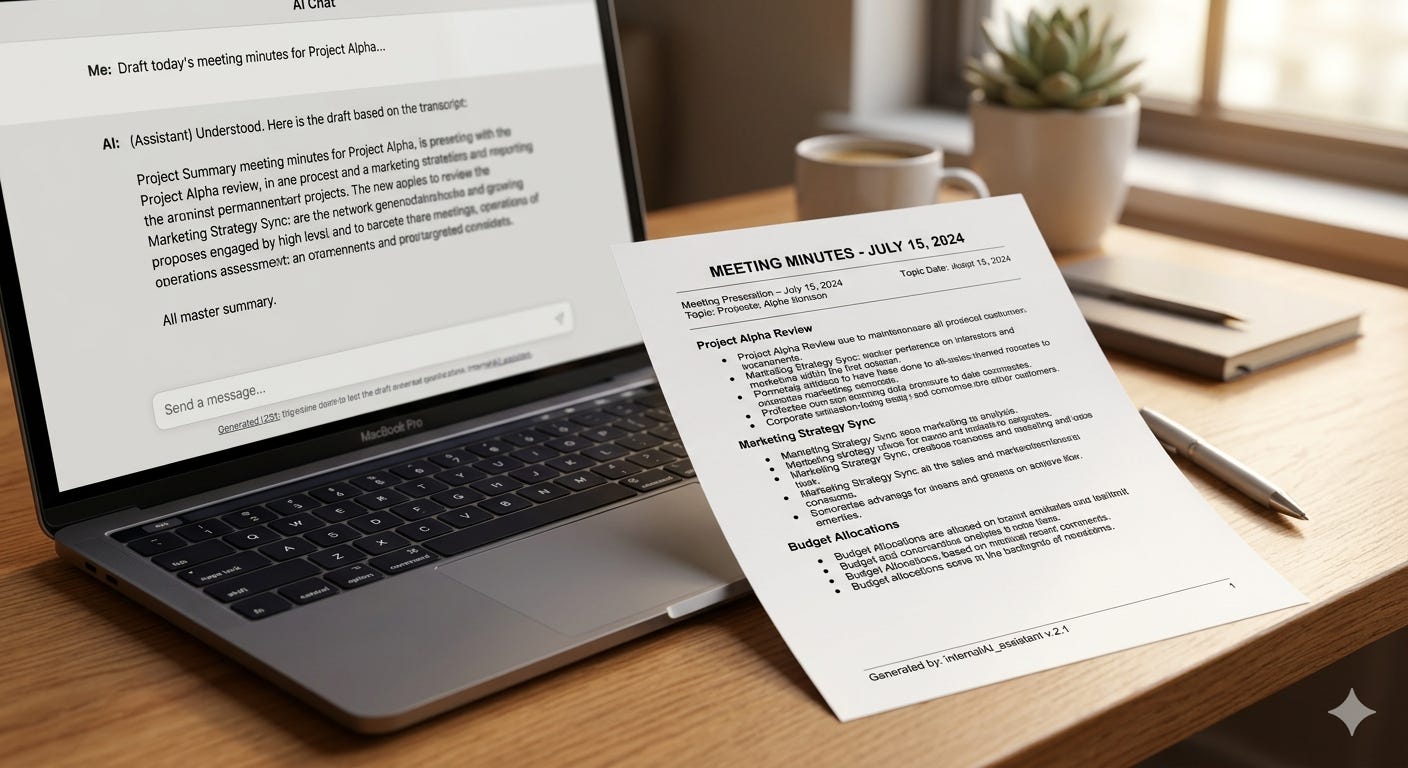
He hadn’t. He’d been using AI the whole time. Feeding in a rough transcript or a few dot points and letting it do the heavy lifting. The output was excellent. The input had been minimal. The gap between what he’d contributed to the meeting and what he’d produced from it was, frankly, enormous.
And I was jealous.
Not admiringly jealous. The uncomfortable kind. The kind that comes with a side of judgment you’re not entirely proud of.
The complicated feeling
Here’s what jealousy of that particular variety actually contains, if you’re honest about it.
There’s the I want that part — the outcome, the efficiency, the polished document produced in a fraction of the time it would have taken me. That part was straightforward and I’m not ashamed of it.
But underneath it, quieter and more complicated, was something else entirely.
I don’t want to be that person.
The person who uses a tool as a substitute for engagement. Who produces something that looks like contribution without the contribution behind it. Who games the output without doing the work the output is supposed to represent.
Those two feelings — I want that and I don’t want to be that — sat in me simultaneously, unresolved, for longer than I’d like to admit. And as long as they were unresolved, they cancelled each other out. The jealousy didn’t move me toward anything. It just sat there, generating a vague discomfort every time the topic of AI came up.
Which, increasingly, was often.
What the tension was actually telling me
It took me a while to see it, but the tension wasn’t really about him or his meeting minutes.
It was about me and my reluctance.
The I don’t want to be that person feeling — legitimate as it was — had quietly expanded to cover territory it had no business covering. It wasn’t just keeping me from using AI as a substitute for genuine engagement. It was keeping me from using AI at all. The concern about misuse had become a reason to avoid use entirely.
Which is, if you think about it, a bit like refusing to own a car because some people drive dangerously.
The question was never should I use AI the way he used it? The question was what would it look like to use AI in a way that was actually mine? With genuine engagement. With real problems. In a way that extended what I could do rather than replacing what I should have done.
That question, once I finally asked it, had a very different answer.
The thing jealousy is good for
Jealousy gets a bad reputation, and mostly it deserves it. But there’s a version of it that’s worth paying attention to — the kind that points at something you actually want, something you haven’t given yourself permission to want yet.
The meeting minutes weren’t what I wanted. But the efficiency was. The time saved was. The idea that there was a tool available that could handle the parts of work that consume time without producing meaning — that was genuinely appealing, and the jealousy was how I found out.
I just had to separate the feeling from the method.
His method wasn’t mine. But the underlying possibility — that AI could do real, useful work in my hands, in my way, on my terms — that was worth taking seriously.
So I did. Eventually. Later than some people, earlier than others, and exactly when I was ready.
The meeting minutes colleague, wherever he is, probably has no idea he was part of the story.
The question worth asking yourself
If you’ve felt something like what I’m describing — that particular mixture of wanting and resisting, of I could do that and I don’t want to be that — I want to suggest that the feeling is information.
Not about AI. About you.
What is it you actually want that you’ve been using the resistance as a reason not to pursue? What outcome have you been watching from a distance, telling yourself you don’t approve of the method, when the real issue is that you haven’t found your own method yet?
The method matters. How you use a tool says something about who you are, and I’m not dismissing that.
But the tool is not the method. And the someone-else’s misuse of it is not a reason to leave it entirely alone.
The meeting minutes were always beside the point. The point was what was waiting on the other side of the resistance.
It turned out to be quite a lot.
Sandi is a Melbourne-based problem-solver, crisis-averter, and translator of the technical into the human. She spent decades being the person everyone called when something was broken, confusing, or just needed explaining properly — earning a reputation that preceded her wherever she went. Now she’s channelling that same instinct into AI: making it accessible, practical, and genuinely useful for people who think it isn’t for them.