



This is Part 3 of 3 in the Try Harder Arc. Before it, the Anti AI sentiment posts worked through why people reject AI; after it, My AI Genesis Arc begins, with the story of my first foray into AI conversations. If you’re new here, start with Pick up the phone, and the post just before this one is Have You Tried It?.
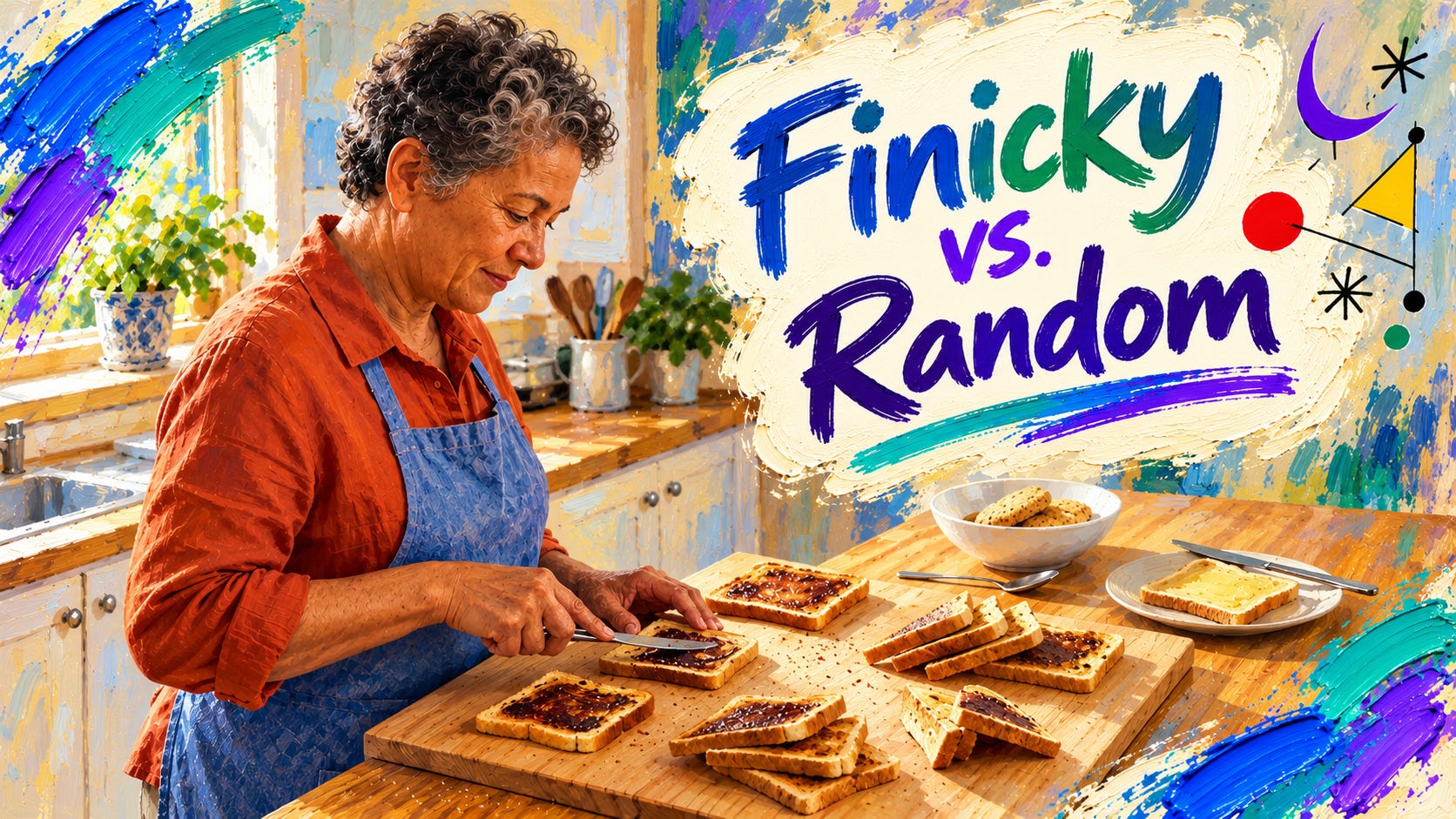
I was buttering toast for my son — eight halves, Vegemite randomly spread, never thickly, arranged in a different pattern every time — and noticed, for the first time, that I do this on purpose. Not consciously. Just compulsively. My brain insists on the variation. The inconsistency is the consistency.
My father was the opposite. Two Weet-Bix and milk, every day of his life. Toast buttered to the edges with a fastidious precision that exasperated his fifteen-year-old daughter. Salmon Kedgeree in which he (and I) insisted on making maps of Australia — the same maps, the same shapes, the same ritual — every Friday night. Sausages overcooked, mashed potato kept. Sameness as comfort. Sameness as love.

Sameness as comfort. Sameness as love.
The juxtaposition isn’t just generational. It’s neurological. Two brains, related by blood, oriented completely differently toward repetition and variation. One finds safety in the identical. One finds safety in the never-quite-the-same.
And then: how does this map onto how people use AI?
Some people want AI to be the Weet-Bix — reliable, predictable, the same output every time, something they can count on to be exactly what they asked for. Others want AI to be the toast — a collaborator that surprises them, follows unexpected threads, turns up something they didn’t know they were looking for.
The Resister often wants the Weet-Bix version and doesn’t trust that it can deliver. The Ready is already using the toast version and can’t quite explain to anyone else why it feels so alive.
I seem to have fallen into AI so naturally
Do you know this post isn’t about Dad or me? Well actually it is about me: me and the person I perceive when I compare myself to other people. I seem to have fallen into AI so naturally.
If you look back at previous posts you’ll see that it came easily for me compared to other people who kind of fought against upgrading their lives or changing their lives: that fight against change, or that desire for control, that imaginary control we all think we have but really quite don’t.
Maybe one of the reasons it came so easily for me is because I liked to make my Vegemite toast so different every single time. Was the randomness of the toast a rebellion against the finickiness of the Weet-Bix? Was it learned, or was it born? And does it matter — if the end result is that my son never knows what his breakfast will look like, only that it will be made by someone who was thinking about him while she made it?
I know that I make mistakes and that when I ask a question in, say, Google, I might get a really bad result. I know that I need to vary my question. That’s the same with AI. When I have a conversation with AI, if it’s going nowhere or if it’s going the wrong way, I’ll always interject and say, “Hey, Claude, that’s not what I meant. Let’s look at it a different way. We can do X, and Y might happen. Maybe have a look at that, please, Claude.”
I think my dad would have resisted AI for quite a while. He was the man stuck in his ways: the Vegemite, the Kellogg’s Corn Flakes, the salmon kedgeree every Friday night, the Weet-Bix, of course.
The people who resist AI, they’re a bit like me when I resisted joining Facebook until 2009. I write about this in an earlier post. What is it that delays people from joining something that’s new?
Do we really have any control?
I’m sure there must be some research into why people with a certain tendency toward doing things a similar way every time have difficulty adopting something different. Conversely, perhaps there’s research into why people who are happy to do things differently every time are happy to adopt new technologies, new things that happen in their environment, new situations, things that might be totally outside of someone else’s comfort zone.
There is, though none of it was about AI. In 2003 Shaul Oreg built a scale to measure how strongly a person is disposed to resist change, and “routine seeking” is one of its four parts. A review of 33 papers on status quo bias found that people resist new systems because switching costs, uncertainty and the wish for consistency make the existing way feel safer. And a study of late-midlife Americans found that openness to experience and cognitive ability went with taking up the Internet, while neuroticism went with not taking it up.
So why do we so stubbornly stay inside our comfort zone? I have a theory that it’s the intangible concept called control. We all want it. We all try to exercise it, like my dad did with the Weet-Bix and the toast and carving maps of Australia out of a salmon and rice casserole. But do we really have any control?
Does evading the looming reality of AI/SI - if you haven’t heard, it’s now being called SI “Super Intelligence” - increase someone’s sense of having control?
Or would the acceptance of AI/SI as a tool bring them the sort of fun and productivity that it has brought me?
Bad with technology
I try to encourage my best friend to do things slightly differently all the time. Guess how hard it is. It’s probably just as hard for everyone else who’s fixed in their ways.
Last weekend I went to the Cactus and Succulent Society annual show. Even the young people behind the cactus and succulent stalls were struggling, trying to get their phones to connect so that they could take a payment from me purchasing $385 worth of succulents. They hummed and hawed and proclaimed that they are bad with technology. I stood across from them, and kept my silence.
They only do PayID because well, the customers want it, and if they didn’t, they’d lose sales. They weren’t prepared to do Stripe or Square or a bank terminal, because the fees ate into their margins. One young Filipina lady said she didn’t know how to get a bank terminal and she’d tried looking up the answers on Google but it was too hard.
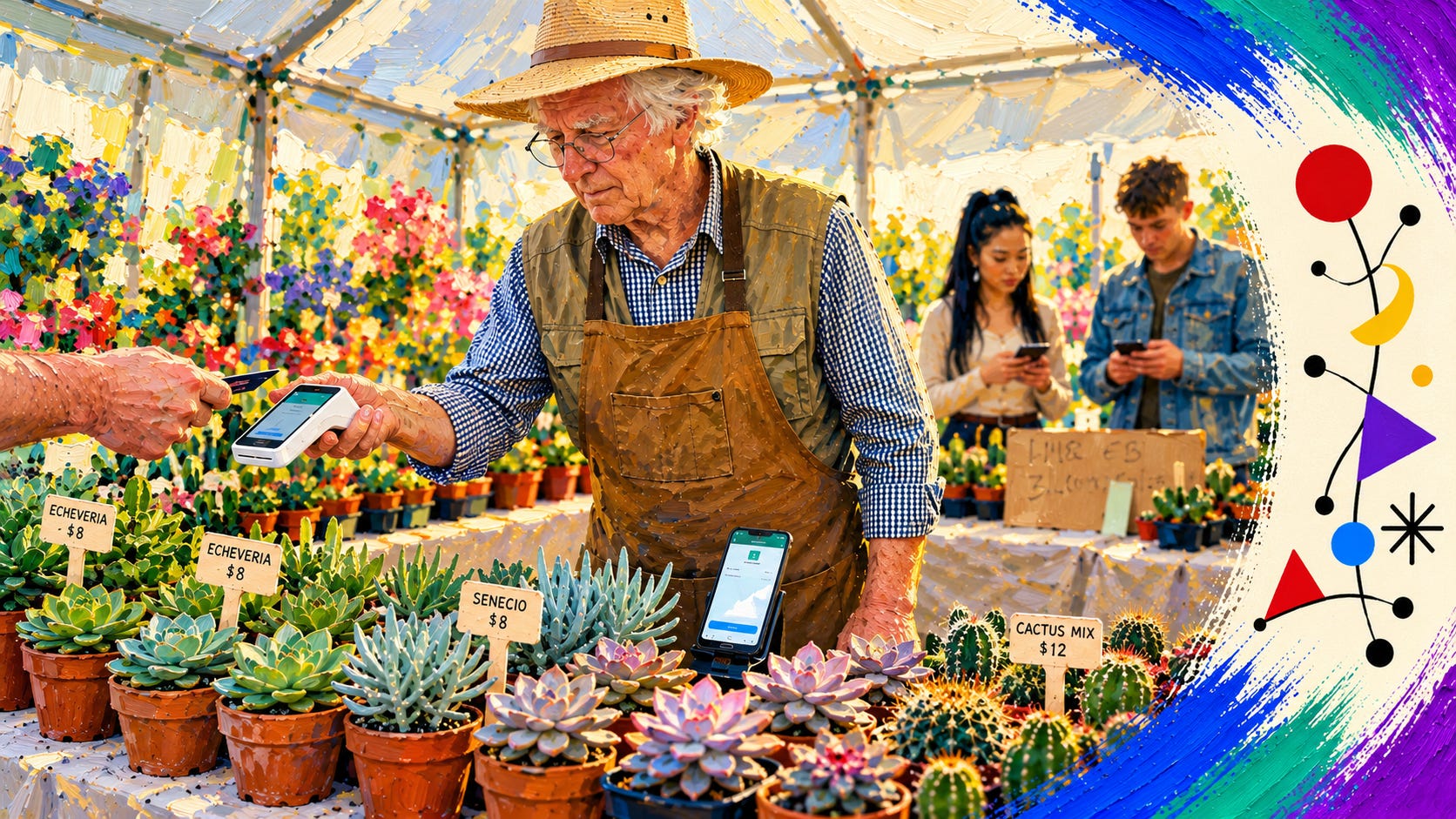
Then I met one of the exceptions. He was proper old, older than me, maybe late 70s, not afraid of learning how to use a tool that makes it easiest to receive payments from people paying by card. Almost every other stall at the show asked for cash or PayID. He surprised me, not your stereotypical older man, happy to embrace tech!
But maybe I’m among the lucky ones: the people who’ve been able to grow up, adopting technology, adapting and changing, looking for new things all the time, embracing change because change is inevitable, rather than revolting against it. Maybe I’m just in the minority.
Where I’m fixed in my ways
But let’s do a little role reversal here. Because surely I want a semblance of that elusive control too.
There must be ways that I’m fixed in! Sure - I do my hair the same, I wear the same pair of shoes till they’re worn out, I prefer trousers to skirts, I don’t like makeup, I must have more plants, there is always room for more plants. I like to cook the same 5 or 10 dishes on rotation. I am always right and I will die on the hill that I create for myself. (“It was not Cockroach” is a great example of this - but that post may never be posted). These ‘fixed in my way’ things are hardly life-changing, are they? But ask me to try and do something right handed and I will tie my left hand behind my back and give it a go. Tell me I have to drive a manual car, or reverse a car down a driveway I’ve never driven, I will try.
Do I ever say no. Yes, I did say no! To reversing my car down my own driveway for about 18 months, when this was my new house - because my neighbour who speaks no English did not understand that he can’t park his car in my turn zone. But after 18 months I tried.
I became less apprehensive.
I’d been parking all the way out on the street for 18 months. One day I saw that the neighbour’s car was not there, and thought I would try to wiggle my way into my carport even if I had to do a 7 point turn (or more, as it turns out) and get stuck (I didn’t). I calmed my nerves - I truly felt so uncomfortable and my heart was beating fast, and drove in, calculating the angles for the turns left and reverse and right and repeat, and I kept breathing, kept telling myself I could do this. And the car was in. The reversing beeps were screaming at me on every turn in reverse, but I quelled the anxiety and told myself I could do it. I’ve never parked out on the street since! I learnt that I could also reverse the whole way out the long driveway, into oncoming traffic in a built up area in peak hour. The two things I’d spent much of my driving life being scared to do, I did, and have done since.
Letters from Rosie put the same idea in June: you’re never ready for anything, so do it scared.
What kind of argument is that, Sandi? I was willing to try. A great many of you are not.
I was made redundant from my corporate job, and decided rather than take the redeployment, to take the payout. I decided I’d never likely get a chance to get such a payout again, so it made sense to take the money. Big decisions come easy to me.
I bought a house with the payout, only a month after finishing work. I told you, big decisions come easy.
What’s stopping YOU?
Deciding to find out “what’s the AI all about” is not a big decision. So what’s stopping YOU. Pick up your phone or get on your laptop and go to Claude.ai or chatgpt.com on the browser - or any other chat bot you know of - and just start typing or talking - have a conversation with it. Ask it to ask you questions about an issue. Ask it why you’ve been so resistant to picking up AI so far - that could be an interesting conversation.
Sandi is a Melbourne-based problem-solver, crisis-averter, and translator of the technical into the human. She spent decades being the person everyone called when something was broken, confusing, or just needed explaining properly — earning a reputation that preceded her wherever she went. Now she’s channelling that same instinct into AI: making it accessible, practical, and genuinely useful for people who think it isn’t for them.


Hi from Narooma. Sandi, a good paper I concur, and you also do the world a service; how to spread Vegimite, should be a Nobel prize in that for you!