



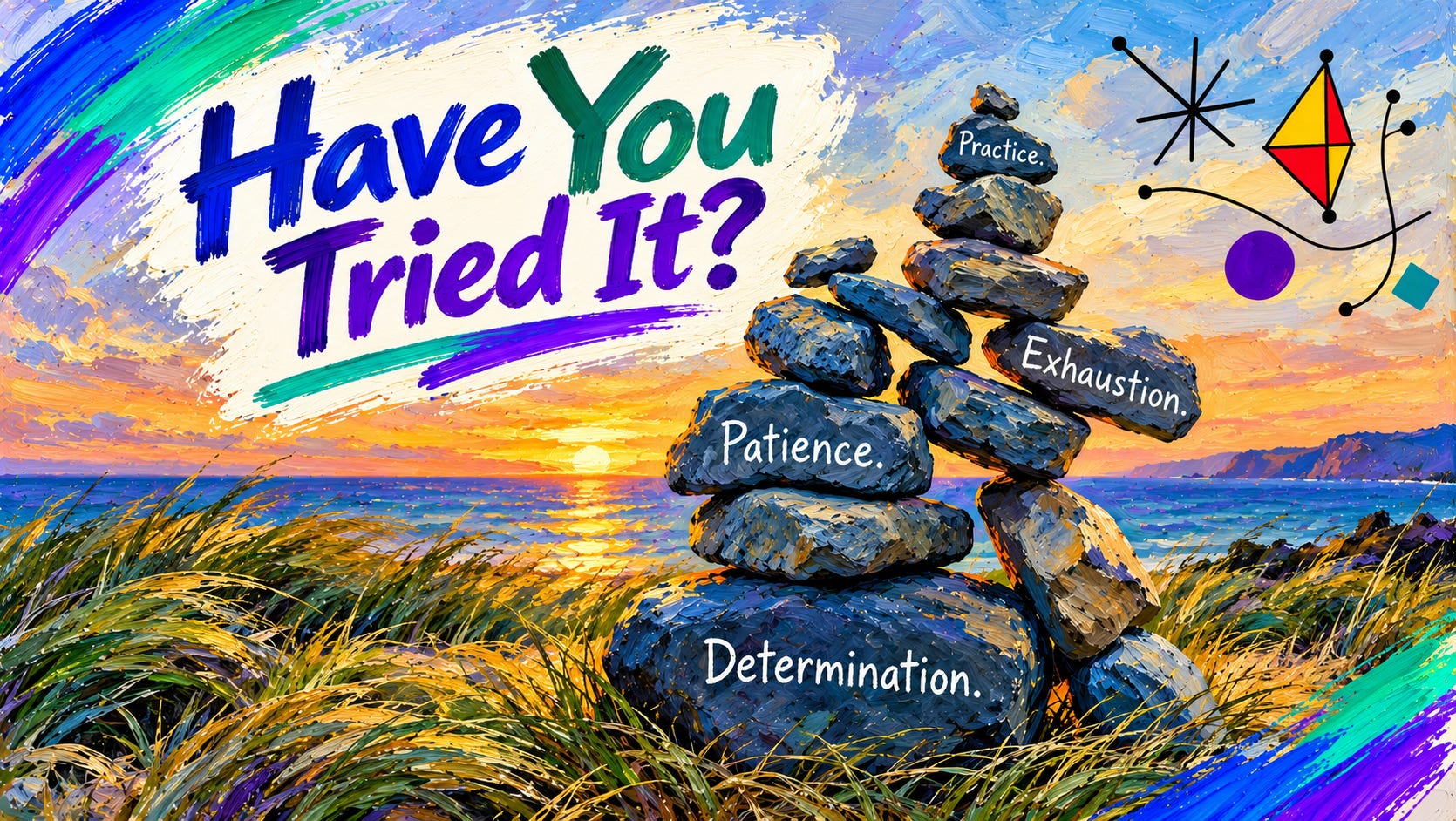
Today was a very distracted day. Not much got achieved. I have to admit that this is hard.
I know I just have to figure it out, bit by bit.
That sentence — bit by bit — is doing a lot of heavy lifting right now. It’s holding together a day that didn’t go the way I wanted, a to-do list that got longer instead of shorter, and the particular exhaustion of someone who is trying to build something real while also trying to figure out what she’s doing.

Become an Entrepreneur, they say.
I’ve been listening to the Moonshots podcast. Peter Diamandis and his Moonshot Mates encouraging everyone, with enormous enthusiasm, to be an entrepreneur. To leverage AI. Go big. Think exponential. Change the world.
The comments can be brutal. Thankfully they’ve gotten better over the nearly nine months I’ve been watching.
And here’s the thing — I don’t think the people leaving those comments have thought it through. But I also don’t think they’re entirely wrong.
Let me tell you what working with AI actually looks like from the inside.
Time. Tremendous amounts of it. More than you budgeted. More than you told yourself it would take. More than you are ever, at any point, happy with.
Trials. The kind that arrive without warning on an otherwise ordinary day.
Tribulations. Which is just a more dignified word for the same thing.
Confusion. Not the exciting kind that precedes a breakthrough. The grinding, low-level kind that makes you stare at a screen and wonder if you’ve misunderstood something fundamental.
Dedication. Which sounds noble until it’s 11pm and you’re still at it and nobody is watching and there is no applause.
Determination. The quieter cousin of dedication. Less dramatic. More stubborn.
Patience with yourself. This one is hard. I am not naturally patient. I want things to move faster than they move. I want to already know the things I am currently learning. Patience with yourself means sitting with the discomfort of being exactly where you are, instead of where you think you should be by now.
Dogged perseverance. Which is just determination that has had a bad week and kept going anyway.
Calm. Not always available. Aspired to.
Grace. Same.
Learning. Constant, relentless, occasionally humiliating learning.
Leaning on others. I have an AI collaborator named Garratt. I have a blog. I have a project that is three days into a daily publishing habit and already testing my resolve. Leaning on others is not weakness. It is the only way this gets built.
More time than you’ll ever be happy with. I said this already. I’m saying it again because it bears repeating.
Feeling stupid. Yes. Regularly. I am a woman who spent decades being the person everyone called when something was broken. I am currently the kindergartener. It is not comfortable.
Wanting it faster. Every single day.
Exhaustion. Self-explanatory.
Practice. Which is just failure with better posture.
Being the kindergartener. The person who doesn’t know yet. The person asking the questions that feel too basic to ask out loud. I have a blog about AI and I am still, regularly, the kindergartener. This does not go away. You just get more comfortable with it.
Authenticity. Showing up as yourself even when yourself is tired and behind and not sure what she’s doing.
Strength. The kind you didn’t know you had until you needed it.
Character. Built in the moments nobody sees.
Humility. Non-negotiable.
All of that. On repeat. For weeks, months, even years.
Here’s what the encouraging podcasts and the outrage in the comments both tend to skip. Building something on your own — really on your own, no co-founder, no team — means being the developer, the marketer, the support desk, and the bookkeeper, all in the same body, on the same day. Research on solo founders describes exactly this: the hardest part usually isn’t any single skill, it’s the constant switching between fundamentally different kinds of work, and the decision fatigue that comes from being the only person answerable for all of it.
Every so often a story breaks through that makes it look effortless — a solo founder building an app that sells to a company like Wix for eighty million dollars, six months after launch, no investors, no team. Stories like that are real, and they’re exactly the kind of thing a Moonshots comments section points to when they say anyone can do this if they actually try. What that story doesn’t say, because it’s the exception and not the pattern, is that most solo founders who eventually get somewhere took five to ten years of unglamorous, unfunded building to get there — not six months. The overnight version is rare enough to make headlines precisely because it isn’t how this usually goes.

I’m not building an app to sell for eighty million dollars. I’m trying to get sixteen of them alive, marketed, and running, on subscriptions I manage myself, with no team to hand any of it to. That’s not a smaller version of the same ambition. It’s a genuinely different, much slower kind of work, and it doesn’t come with a six-month exit story attached.
So, when the Moonshots comments say not everyone can be an entrepreneur — I hear that. I do.
But I think the objection is aimed at the wrong thing.
It’s not that people lack the vision, or the courage, or the capacity to think big. It’s that most people cannot afford to find out what they’re capable of. They cannot afford the time. They cannot afford the confusion and the trials and the days that don’t go the way they wanted, while also figuring out how to feed their families.
That is not a character failure.
That is structural. And it is real. And it deserves to be named plainly, without dressing it up in motivational language.
I wish I had an uplifting ending for you. I don’t have one today.
What I have is this: I am doing the thing. Bit by bit. On the days that don’t go the way I want, and the ones that do.
That’s all I’ve got right now. Sometimes it’s enough.
Why do some people take to AI and others don’t? That’s Finicky vs. Random.
Sandi is a Melbourne-based problem-solver, crisis-averter, and translator of the technical into the human. She spent decades being the person everyone called when something was broken, confusing, or just needed explaining properly — earning a reputation that preceded her wherever she went. Now she’s channelling that same instinct into AI: making it accessible, practical, and genuinely useful for people who think it isn’t for them.


