

The List
How I stopped worrying and learned to just talk to it
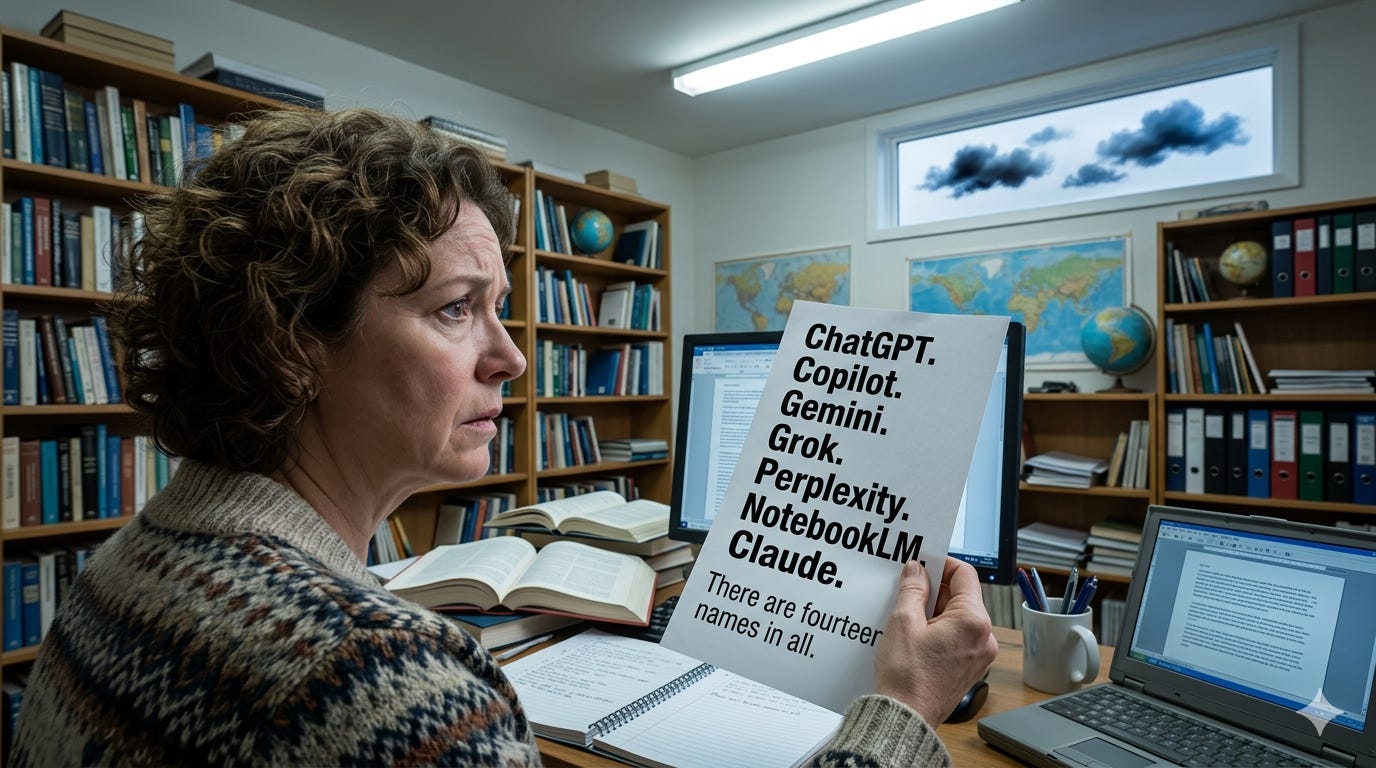
I’ve been staring at a list lately.
It appeared on my screen the way these things do — a neat column of names, each one representing a tool, a platform, an AI of some description. ChatGPT. Copilot. Gemini. Grok. Perplexity. NotebookLM. Claude. Fourteen names in all, and growing.
And my first thought wasn’t *”how exciting.”* It was something closer to *”no wonder people are overwhelmed.”*
Because if you’re coming to this fresh — if you’ve never really used any of them, or you tried one once and got something generic and vaguely unsettling back — that list doesn’t look like opportunity. It looks like homework.
I came to AI the way a lot of us do — sideways, and almost by accident.
I’d barely ever used Copilot, and only because it was pushed on us at work. I’d heard of ChatGPT the way you hear about things you’re not quite ready for. And then one day earlier this year, I had some genuinely complex questions — about health, medications, diet — the kind of questions that send you down a rabbit hole of contradictory Google results at two in the morning, leaving you more anxious than when you started.
I found the Claude app on my phone. I asked my questions. And what happened next stopped me in my tracks.
We’ve all played with Doctor Google. We know how that goes. You type in a symptom, and within three clicks you’ve diagnosed yourself with something catastrophic and have six months to live. The information is there, somewhere, buried under advertisements and forum posts and articles written for an audience of one — the algorithm.
What I needed was different. I needed someone to actually *listen*.
And here’s the thing about a ten-minute appointment at the doctor’s surgery — you have ten minutes. Ten minutes to tell your story while the doctor types it into a computer, writes two prescriptions, and says goodbye. How much do you forget to mention in that time? How much do you forget to ask? You drive home and it hits you — *I never even brought up the thing that’s been worrying me most.*
What I had with Claude was the opposite of that.
Over several afternoons, I had a conversation that would simply never be possible in a doctor’s office. I got more information *out of myself* — the full picture, the whole history, every connected thread — and received more considered, scientifically grounded responses than any ten-minute appointment could accommodate. There was no clock on the wall. No next patient waiting. No sense that my questions were inconvenient.
And somewhere in those conversations, I felt something unexpected.
I felt heard. Properly heard — sometimes for the first time. Like the full complexity of what I was carrying had been received and taken seriously, rather than efficiently processed and filed.
I want to be careful here, because this matters: Claude is not a therapist. It is not a replacement for your doctor. The disclaimers are real and they’re important. But as a replacement for Doctor Google? As a thinking partner for the questions you’re not sure how to ask? As a patient, knowledgeable presence that has time for you?

“Doctor Claude” had me at hello.
I became a devotee fairly quickly after that. But I’m the kind of person who needs to validate her choices rather than just go with her gut — so I did my research. Turns out my gut and the collective instincts of millions in the AI community are in fairly good agreement. That was reassuring.
But here’s the thing about that list.
It’s not just a list of tools. It’s a portrait of a moment in time — a moment when AI went from something that happened in laboratories and science fiction to something sitting in your pocket, waiting to be talked to.
And most people I know are not talking to it.
They’re watching from a safe distance. Or they’ve decided it’s not for them. Or they’ve tried it once, got something generic and hollow back — what the AI community has taken to calling *slop* — and concluded that they must have done something wrong. That there’s a skill to this they don’t have. That prompting is an art form for technical people, and they’ll never be one of those.
The AI community, with the best of intentions, accidentally built a wall.
All that talk of sophisticated prompting frameworks and optimised inputs and model benchmarks — it was never meant to exclude anyone. But it did. It made ordinary, intelligent, capable people look at this technology and think: *that’s not for me.*
Here’s what I want to tell every single one of those people:
It’s just a conversation. That’s all it is.
You don’t need frameworks. You don’t need to understand how any of it works under the hood. You don’t need to be young, or technical, or particularly brave.
You just need to type the way you’d talk to someone who was genuinely listening. Someone patient, knowledgeable, and completely uninterested in making you feel foolish for asking. Give it context. Tell it what you actually need. Treat it like a conversation rather than a search query.
That’s it. That’s the whole thing.
The more I talked, the more I discovered. What started as a health conversation became a creative one, then a practical one, then — almost without noticing — I was solving problems I’d been circling for months, and building things I’d never imagined I could build. Not because I’m technical — though I’m more comfortable with technology than most people in my world. But because I was willing to just start talking, and to keep talking until I got somewhere useful.
So when I look at that list now — all fourteen names, with more arriving every month — I don’t feel overwhelmed.
I feel something more like urgency.
Because somewhere in that list is a tool that could help my mother-in-law with something she’s been struggling with. There’s a conversation waiting for my friends who’ve decided this isn’t for them. There’s an answer sitting patiently for everyone who’s ever typed a symptom into Google at two in the morning and come away more frightened than when they started.
The tools are ready. The door is open. The only thing required is a willingness to walk in and say hello.
And if you’re not sure what to say?
Start with whatever’s on your mind. It’s better at listening than you might expect.
Sandi is a Melbourne-based problem-solver, crisis-averter, and translator of the technical into the human. She spent decades being the person everyone called when something was broken, confusing, or just needed explaining properly — earning a reputation that preceded her wherever she went. Now she’s channelling that same instinct into AI: making it accessible, practical, and genuinely useful for people who think it isn’t for them.