

Please leave a comment on the blog if you enjoy it
or if you take something interesting away. Let’s get into it.
A quick note if you’re new here:
I’m right at the beginning of the origin story
of how I went from AI-curious to AI-fervent.
This is the first app I ever built.
I had no idea what I was doing.
That’s the whole point.
The system that never worked
Recipes have always been a strong thread in my life. From a very young age, Mum’s recipes were part of the furniture of things — quietly, constantly present.
In Grade One, Mum’s recipes were a feature in the primary school’s Recipe Book. In my memory she was responsible for all of it — the idea, the committee, the gathering, the churning of the drum on the Gestetner printing press in the school support office. She was probably President of the Mothers’ Club, or Secretary, or Treasurer. She was always into something to help others.
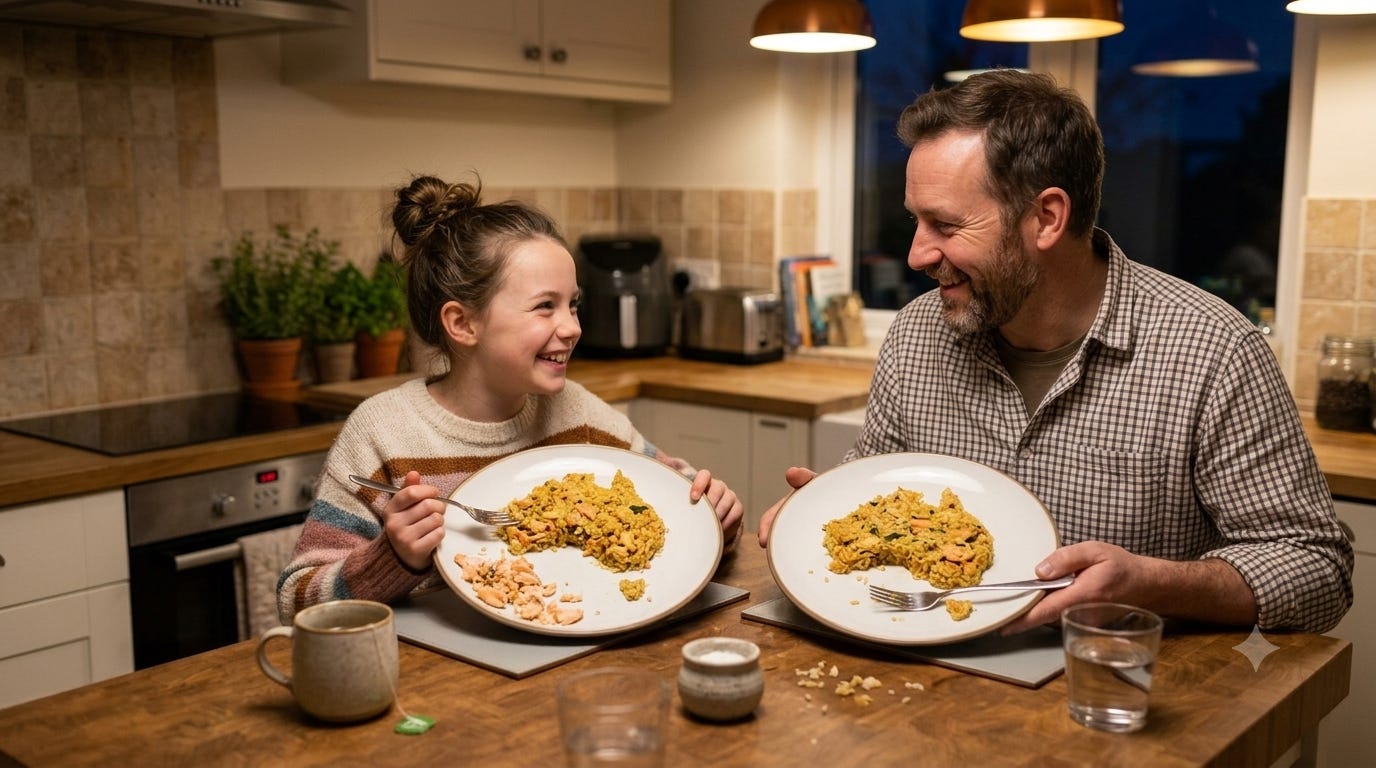
Friday nights, Dad and I made maps of Australia out of Mum’s Salmon Kedgeree — rice and salmon and gloop, pushed around the plate into shapes. Nana’s Sago Pudding. Anzac biscuits, which, like Hot Cross Buns, only turned up for one short season a year, which somehow made them better. There were more 1970s overcooked vegetables than culinary triumphs, in truth, but everything gets the rose tint of a good childhood, and I had one.
Mum’s own collection was a few battered books, stuffed with cuttings from newspapers and magazines, soft at the edges from being leafed through for years. When you idolise your mum, it’s easy to idolise the things she loved too.
After I moved out at nineteen, cooking became both a joy and a burden. I experimented, sometimes badly. I rehashed Mum’s recipes, developed a few of my own, called myself competent — nothing chef-y, but I could pull a meal together.
In my thirties I sold cookware for Chef’s Toolbox. Four trips to the car and back with a kit that weighed a tonne, and I never liked the selling part, but I loved getting a kitchen full of people — mostly women, the occasional gent — cooking something together and eating it after. One of the best stretches of my working life, until I was heavily pregnant and the lifting wasn’t sustainable anymore. The company folded not long after.
Through all of it, I never developed a system. Sometimes I’d sit at the computer and an idea for dinner would surface, and I’d write out a list — no quantities, just ingredients and names, the details long since cooked into memory. Years later, on a whim, I’d write the names alone, no ingredients at all, because by then I’d made them so often I didn’t need reminding.
Every recipe I’d ever collected from Chef’s Toolbox or a magazine eventually got tossed. Untried meant too hard. Tried and disliked meant gone. Tried and loved might make it into the plastic envelope stuck to the inside of the pantry door, or stay filed in the only system that ever really worked — my own head.
That worked, until it didn’t. Until decades of accumulation finally outran what one brain could hold onto.
The conversation that built the app
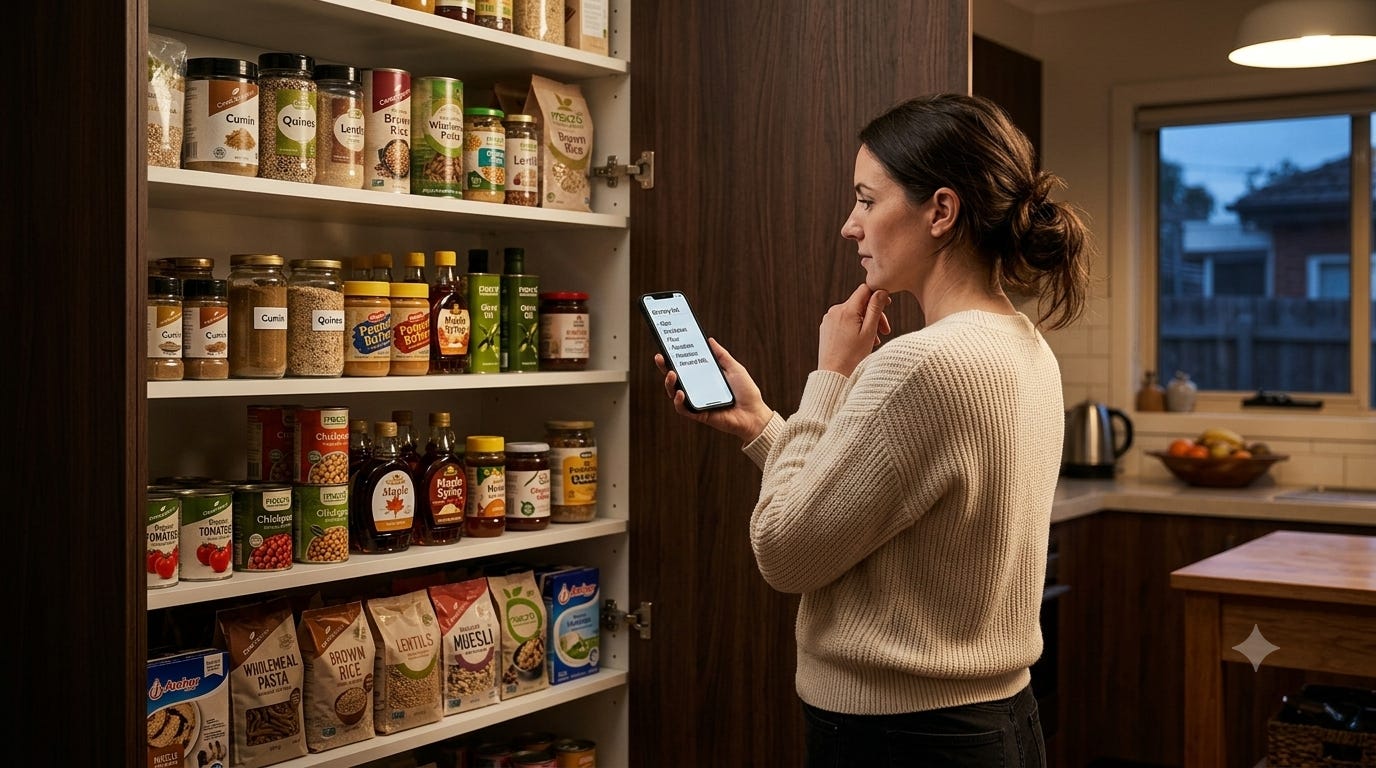
So that’s what I brought to Claude. Not a clean brief. A lifetime’s worth of half-remembered recipes, a pantry full of things bought for one dish and never quite used up, and the same nightly question Mum’s generation probably asked too: what can I actually make with what’s here?
I described the pantry. I described the recipes I still cook. I asked for something to show me where they overlap — what’s ready tonight, what’s one ingredient away, what’s just sitting there, useless, in no recipe at all.
A bit of back and forth, a few corrections, and then: go ahead and build it.
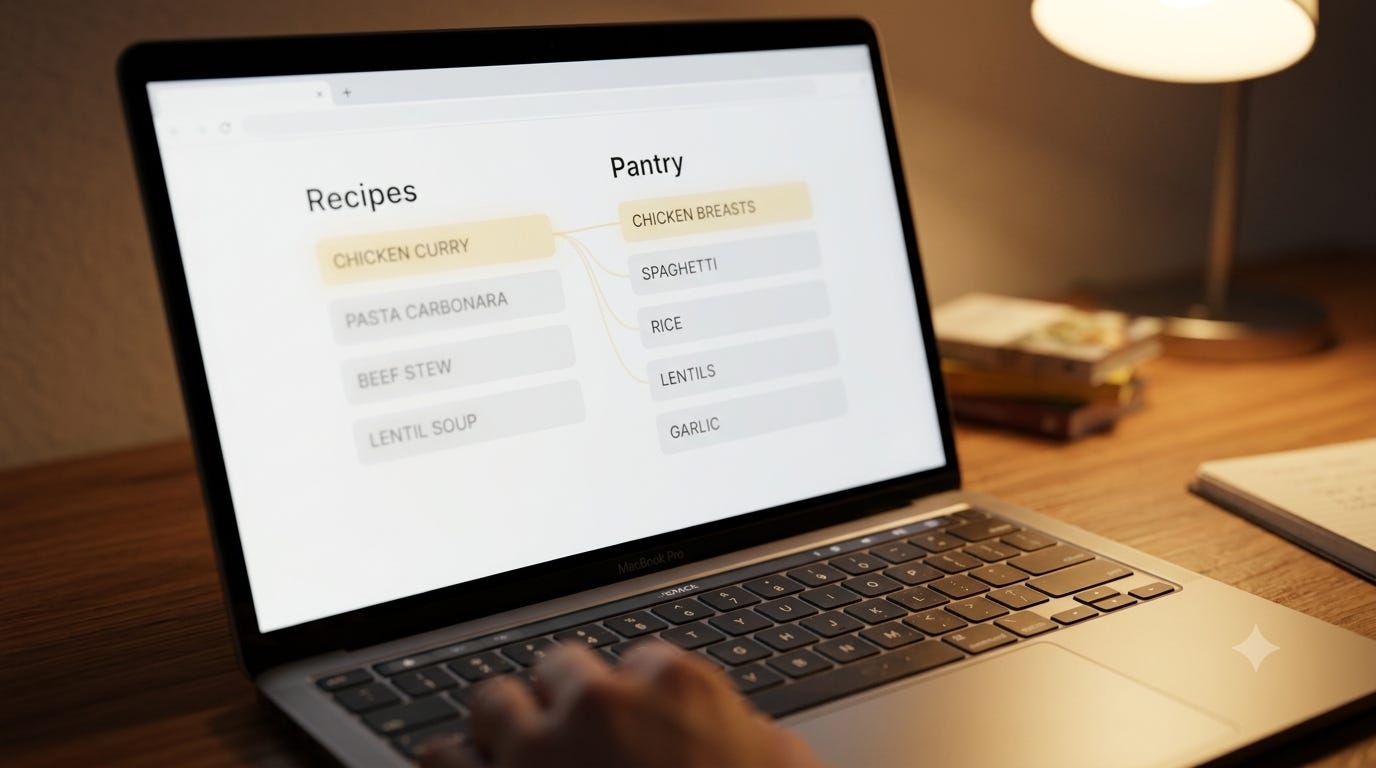
What came back was a small, working app — nothing dramatic, nothing trying to be more than it is. Click through the pantry, see what’s ready, see what’s nearly there, see the orphan ingredients with nowhere left to go.
An evening. Not a filing system. Not a plastic pocket stuck to a cupboard door. An evening, a conversation, and the question Mum’s recipe book never quite answered, finally solved.
I want to say that again, because I think it gets glossed over: I had no idea what I was doing. I hadn’t built an app before. I didn’t write a line of code. I described a problem I’d been living with for forty years, to something that could actually help me solve it, and a working thing came out the other end of that description.
That’s it. That’s the whole skill. Describing a problem you actually have.
What it actually does — all of it
The simple version: RecipeMatcher takes two lists — pantry, recipes — and shows you where they overlap. Ready to cook tonight. Almost there, needs one ingredient. Not currently useful for anything.
But it’s grown from that. The version I use now also helps with the restocking side of things — what I’m running low on, what I need to add to the shopping list, what I want to pick up at Aldi this week versus the farmers’ market on Saturday. Online shopping integration isn’t far behind. The same brain that couldn’t keep track of a plastic envelope of recipes now has a system that surfaces what I can cook, what I need to buy, and where to get it — in one place, built the way my brain actually works.
It’s still the app I open most.
You’re not the only one
I’m not the only person who’s discovered that a recipe problem is the perfect first app.
A CEO of a 12-unit restaurant chain — a self-described “computer nerd” who hadn’t actually written code for fifteen years — built a professional recipe management tool in a single night using AI, after failing to find any off-the-shelf software that did exactly what he needed. He described features to an AI tool in plain language, went to bed at 1am, and had the tool he’d been looking for. “You’re just talking to a developer and he’s your personal developer,” he said. “It’s the craziest thing.”
Separately, a 60-year-old developer whose story went viral on Hacker News described the same experience from the other direction: decades of knowing what to build, paired with AI that handles the how. He described features to Claude Code, reviewed the output, and shipped working software — no modern framework knowledge required. Other developers in their 40s, 50s, and 60s in the same thread described tools like Claude as breathing “new life into my desire to create.”
None of these people were starting from scratch with AI expertise. They were starting from expertise in their own problem — which is, it turns out, exactly the right starting point.
The thing nobody told me, that I’m telling you
Building an app sounds like a technical thing. It sounds like it belongs to the person with the dark screen and the hoodie, churning out code nobody else can read.
It isn’t. Or rather — it doesn’t have to be, for the kind of app you actually want to build for your own life.
What it requires is knowing your problem well enough to describe it. You’ve been doing that your whole life, for every job you’ve ever done, every argument you’ve ever made, every thing you’ve ever wanted and had to explain to someone else.
The identity story — the deeper one, about being the bridge who became the builder — that’s a different post, and it’s already written. Click here to read A BA Watches Her Developer Build
This one’s simpler: don’t be scared of trying. It’s just a conversation. Describe the problem you’ve been living with, to something that can actually help you solve it. See what comes back.
What came back for me was the answer to a question I’d been asking since Friday nights in the kitchen with Dad, pushing Salmon Kedgeree into the shape of Australia.
It just took forty years to find the right person to ask.
Sandi is a Melbourne-based problem-solver, crisis-averter, and translator of the technical into the human. She spent decades being the person everyone called when something was broken, confusing, or just needed explaining properly — earning a reputation that preceded her wherever she went. Now she’s channelling that same instinct into AI: making it accessible, practical, and genuinely useful for people who think it isn’t for them.
I’ve been thinking about vibecoding for a while. I’ve seen amazing results from it - little, highly-personal apps and websites, like the one you describe. A workmate made garden planning apps and I gleefully tested them for 30mins. Another workmate created the most adorable little 80’s style game you’ve ever seen. A third got a website that tracks results from slotcar races he runs with friends.
I’m not a programmer, although I’m very programmer-adjacent. Code just never stuck in my brain the way HTML and XML and CSS did.
But now I’m trying to look at the world around me with eyes to “a question that an app could solve” and I admit, I’m seeing places where “a red-hot go at vibecoding” seems a decent time investment. Very small, very personal, mostly related to poultry-keeping things - tracking breeding, how and where to place housing based on prevalent weather conditions. Very specific. Potentially useful.