

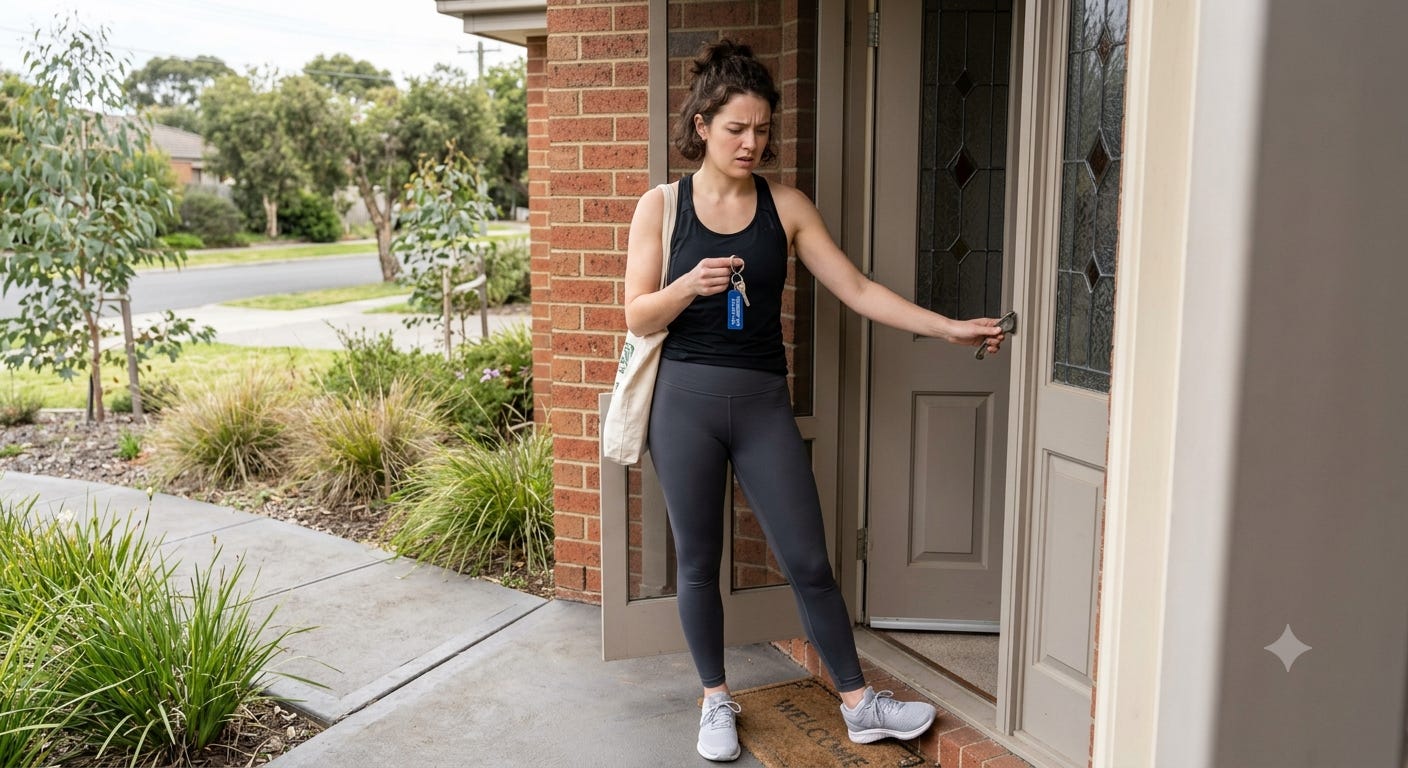
Between Australia Day and April, I used Claude the way you use a gym membership in February.
Occasionally. Guiltily. With the vague sense that I should be getting more out of it than I was.
I’d open a conversation, ask something sensible, get something useful back, and close the tab. It was fine. It was genuinely fine. But it wasn’t the thing people kept describing — the revelation, the unlock, the moment where everything changed. I watched people online finding their angles, building things, talking about AI with the particular energy of someone who has discovered something that fits them exactly. And I felt approximately nothing.
Not scepticism. Not resistance. Just — nothing. The lights were on and nobody was home.
I want to tell you what that felt like, because I think a lot of people are in that space right now, and nobody talks about it honestly.
The problem with “find a problem and solve it”
The advice is everywhere. It sounds so simple it almost sounds insulting.
Find a problem in the market. Build a solution. That’s how you use AI to create something.
I heard it. I read it. I nodded along. And then I sat with it for weeks and produced exactly nothing, because the advice assumes something it never says out loud:
That you can see yourself as the person who could build the solution.
I couldn’t. Not yet.
I’d look at a problem and think: yes, that’s real. And then immediately: but not me. Not with what I know. Not with the experience I have. Not at this stage. Maybe later, when I’m more confident, when I understand this better, when I’ve done the thing I haven’t done yet that will make me qualified to try.
My brain was scanning for opportunity through a filter that kept rejecting everything it found. Not because the opportunities weren’t there. Because I couldn’t yet see myself on the other side of them.
That’s the part nobody tells you about. The fog isn’t ignorance. It’s a failure of imagination — specifically, the imagination required to picture yourself succeeding at something you haven’t done before. There’s a real reason that gap is so hard to close by reading about it or watching other people do it: belief in your own capability is built most powerfully through actually doing the thing yourself, not through advance confidence or watching someone else manage it. I hadn’t done the thing yet. So I couldn’t yet believe I was someone who could.
The trip I was planning
In April I sat down with Claude to plan a few days away in regional Victoria — nothing elaborate, just trying to save myself the usual hours of tab-jumping and starting over.
What came back wasn’t just an itinerary. It was good enough, fast enough, that I sat back and thought:
Other people would use this.
“Ramble & Roam” - the full story of that session, the AI comparison I ran out of curiosity, and how it became my first saleable app is in my next post.
I wasn’t trying to build an app. I was trying to plan a trip. But I’d accidentally answered the question I’d been stuck on for months — not by finding a market problem and solving it, but by having a real need, using the tool naturally, and producing something that turned out to be more than just mine.

What the fog lifting actually feels like
It doesn’t feel like a lightbulb moment. That’s the thing I want you to know.
It feels like suddenly being able to see things you couldn’t see before. Not one thing — everything. The landscape changes. Problems that had always been invisible become obvious. Solutions that would have seemed beyond you a week ago seem entirely manageable. The filter that was rejecting everything quietly switches off.
Within days of Ramble & Roam, I had six more app ideas. Not vague ones. Specific ones, with a shape and a purpose and a sense of who they were for. They didn’t arrive because I’d become more capable. They arrived because I now had evidence — my own evidence, from my own experience — that I could take an idea from conversation to something real.
The confidence didn’t come from learning. It came from doing. That’s not just how it felt — it’s the actual, well-documented order these things happen in. Motivation is more often the result of taking action than the reason for it; the small first step is usually what produces the feeling of readiness, not the other way around.
And the doing, that first time, came from planning a country trip.
What I want you to hold onto
If you are currently in the February gym membership phase — using it occasionally, getting something useful back, feeling vaguely guilty that it isn’t more — I want to tell you something.
You are at the beginning. You just don’t know it yet.
The click isn’t something you can manufacture. You can’t decide to have it, or study your way to it, or find it by following someone else’s advice about market problems and scalable solutions. It arrives in its own time, usually sideways, almost always from something you weren’t trying to do.
For me it was a country trip. For someone else it’ll be a letter they were trying to write, or a problem at work they’d been circling for months, or a conversation that started as something practical and ended somewhere they couldn’t have predicted.
You don’t find the spark. The spark finds you — usually in the middle of something else, when you’ve stopped looking for it.
The only thing required of you in the meantime is to keep showing up. Keep opening the conversations. Keep following the threads even when they don’t seem to lead anywhere obvious.
The fog doesn’t lift all at once. It lifts when something you’ve built with your own hands shows you what you’re capable of.
And then you can’t unsee it.
The click isn’t an arrival. It’s a door you walked through without noticing — and only recognised from the other side.
Sandi is a Melbourne-based problem-solver, crisis-averter, and translator of the technical into the human. She spent decades being the person everyone called when something was broken, confusing, or just needed explaining properly — earning a reputation that preceded her wherever she went. Now she’s channelling that same instinct into AI: making it accessible, practical, and genuinely useful for people who think it isn’t for them.