


I’d already committed to Claude Pro by the time I sat down to plan a week away. This was supposed to be the easy part — not building anything, just working out where to go.
I was planning a trip to north-east Victoria with a friend who likes most of the same things I do. So I gave Claude the actual list, properly:
Silo Art. Cactus Country (two days). Op shops. Arty and foodie destinations. Local grocery stores. Restaurants, delis, cafés, coffee shops. Bars, pubs, breweries, distilleries. Arts and crafts destinations. Nature, walks, sights, scenery.
The itinerary appeared almost immediately. A proper multi-day plan, built around two days at Cactus Country, with op shops, small art galleries, local artists, silo art, railway history, lakes, rivers, and walking tracks woven through the rest.
The comparison
Curious, I ran the same request through Copilot and Gemini, just to see.
It wasn’t close.
Copilot, in particular, turned into something genuinely gruelling — ten rounds of “just one more question before I produce the map,” and then, after all that, an admission it couldn’t produce a map at all. Gemini wasn’t much better. Same list, same request, wildly different and largely unsatisfying results from both.
I went back to Claude and told it exactly that — what Copilot had put me through, what Gemini had handed back. And Claude did something useful with the comparison: it used what the other two had gotten wrong to sharpen what it had already gotten right, refining the itinerary further with that context in hand.
What Googling would have cost me, and everyone else
Here’s the part that actually mattered. If I’d tried to build that same itinerary by searching “top things to do near Cactus Country,” I’d have spent hours just surfacing the obvious, top-of-the-page results — and a lot of what Claude found probably wouldn’t have shown up at all.
It turns out that’s not just a feeling. There’s actual research on this — a study of Google, Yelp, and Booking.com found a measurable “popularity bias” (Popularity/exposure bias study): places further from well-known landmarks get systematically less visibility than lower-rated places that happen to sit near something already famous. It’s not that search engines deliberately bury the small, local, genuinely good places. It’s that proximity to popularity quietly outranks relevance, every time, by design. One travel-AI commentator put it almost cheekily: “sometimes the best thing an algorithm can do is keep a secret” — some newer tools are now deliberately steering people away from overexposed spots rather than toward them, which is the opposite mechanism to what just happened for me, but the same instinct underneath it.
I want to be honest about the limits of this, though, because the evidence isn’t all one-sided. Plenty of people report the exact opposite experience with AI trip planning — generic suggestions, outdated venue information, tools that funnel you straight toward the same major attractions everyone already knows about rather than away from them. One survey found over a third of AI-planned trips came back with missing or simply wrong details. So this isn’t a guarantee built into the technology. What I think actually made the difference was the brief itself — specific, categorised, nothing vague in it for Claude to fill with a safe, popular guess. A precise question got a precise answer. A vague one, by all accounts, gets you the same generic itinerary as everyone else.
Claude wasn’t searching the way Google searches, and it wasn’t fumbling the way Copilot and Gemini had. It was building something that actually matched what I’d asked for — not what was already popular, and not a polite negotiation over whether a map was even possible.
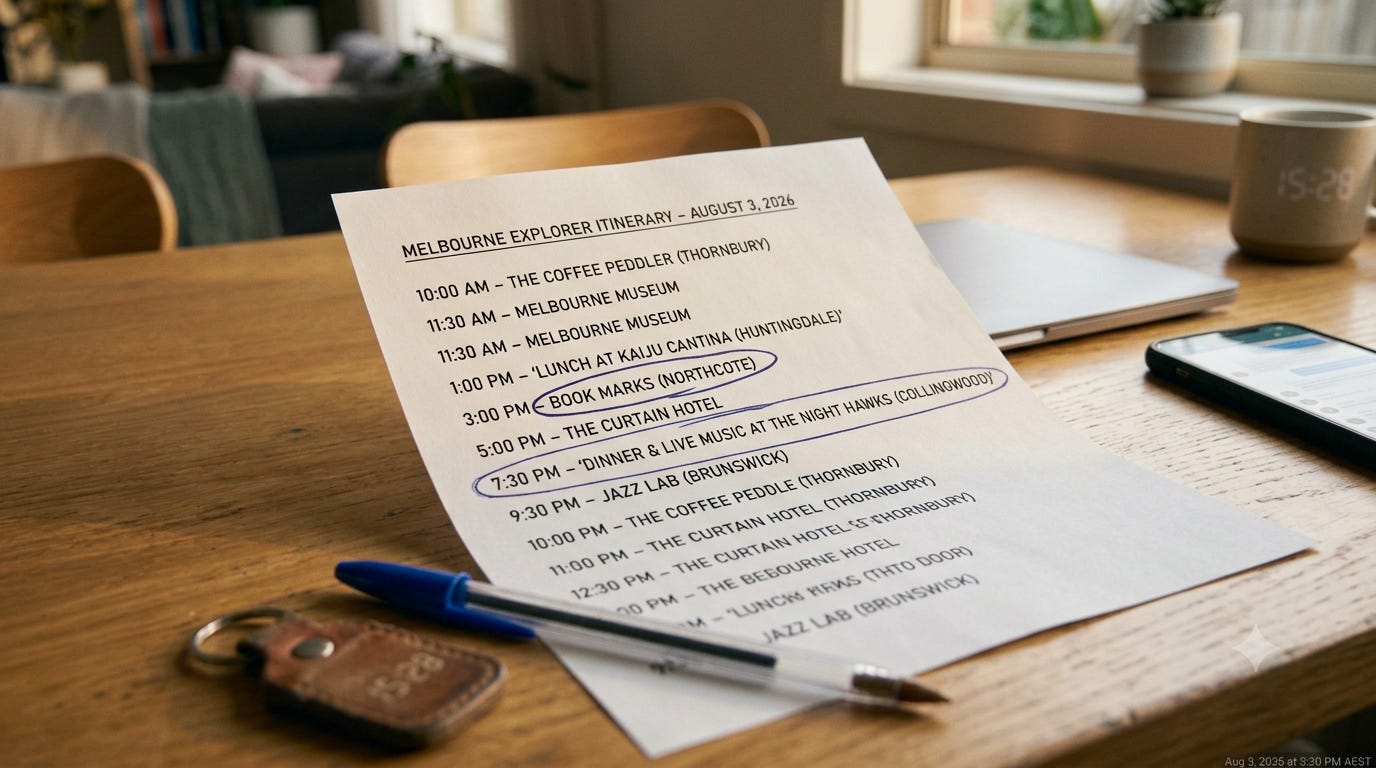
Five minutes that changed the shape of my afternoon
I asked a few more questions. Refined a couple of things. And somewhere in there — it took maybe five minutes from start to realisation — my brain came alive with a thought that had nothing to do with the actual holiday anymore.
This is an app idea.
Not “this was a useful tool for one trip.” An actual, buildable thing: an itinerary planner that took a real, specific list of categories and turned it into a genuine week away, properly tailored, in minutes, instead of the hours-long, multi-tab, mostly-fruitless search — or worse, the ten-round interrogation that doesn’t even end in a map.
I asked Claude to draft an About Me document and a handover, so I could carry the idea properly into Yol Studio and run it through the same CR Tracker rigour I’d already built for everything else. I wasn’t going to let a good idea turn into a vague one just because it had arrived in the middle of planning a holiday.
That’s how Ramble & Roam started. Not as a deliberate “I should build a travel app” decision. As five minutes of realising that what had just happened to my actual holiday plans could happen for anyone else’s, too.
There was more where that came from. A lot more, and fast.
Sandi is a Melbourne-based problem-solver, crisis-averter, and translator of the technical into the human. She spent decades being the person everyone called when something was broken, confusing, or just needed explaining properly — earning a reputation that preceded her wherever she went. Now she’s channelling that same instinct into AI: making it accessible, practical, and genuinely useful for people who think it isn’t for them.