

A quick orientation if you’re new here: I’ve been building apps with Claude since April. By the time this post begins, three of them are working. This is the story of why that wasn’t enough to make me feel like I knew what I was doing.
By the time I’d built Recipe Matchup, DayCompass, and CR Tracker — three real, working apps, all running, all useful — I’d stopped asking whether I could do this. I was actually pretty damn pleased with myself. The apps were all incredibly helpful, I was using them every day and I felt a massive sense of achievement.
But. What I started asking myself was harder to answer.
I felt a sense of paralysis? I was tired. Not of building — of perfecting. I’d spent hours refining the same three apps, polishing edges nobody but me would ever notice, because I didn’t know what the next thing should be. The paralysis wasn’t “can I build something.” I’d already proven that, three times over. This was quieter and stranger: restlessness with no obvious next step, sitting right next to genuine pride in what I’d already made.
Underneath the restlessness was something more specific, if I’m honest about it. None of the three apps were saleable. I didn’t yet know how to make them saleable. And I knew, somewhere in the back of my mind, that the next real step meant paying for something — Claude Pro, maybe Cowork or Claude Code eventually — a licence to Google Store and the Apple Store as well. An investment in Facebook and Instagram ads.
I still felt like a newbie, despite three working apps sitting right there on my hard drive as evidence to the contrary.
The developer in the hoodie
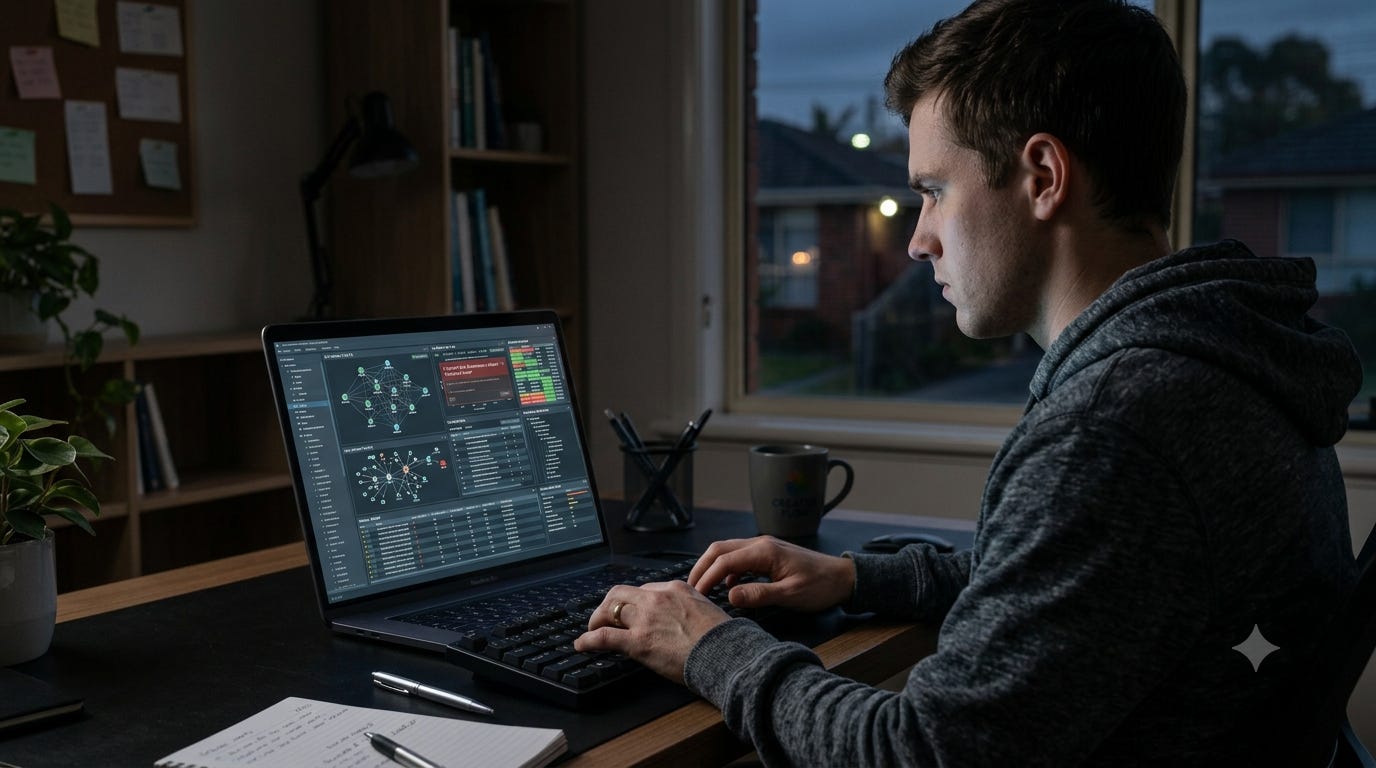
Here’s the image that kept turning up whenever the doubt got loud: a twenty-something young man, in a hoodie, in a dark room, lit only by a screen full of code I wouldn’t be able to read. That was my picture of a “real” developer. Quietly, unintelligibly competent. Churning out the kind of work that counted. He went to Uni for that skill. I didn’t.
I had three apps built through plain conversation, in my own kitchen, in daylight, with no code I’d written myself visible anywhere. Measured against the hoodie and the dark screen, that didn’t feel like building. It felt like something adjacent to building, performed by someone who hadn’t earned the title yet.
It turns out I was experiencing something that affects up to 82% of people at some point — and that’s most common specifically among high achievers and perfectionists, the people who care most about doing things well. Research consistently shows that external achievement doesn’t automatically close the gap between what you’ve done and what you believe about yourself. The gap between external reality and internal experience can be so wide it creates what one researcher calls “psychological vertigo” — and it doesn’t close on its own, no matter how many more achievements you stack on top.
Read about Imposter Syndrome at Why Successful People Feel Like Frauds
And Annie Wright’s explanation of achieving everything and still feeling like a fraud.
The doubt wasn’t about whether the apps worked. They worked. It was about whether I was allowed to call what I’d done real.
Doubting myself when I was winning!
Here’s the thing that reframed this experience for me: the doubt didn’t arrive when I was failing. It arrived when I was winning.
Research on high achievers finds this pattern consistently. The imposter feeling hits hardest not when you’re struggling, but precisely when you’ve nailed something. Three working apps should have resolved the self-doubt. Instead, they intensified it — which is, apparently, exactly what the research predicts. “You just nailed a presentation,” one piece puts it, “and instead of feeling proud, your first thought was: they’re going to realise I had no idea what I was doing.” The doubt wasn’t a sign that something was wrong. It was a sign that something was right — that I cared enough about the work to feel the weight of it.
Understanding that didn’t make the doubt go away. But it made it easier to hear by reading what it actually was.
What actually moved me
I didn’t talk myself out of the doubt with a realisation. I moved through it with an action.

In mid-April, I paid for Claude Pro. Building Apps and testing and fixing with web-browser-based Claude.ai too often led to me exceeding my ‘free’ limit. The shift to the paid version wasn’t dramatic, but at least I got bigger limits and stopped running out of session time. The doubt? There was no moment of clarity where the hoodie-developer image dissolved, and I suddenly believed in myself. I just got restless enough, and curious enough about what came next, to commit — properly, with my own money — to finding out. The doubt didn’t leave. It just stopped being the thing deciding what I did next.
That’s the resolution the research points to, too: not that the gap closes, but that you choose not to let it decide. “The doubt doesn’t get to decide. I do.” External proof doesn’t create that shift. The decision to act anyway does. It’s a framework for doing the hard thing, for taking the next step, even when you don’t know what the step after that is.
I’m not going to tell you the doubt is fully resolved, because it wasn’t, and pretending otherwise wouldn’t be honest. What I can tell you is that “real” turned out to be a much lower bar than the hoodie suggested. It just required going first, while still feeling like a newbie, and finding out what was on the other side of the subscription page.
Turns out there was a lot on the other side and that’s its own story.
Sandi is a Melbourne-based problem-solver, crisis-averter, and translator of the technical into the human. She spent decades being the person everyone called when something was broken, confusing, or just needed explaining properly — earning a reputation that preceded her wherever she went. Now she’s channelling that same instinct into AI: making it accessible, practical, and genuinely useful for people who think it isn’t for them.
There’s more on this story in the next three posts. Keep an eye out for them.