

There was a man who used to appear at shopping centres.
He had a display stand, a brochure, and a particular kind of confident patter that belonged to an era when knowledge was something you could buy in instalments. He was selling the Encyclopaedia Britannica. Thirty volumes, arriving one or two at a time over three years, until the full set stood on your shelf like a promise you’d kept to your children.
Sixty-nine dollars and ninety-nine cents a month. Thirty-six months. Two thousand, five hundred and nineteen dollars and sixty-four cents, if you did the maths and nobody really did, because you weren’t buying a product. You were buying access. You were buying the possibility that your child would reach for the right volume on a Tuesday afternoon and find the world opening up in their hands.
Some of us signed up. Some of us couldn’t afford to and felt the absence. Either way, we understood what we were reaching for.
The librarian on the step-stool
I was the senior librarian at my school.
Not a paid position — I was a student, the kind who stayed in the library at lunch because that’s where the interesting things were. I knew the Dewey decimal system the way other kids knew the bus timetable. I had a wheelie step-stool and access to encyclopaedias that the teachers definitely weren’t teaching from, and I used both with a frequency that probably alarmed the actual librarians.
I wasn’t gaming anything. I was just — hungry. For the subjects that weren’t on the curriculum. For the rabbit holes that opened when you pulled one thread and found seventeen more underneath it.
That’s what the encyclopaedia was for. Not for copying. For following.
What I watch now
My generation became parents. We signed up for the encyclopaedia, or we wished we could, or we drove our children to the library on Saturday mornings and felt virtuous about it. We understood that knowledge had value because we’d seen it priced.
And then the internet arrived. And then Wikipedia. And then, in 2022, ChatGPT — and suddenly everything we’d paid for, everything we’d driven across town for, everything we’d understood as precious and finite and worth sacrificing for was available, instantly, for free, on the phone in our child’s pocket.
We thought: what a gift.
And then we watched what they did with it.
I’m not going to pretend I don’t understand. I copied things too — changed a word here and there, paraphrased badly, handed in something that was sixty percent someone else’s thinking and forty percent the effort of not quite getting caught. Every generation finds the path of least resistance through homework. Every generation turns out approximately fine.
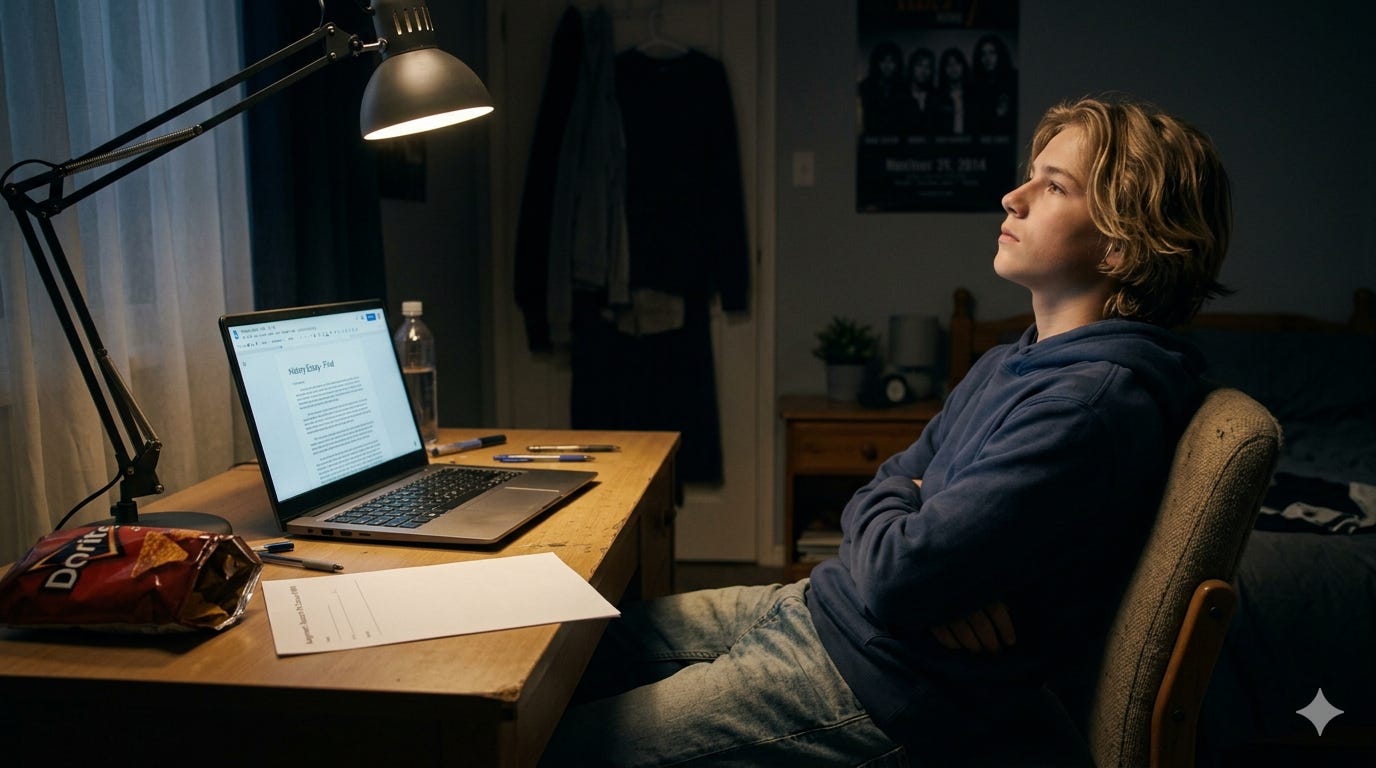
But here’s what I keep coming back to, sitting at the kitchen table at nine on a Sunday night, watching a teenager press send on something they didn’t write and couldn’t explain:
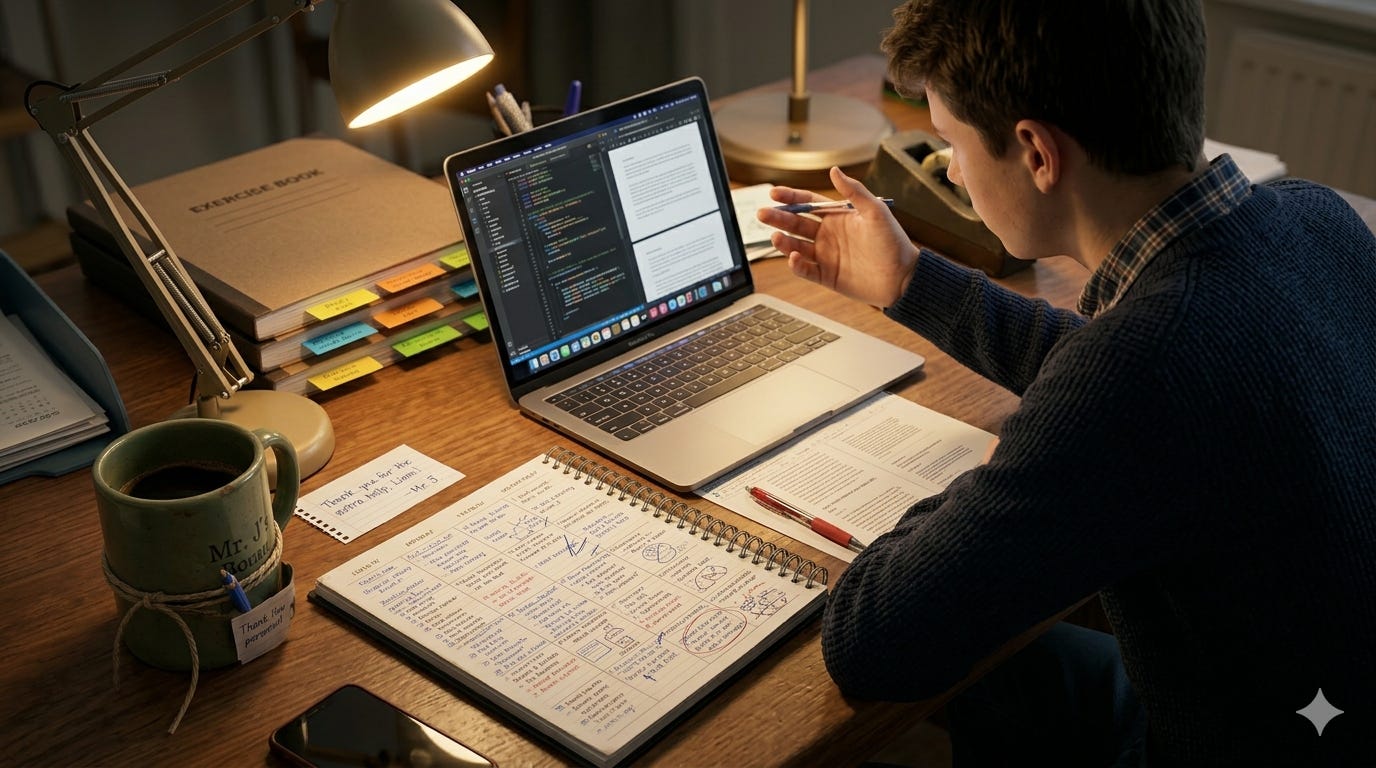
We gamed the encyclopaedia. We couldn’t game it completely, because to copy from it you still had to read it. You had to find the right volume, locate the right entry, understand enough of what you were reading to know which part to steal. The encyclopaedia demanded something of you even when you were using it badly.
The child pressing send demands nothing of themselves at all.
What’s the same and what isn’t
The parents who signed up for the encyclopaedia at the shopping centre weren’t buying homework answers. They were buying the possibility of curiosity. The hope that their child would sit with a volume on a rainy afternoon and follow a thread somewhere unexpected.
Some children did. Some didn’t. That’s always been true.
What’s different now is abundance without friction. The encyclopaedia cost money and took up shelf space and arrived slowly and required you to get off the couch. Those weren’t bugs. They were features. They created the conditions for the accidental discovery — the entry you read on the way to the one you were looking for.
AI has no such friction. It answers before you’ve finished asking. It requires nothing of you except the question — and if you don’t even bring a real question, it will generate something that looks like an answer anyway.
The student who uses it that way isn’t learning less than the encyclopaedia copier did.
They’re learning less than they could. And the gap between what they could learn and what they’re choosing to learn is wider than anything a shopping centre salesman could have imagined, standing at his display stand in 1992, convinced he was selling the future to anyone sensible enough to buy it.
The librarian is still in there
Here’s what I believe, and why this post isn’t a lecture.
Every child who presses send without reading is also the child who, given the right question at the right moment, would pull the thread. Who has something genuinely interesting to say and hasn’t yet found the conversation that draws it out. Who is not incurious — just untriggered.
The librarian on the step-stool didn’t appear because someone told her to be curious. She appeared because the shelf was there and the lunch hour was quiet and one thing led to another.
AI can be that shelf. Not the photocopier version — the other one. The one where you ask a real question because something is genuinely bothering you, and the answer opens into three more questions, and an hour later you understand something you didn’t know you wanted to understand.
That version is available too. It’s sitting right next to the homework-doing version, on the same phone, in the same app.
The parent who paid sixty-nine dollars and ninety-nine cents a month for thirty-six months knows which one they were buying.
The question is whether anyone has shown their child that it exists.
Sandi is a Melbourne-based problem-solver, crisis-averter, and translator of the technical into the human. She spent decades being the person everyone called when something was broken, confusing, or just needed explaining properly — earning a reputation that preceded her wherever she went. Now she’s channelling that same instinct into AI: making it accessible, practical, and genuinely useful for people who think it isn’t for them.
