

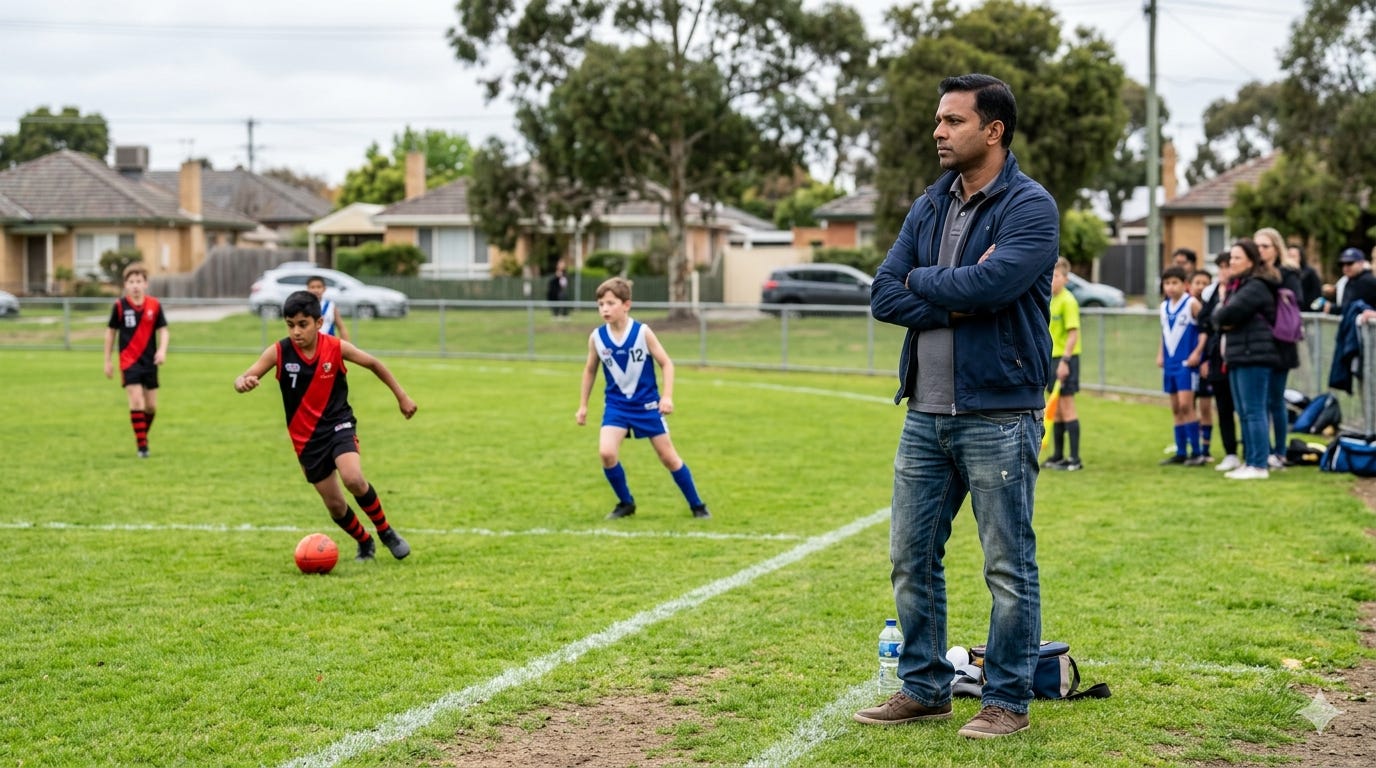
I know nothing about AFL.
I want to be precise about this, because the story requires it. I am not someone who knows a little about AFL but wishes they knew more. I am someone who stands on the sideline of a junior football oval on a Saturday morning and produces enthusiastic, confident, completely context-free encouragement at regular intervals.
Great mark!
I don’t really know what a mark is. I mean — I have a general sense. Someone caught the ball, sometimes spectacularly. That seems good. I said it anyway, with the authority of someone who has been watching this sport their whole life, which I have not.
The parents around me nodded. Nobody corrected me. I chose to interpret this as confirmation that I had said the right thing.
The boy I was watching
There’s a kid I’ve been watching for a few seasons now — not mine, but one I’ve come to know from the sideline. He plays differently from most of the others.
Where they charge, he reads. Where they go for the ball, he hangs back, scanning, positioning. He’s not slow and he’s not afraid — he’s calculating. You can see it in his eyes. He knows where the ball is going before it gets there.
Whether that’s exactly right or slightly wrong, I genuinely couldn’t tell you. It might be precisely what his coach has been working on with him for months. It might be a habit the coach is trying to break. I have watched this child play football for two seasons and I still don’t know enough about the game to answer that question with any confidence.
What I know is that his father stands next to me on the sideline every Saturday, watching with the focused expression of someone trying to solve a problem he doesn’t quite have the language for. He can see something. He can’t name it. And after the game, when he tries to talk to his son about it, the boy is too exhausted to run through it and the father is too unknowledgeable to lead the conversation anywhere useful.
So they drive home in the particular silence of two people who both care about the same thing and don’t quite have the shared vocabulary to talk about it.
What I did before last Saturday
I had a conversation with Claude.
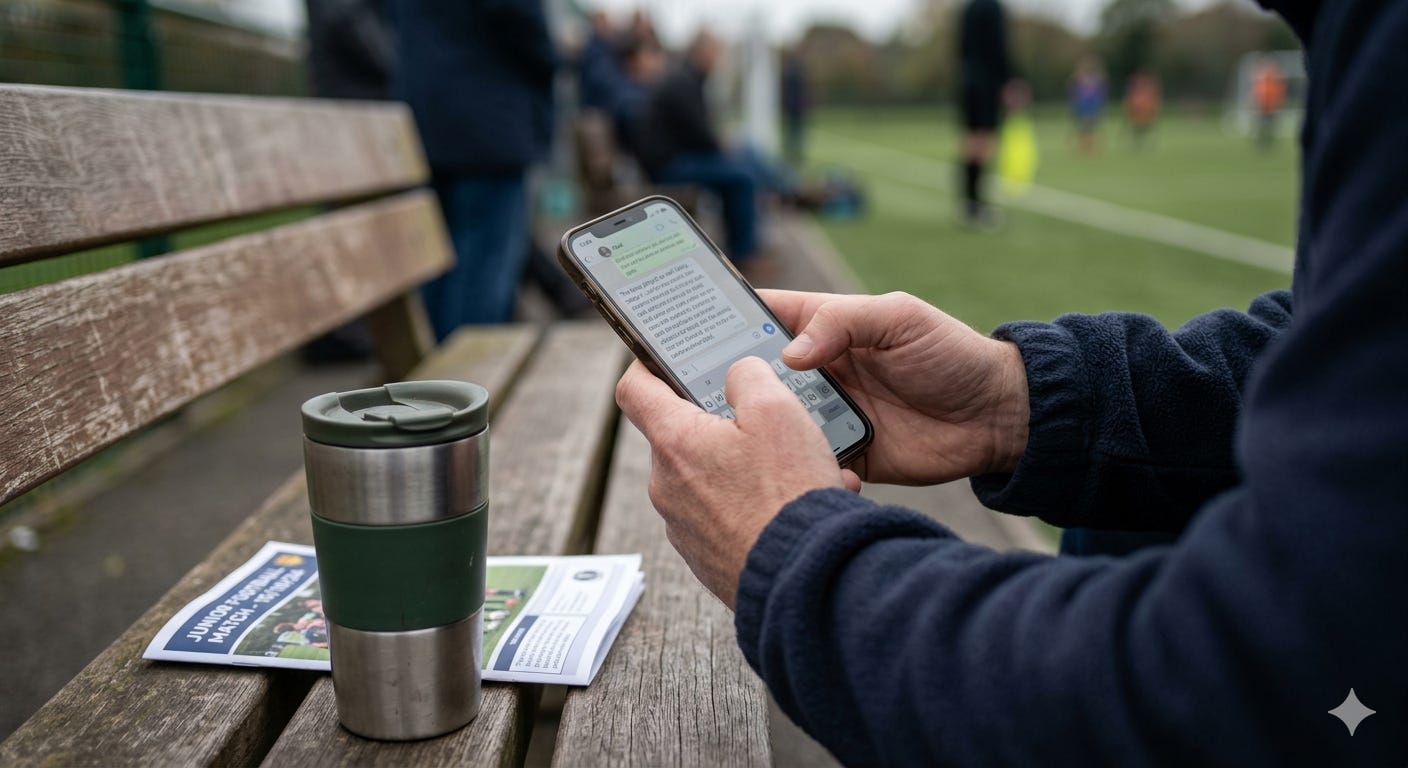
Not a long one. Twenty minutes, maybe, the night before the game. I described the boy — his style, his instincts, the way he hangs back and reads rather than charges. I asked what position that style suited. I asked what a coach would be trying to develop in a player like that, and what the specific language was for what he was doing well.
What came back was a small education.
The hanging back has a name. The reading of the play has a name. The specific skill of positioning yourself for the ball before it arrives rather than chasing it after it leaves — that has a name, and a value, and a context in which a coach would be deliberately cultivating it.
I learned what a mark is. I learned what shepherding means, and why you’d do it, and when to call it out from the sideline. I learned the difference between a player who is cautious and a player who is strategic — and why those two things can look identical from thirty metres away but mean completely different things inside the game.
I arrived at the oval on Saturday morning with vocabulary.
What happened next
I will not pretend I used it perfectly.
There was a moment in the second quarter where I called out something about positioning that was, in retrospect, probably about two seconds late and directed at entirely the wrong player. The boy’s father looked at me. I looked at the field. We said nothing.
But there were other moments. Moments where I said the right thing at the right time, where the language I’d borrowed from a twenty-minute conversation the night before landed accurately on what was actually happening on the oval. Where the boy’s father turned to me with the look of someone who has just heard their own half-formed thought said out loud.
That’s it. That’s what I’ve been trying to say.
We talked after the game. Properly. With words that meant something, that connected to what his son was actually doing, that gave the boy something specific to think about on the drive home instead of a silence shaped like good intentions.
The gap that AI fills here
I want to name it clearly because it’s not obvious.
The football dad doesn’t need to become an expert. He doesn’t need to do a coaching course or memorise the rulebook or suddenly develop opinions about zone defence. He needs enough language to show up for his kid in a way that feels informed rather than enthusiastic-but-lost.
That’s a completely achievable thing. It takes one conversation the night before. It takes describing what you’re seeing and asking what it means. It takes arriving at the oval on Saturday morning with three more words than you had on Friday night.
You don’t need to know everything. You just need to know enough to say the right thing once, at the right moment, to the right kid.
Good reading, mate. That’s exactly where you’re supposed to be.
Those words, said with accuracy instead of hope, land differently. The kid who hears them knows his parent saw something real. Not just noise from the sideline. Something true.
That’s what the twenty-minute conversation gave me.
It turns out that’s not nothing. It might, in fact, be everything.
Sandi is a Melbourne-based problem-solver, crisis-averter, and translator of the technical into the human. She spent decades being the person everyone called when something was broken, confusing, or just needed explaining properly — earning a reputation that preceded her wherever she went. Now she’s channelling that same instinct into AI: making it accessible, practical, and genuinely useful for people who think it isn’t for them.
Have you missed the other characters in this series?

The parent who can’t afford a tutor.

His daughter has been staring at the same maths problem for forty minutes.
