


His daughter has been staring at the same maths problem for forty minutes.
She understands maths. he knows she understands maths — He’s watched her work things out in her head that I’d need paper for. But tonight, something isn’t clicking. The worksheet wants her to show her working, step by step, in the specific sequence the teacher demonstrated. Her brain doesn’t work in that sequence. Her brain just — gets there. And now she has to reverse-engineer the journey from an answer she already has, in a format that feels like translating a language she doesn’t speak into one she does.
She’s not struggling with the maths.
She’s struggling with the method.
Across town, a boy is at a kitchen table with an essay to write.
He has things to say. Vivid, specific, interesting things — the kind of ideas that arrive fully formed and want to come out fast, in the order they arrive, because that’s how they’re alive. His teacher has given him a structure. Introduction, three body paragraphs, conclusion. Topic sentences. Evidence. Analysis.
He knows what he wants to write. He has no idea how to pour it into that shape without losing the thing that made it interesting.
The ideas are there. The page defeats him every time.
His father sits beside him, re-reading the assignment sheet for the third time, trying to explain something he only half understands himself.
The Sunday night feeling
These two households don’t know each other. Different suburbs, different schools, different children with different frustrations.
Same feeling. The particular sinking weight of a Sunday evening when the homework comes out and you can see your child struggling and you know, with quiet certainty, that what they need is someone who can explain it differently. One more time. In a different way. Patient, unhurried, starting from where the child actually is rather than where the curriculum assumes they should be.
That person is a tutor.
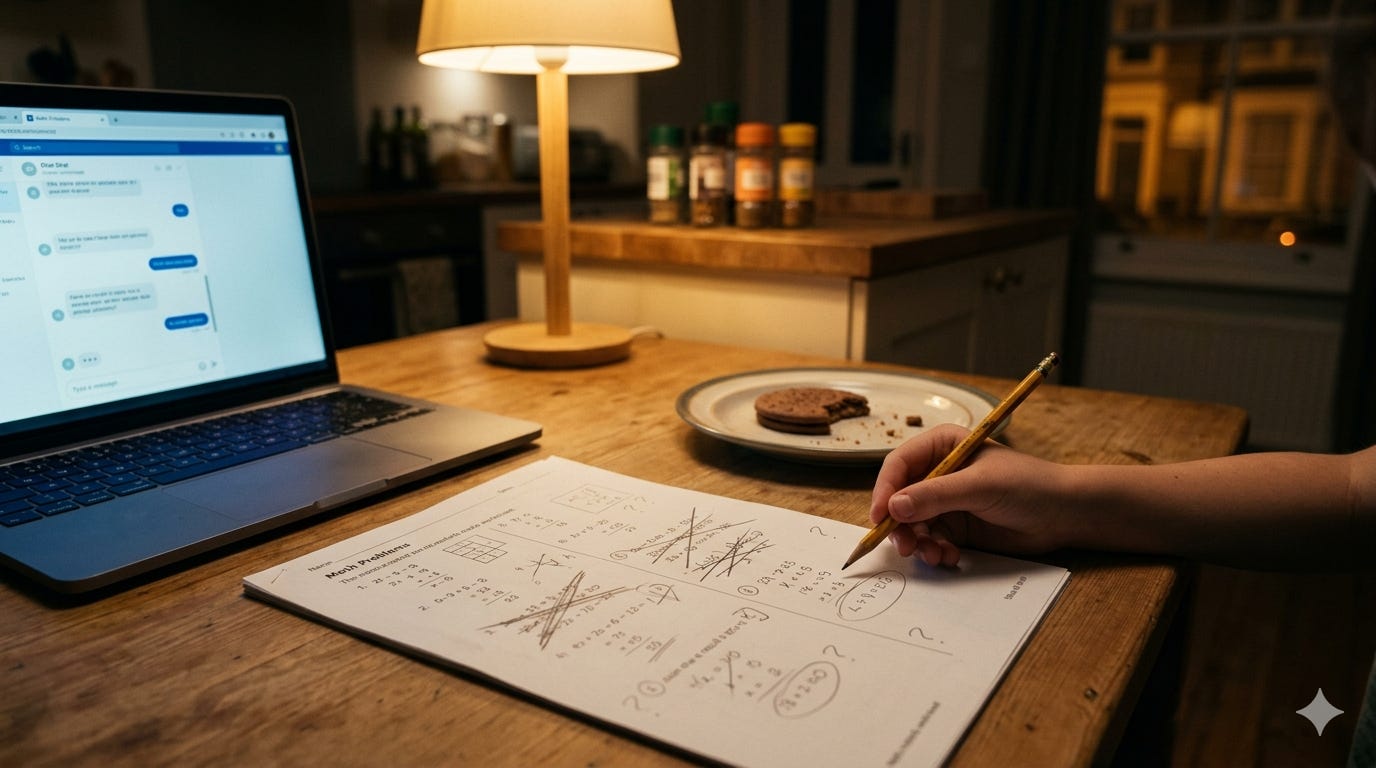
And a tutor costs money that not everyone has.
I know this from the inside. There was a time when my own child could have used one, and I couldn’t make the numbers work. You do what you can — you sit at the table, you look things up, you try to explain what you only half understand yourself. You google “what is a rubric” at 9pm and hope the answer makes sense before your child loses the thread entirely.
You show up. But showing up without the knowledge feels, some nights, like not quite enough.
What AI does in that gap
Here’s what I want to tell both of those parents.
The tool on your phone — the one you might have tried once and set aside, or never quite got around to — is patient in a way that people aren’t. It doesn’t get frustrated. It doesn’t have seventeen other things to do. It doesn’t move on to the next student.
It will explain a rubric to a nine-year-old in plain language. It will explain it again a different way if the first explanation didn’t land. It will explain it a third way, with an example, if that’s what it takes. It will not sigh.
It will sit with your daughter and work backwards from the answer she already has, showing her how to reconstruct the working in the sequence the teacher needs to see — not because that’s the only way to think, but because understanding the method is part of what school is teaching her, and someone patient enough to walk through it step by step is exactly what she needs tonight.
It will ask your son questions about his essay. Not tell him what to write — ask him. What’s the most interesting thing about your topic? What do you want the reader to understand that they don’t know yet? What’s the thing you keep coming back to? And then it will help him see how his answers map to the structure that’s been frustrating him — not as a cage, but as a frame that might actually hold what he wants to say.
It’s not a great tutor. A great tutor knows your child, their history, the specific way their brain works, the encouragement that lands and the kind that doesn’t.
But it’s available at 9pm on a Sunday. It costs nothing. And it will explain the rubric as many times as it takes.
The thing about quality
Here’s the part that matters beyond the homework.
Quality educational support has always been a function of what you can afford. The child with a tutor gets the explanation repeated six different ways until it lands. The child without gets one explanation, delivered to a class of thirty, and moves on whether it landed or not.
That gap is real. It has always been real. And it has always mattered — not just for the grade on Tuesday, but for the child’s relationship with their own learning. The child who is told, implicitly, that their brain works wrong because it doesn’t follow the expected sequence. The child who stops putting their hand up because the experience of not understanding in public is worse than the experience of not understanding at all.
AI doesn’t close that gap entirely. Nothing does.
But it gives every child access to something that used to require a credit card. The explanation repeated. The question answered without judgment. The patience that doesn’t run out.
Two households. Two children. Two parents who showed up on a Sunday night with the one tool that was actually available.
That’s not a small thing.
Sandi is a Melbourne-based problem-solver, crisis-averter, and translator of the technical into the human. She spent decades being the person everyone called when something was broken, confusing, or just needed explaining properly — earning a reputation that preceded her wherever she went. Now she’s channelling that same instinct into AI: making it accessible, practical, and genuinely useful for people who think it isn’t for them.
