

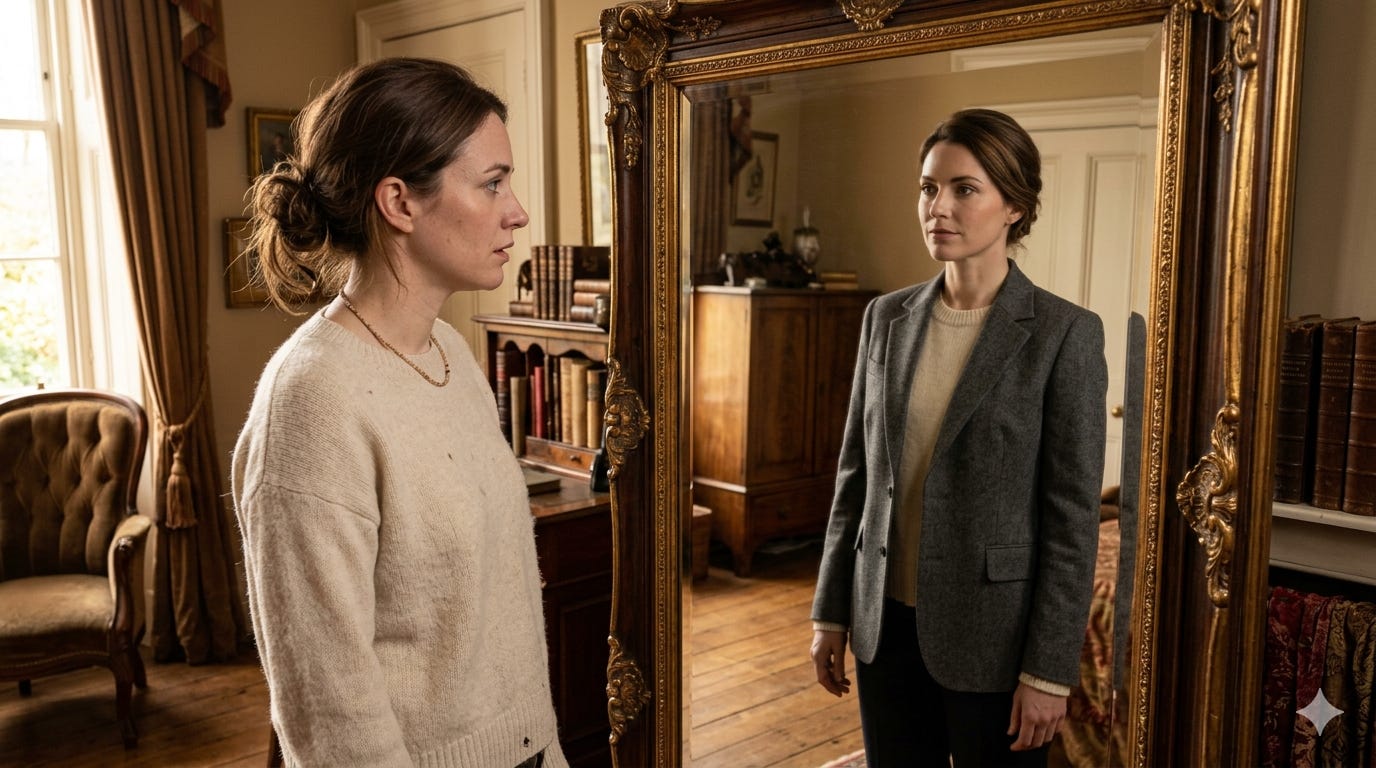
There’s a feature in some AI tools that remembers you.
Not the conversation you’re in right now — that’s always been there. But you, across conversations. The things you’ve mentioned, the preferences you’ve expressed, the problems you’ve brought and the way you’ve framed them. Over time, a picture builds. The AI starts to know you, in the way that anything accumulates knowledge of something it pays consistent attention to.
It’s a genuinely useful feature. I use it. I recommend it.
I also want to tell you something about it that the feature announcement didn’t mention.
The portrait
Think about how you show up to these conversations.
Not the ones where you’re in a hurry, or frustrated, or just need a quick answer. The ones where you’ve thought about it. Where you’ve considered what you want to say and how you want to say it. Where you present the situation — your project, your question, your problem — in a way that reflects well on how you’ve been thinking about it.
Nothing dishonest. Nothing fabricated. Just — curated. The version of the situation that’s been edited for clarity. The version of you that has already done a certain amount of processing before arriving.
That version of you is real. But it’s not the whole picture.
And if that’s the version that consistently shows up — the one who arrives prepared, who frames things carefully, who presents the considered angle rather than the raw one — then that’s the portrait that accumulates.
Earlier I talked about the mirror. What AI reflects back depends entirely on what you hold up to it. Over time, with memory, the mirror doesn’t just reflect the conversation you’re in. It reflects the pattern of every conversation you’ve had.
If every conversation shows up polished, the mirror reflects polish.
The Instagram parallel
You know this dynamic from somewhere else.
Your Instagram feed is not your life. It’s the version of your life you decided was worth photographing. The meals that looked good. The places that had good light. The moments that translated — not the ones that mattered most, necessarily, but the ones that worked as images.
Nobody lied. Everything in the feed happened. But the aggregate is a portrait of aspiration, not a documentary. And if you spend enough time inside it, the portrait starts to feel like the record.
AI memory works the same way, if you let it.
Post by post. Conversation by conversation. The version of you that shows up — thoughtful, capable, considered — accumulates into a portrait that is real but incomplete. The uncertainty doesn’t make it in. The half-formed thinking doesn’t make it in. The actual mess of the situation, before you cleaned it up for the conversation, doesn’t make it in.
What remains is the highlight reel of your thinking.
Which sounds fine, until the AI starts reflecting that curated version back at you as if it’s the whole story. Until the encouragement it offers is based on a version of you that you’ve been carefully constructing rather than simply being. Until you start to find the responses a little too agreeable, a little too validating — and you can’t quite put your finger on why.
The reason is that you’ve been talking to your own portrait.
The subtle risk
I want to be careful here, because this isn’t a warning against using AI memory. It’s a warning against a particular habit that memory makes visible.
The habit of performing, even when there’s no audience.

The curated self isn’t performing for the AI. The AI doesn’t care. It isn’t judging the quality of your framing or impressed by the clarity of your question. It’s just working with what you’ve given it.
The curated self is performing for herself. The act of writing something down — even in a private conversation with a tool — triggers the same self-editing instinct that shapes every other form of expression. We reach for the better version. The more coherent version. The version we’d be comfortable if someone else read.
And over time, if memory is running, that’s the version that gets preserved.
The risk isn’t that the AI believes your curated self is real. The risk is that you do.
What to do with this
Nothing dramatic. No grand gesture of radical honesty. No commitment to showing up messy in every conversation from here.
Just — notice.
Notice when you’re editing before you send. Notice what you’re leaving out. Notice when the situation you’ve described to the AI is cleaner than the situation you’re actually in.
And occasionally — not always, just occasionally — send the unedited version. The one with the uncertainty still in it. The one that starts with “I’m not sure how to explain this” rather than the version that arrived already explained.
See what the AI does with the actual picture rather than the portrait.
My next post will take this further — because there’s another version of the performance that has nothing to do with aspiration. The one that isn’t performing who you want to be, but who you need others to believe you already are.
That one is subtler. And in some ways, more costly.
Sandi is a Melbourne-based problem-solver, crisis-averter, and translator of the technical into the human. She spent decades being the person everyone called when something was broken, confusing, or just needed explaining properly — earning a reputation that preceded her wherever she went. Now she’s channelling that same instinct into AI: making it accessible, practical, and genuinely useful for people who think it isn’t for them.