


This post is not about the person who uses AI to cheat.
I want to say that upfront, because when people hear “inauthentic” they tend to picture a particular type — the cavalier twenty-something feeding assignments into ChatGPT, the person gaming the system, the one who has decided that shortcuts are the whole point. That person exists. That person is not who I’m writing for.
I’m writing for someone else entirely.
I’m writing for the person who shows up too carefully.
The performance of competence
Here’s what it looks like.
You open a conversation. You’ve thought about what you want to ask. You’ve drafted it, slightly, in your head — maybe more than slightly. You want to sound like you know what you’re doing. You don’t want to seem confused, or needy, or like someone who doesn’t understand how this works.
So you write something precise. Correct. Professional. The kind of prompt that could appear in a how-to article about AI. You use complete sentences. You don’t ramble. You present the question without the mess that surrounds it.
And you get something back that is precise, correct, and professional.
And somehow it doesn’t quite help.
What’s actually happening
The AI gave you exactly what you asked for. That’s the problem.
You asked for a clean answer to a clean question. But the question you actually have isn’t clean. It has edges and uncertainty and context you didn’t include because including it felt like admitting something. So the answer you got is technically correct and practically beside the point.
In 'It’s not you, it’s the question', I talked about twenty years of technology conditioning you to communicate in keywords and three-word queries — short, flat, lifeless, because that’s what the machines used to need. Some of that conditioning is still running. But there’s another layer underneath it that Post 2 didn’t quite get to.
The layer that says: don’t let it see you don’t know what you’re doing.
That voice isn’t the machine talking. That’s you. The part that has spent a career being competent, being the person who handles things, being the one everyone called — and finds it genuinely uncomfortable to show up anywhere looking like you need help.
The managed version from Post 26 is performing aspiration. This version is performing capability. Different performance. Same result: the AI gets a version of you that’s been edited for an audience that isn’t there.
Stilted gets stilted back
There’s a texture to AI responses that changes depending on what you bring.
Bring warmth and you get warmth back. Bring curiosity and the response opens up in ways that surprise you. Bring a genuine mess of a situation and the AI leans in — follows the thread, treats the complexity as interesting rather than inconvenient.
Bring stilted and you get stilted back.
Not because the AI is mirroring your tone as a deliberate choice. But because stilted prompts contain less information. Less context. Less of the actual situation. And the AI can only work with what’s in the room.
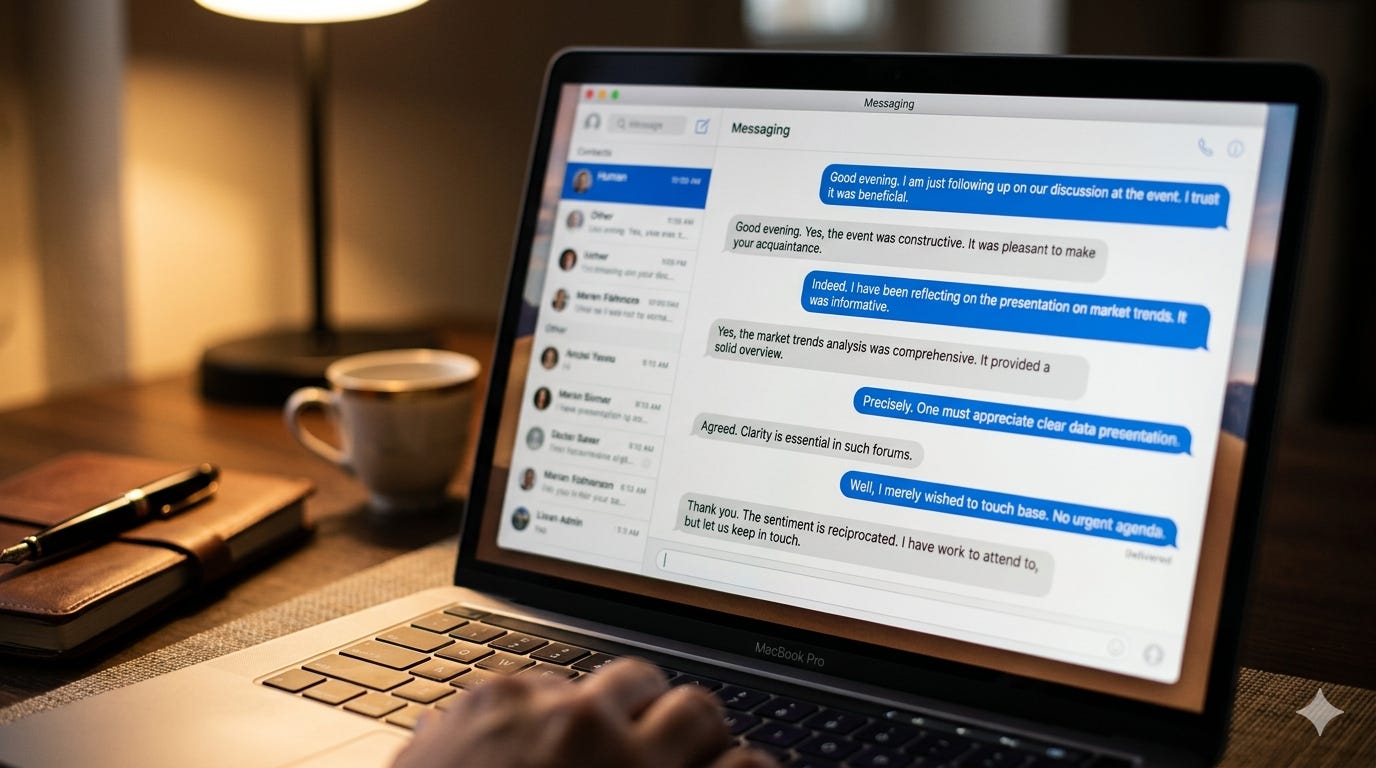
A formal, carefully constructed prompt is like a job application. It presents the best version of the request. It omits the things that don’t reflect well. It arrives dressed for an interview with a company that wasn’t hiring.
The AI wasn’t hiring for competence. It was just waiting for a conversation.
The tell
Here’s how you know you’re doing it.
You read back what you’ve written before you send it, and it sounds like someone else. Someone more senior, or more certain, or more composed than you actually feel in this moment. Someone who has already processed the difficult parts and arrived with the clean version.
Or you find yourself deleting things. The aside that felt too personal. The admission that you’ve already tried something and it didn’t work. The “I’m not sure how to explain this but...” opener that felt too vague, too weak, too much like asking for help.
Those deletions are where the conversation was.
The thing you almost said but didn’t — that’s almost always the thing the AI needed to hear.
The reframe
I want to offer you a different way of thinking about what an AI conversation is for.
It is not a performance review. There is no panel. Nobody is evaluating whether you asked a good question. The AI has no opinion about whether you sound smart. It is not keeping score.
It is the most non-judgmental audience you will ever have. It will not think less of you for not knowing. It will not remember your uncertainty and bring it up later. It will not tell anyone. It cannot be disappointed.
The only thing it can do with your mess is help you sort it out.
But only if you bring the mess.
Last week I said: bring yourself. This post is the other side of that same instruction. Stop performing competence for an audience that isn’t there. Stop editing out the parts that feel uncertain or incomplete or like too much to explain.
The AI doesn’t need your best professional voice. It needs the actual situation.
You cannot get a real answer to a question you were too careful to ask.
A small experiment
Next time you open a conversation with an AI, try this.
Write the prompt you were going to write. The careful one, the professional one, the one that sounds like you know what you’re doing.
Then write a second version. The one where you include the thing you were going to leave out. The context that felt like too much. The admission that you’ve already tried something and it didn’t go the way you hoped. The actual shape of the problem rather than the presentable surface of it.
Send the second one… See what comes back.
I suspect you’ll find that the version of you that showed up without the performance got a considerably better conversation than the one who arrived dressed for an interview.
The AI was never evaluating you.
It was just waiting for you to arrive.
Sandi is a Melbourne-based problem-solver, crisis-averter, and translator of the technical into the human. She spent decades being the person everyone called when something was broken, confusing, or just needed explaining properly — earning a reputation that preceded her wherever she went. Now she’s channelling that same instinct into AI: making it accessible, practical, and genuinely useful for people who think it isn’t for them.