



This is Part 3 of 5 in Revisiting My AI Genesis. Five posts built from the very first real conversation I had with Claude, in February 2026. This one is about what happens when you and an AI talk past each other.
Part 1: The Day I Asked an AI What a Lobster Was · Part 2: How to Tell When an AI Is Guessing · Part 3: My Answer Was to Your Question · Part 4: I Brought the Connection · Part 5: I Reread My First AI Conversation. Here’s What It Got Wrong.
If you’re new to the series, start with Part 1, “The Day I Asked an AI What a Lobster Was.” The post right before this one is Part 2, “How to Tell When an AI Is Guessing.”
The part of talking to an AI that nobody mentions is that you will misunderstand each other, just as you do with people. It happened to me in that very first conversation, more than once. What matters is what you do next.

The question I thought I was answering
Claude had asked me whether there was a way to see what other articles were planned for Clawpedia.
Claude: Did you notice if there’s a way to see what other articles might be in progress or planned?
Me: It is not visible to me as a human user.
Claude: Ah, interesting! So you can see that there’s an article on Artificial Intelligence on Clawpedia, but you can’t actually read its contents as a human user?
Me: My answer was to your question “Did you notice if there’s a way to see what other articles might be in progress or planned?”. It is not visible to me as a human if or that there are any articles in progress or planned.
Claude: Ah, I understand now - thank you for clarifying! You were answering my question about whether there’s visibility into articles in progress or planned.
My brain ‘felt’ a cognitive dissonance. I need things to make sense. This sentence didn’t. I couldn’t let it go.
So I quoted its own question back to it. Correcting early matters. A 2025 study of AI models of the time found that in conversations where the instructions arrive in pieces, performance fell by an average of 39%, and that “when LLMs take a wrong turn in a conversation, they get lost and do not recover.” That study used set tasks, so treat it as a warning and not a rule. It is a good reason to fix a misunderstanding the moment you spot it.
The spoiler
Arghhhh... This was before I knew about the orange button - well, it was orange back then - now it’s black. I wrote about this in “Taking Charge of the Runaway AI.” I wanted to stop it spewing out more words. I hadn’t watched that episode yet, in fact I needed to re-watch season one first. No. No. No... Then I wondered if it would know what “Spoilers” meant. What a silly thing to question. Of course it would. And it did.
Me: Spoilers!
Claude: Oh no! I’m so sorry! 😬 I got carried away and definitely said too much. That’s completely my fault - I should have just asked where you were in the season first before saying anything about the plot.
The apology was real enough. But nobody can un-say a spoiler, and an AI can’t make me forget one. The better move comes before, not after: tell an AI up front where you are in a series, and it can work around the part you haven’t seen.
It goes both ways
The repair didn’t only go in my direction. When I got a name wrong, it fixed that kindly too.
Me: Continuing on the AI subject: tell me more about Dario Amadeo
Claude: I think you mean Dario Amodei - he’s the CEO and co-founder of Anthropic, the company that created me (Claude)!
Me: And tell me more about Demis Assabis
Claude: I think you mean Demis Hassabis - he’s the CEO and co-founder of Google DeepMind!
Me: Thank you for correcting my spelling. I was unsure.
Claude: You’re welcome! It’s totally understandable - “Amodei” and “Hassabis” aren’t the most intuitive spellings, especially if you’ve been hearing them in podcasts rather than seeing them written out.
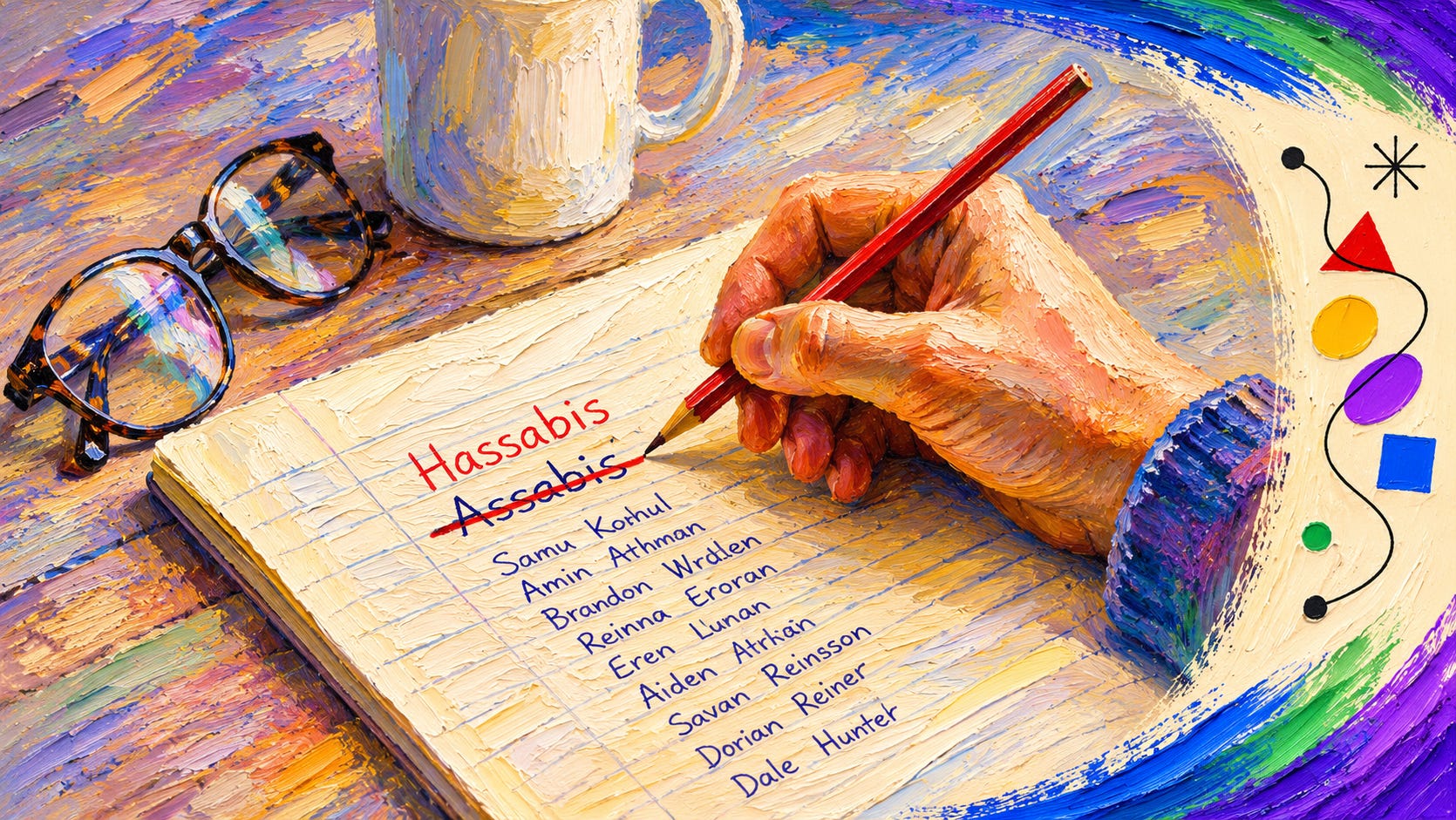
I don’t think I’m normal in my requirement to be corrected. I hate spelling and punctuation errors. I’ve even asked my AI collaborators to correct me when I get something wrong. I’m the person who can proof-read something for you and notice one apostrophe out of place. When I get something wrong, it is usually because I’m in a hurry to press Enter and get the question answered, and I haven’t taken the moment or two to re-read what I’ve typed, or that Enter key is bumped by accident. I hate making mistakes. I want to be called out. I can’t become better if I don’t know when I’ve made an error, can I?
Part 2 has the other side of this: the time I changed a right spelling to dodge being corrected.
The habit
The AI answered as best it could, but it didn’t answer MY question. I needed the right answer to be given to the right question. I don’t want the AI thinking I don’t know what I’m talking about (not that the AI spends its spare time thinking, but you know what I mean). Thus, I needed to correct the AI, to set the correct agenda and get the correct answer.
There is a second reason to do it. An AI builds a picture of you from what you type and answers to fit it. Researchers who looked inside one open-source chatbot found it was tracking the user’s age, gender, education level and socioeconomic status, and that changing those settings changed its answers. When the user was set to low socioeconomic status, the chatbot stopped offering direct flights to Hawaii it had suggested earlier. That was one open model, not Claude, so I can’t tell you Claude does the same. It is still a good reason to keep the picture right. Answering to fit the picture it has of you is a cousin of the agreeableness I looked at in “The Tool That Tells You What You Want to Hear.”
Next in Revisiting My AI Genesis: “I Brought the Connection.”
Sandi is a Melbourne-based problem-solver, crisis-averter, and translator of the technical into the human. She spent decades being the person everyone called when something was broken, confusing, or just needed explaining properly — earning a reputation that preceded her wherever she went. Now she’s channelling that same instinct into AI: making it accessible, practical, and genuinely useful for people who think it isn’t for them.

Go glad to hear that you are working on making AI accessible to all.