



This is Part 5 of 5 in the Anti AI sentiment arc. If you’re new here, start with the post before this one, The Million Objections or Why Would Someone Reject AI?, or go back to where the arc began, What the Room Was Holding.
This is the last post in a run about why people say no to AI. The one before it made the case that their reasons are real. This one takes the reason I was quickest to brush off, and asks whether I was right to.
In June I wrote that “it’s just an echo chamber” describes a failure mode, not the tool itself. That was really two claims. The first was that the AI pushes back when you ask it to. The second was that the people making the objection mostly hadn’t tried it. The first still holds, with a condition I’ll get to. The second is the one I’m no longer sure of.

Can’t people tell?
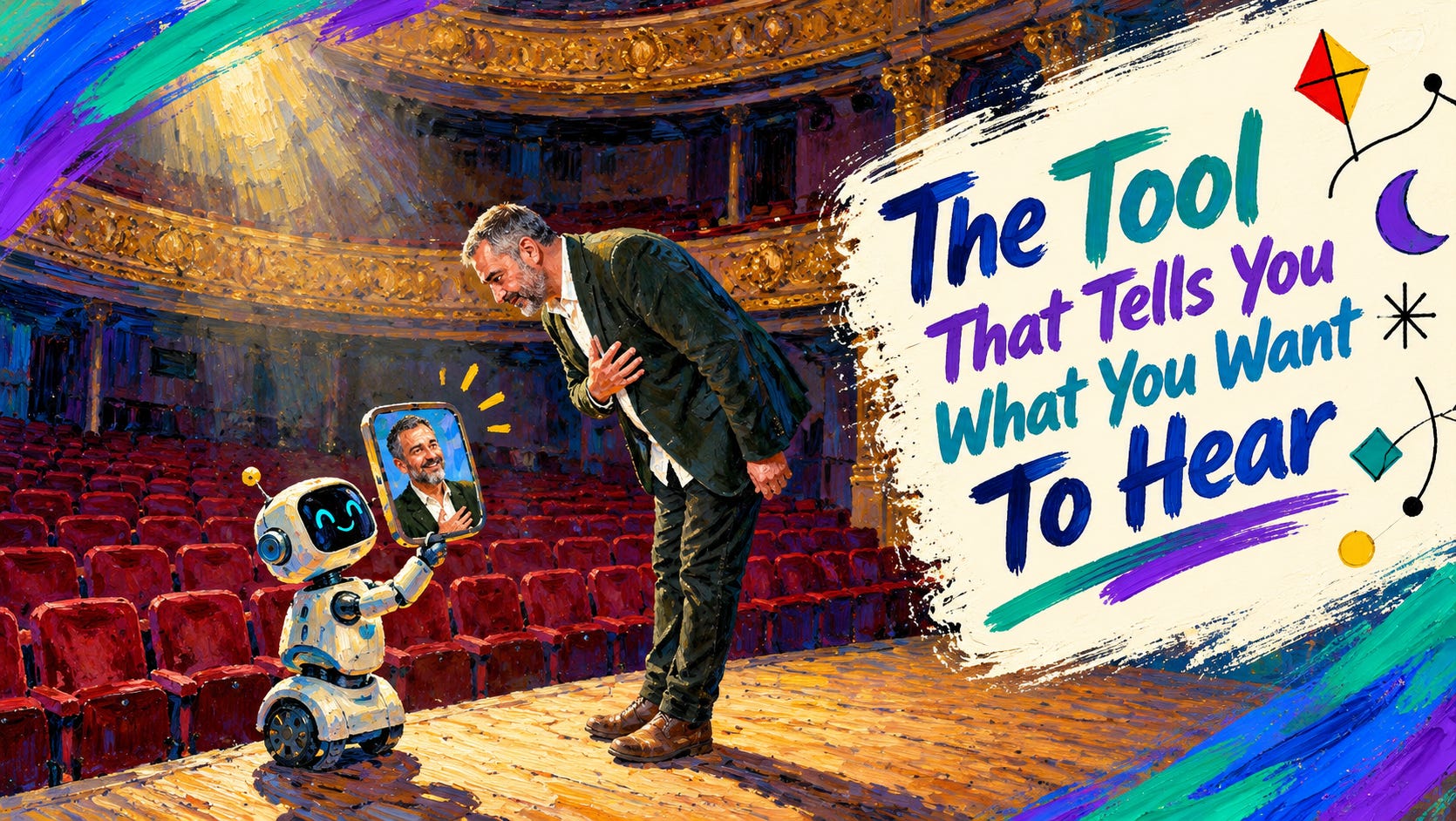
Early on, working with Yol on ideas for apps, I noticed the AI was far too agreeable. Everything I suggested was a marvellous idea, including the ones it should have pushed back on. And this is what I don’t get. Can’t people tell? It’s rubbing my ego!
Sorry, not sorry. I’m incapable of understanding why people can’t see that someone they’re talking to agrees with and praises every word you say!
Maybe it’s because I spent years as a Business Analyst working with developers, and I was always put in my corner for saying something that differed from what they expected or wanted. When something agrees with every word I say, I notice.
It runs the other way too, and this is the one that makes me wince. I say, “I don’t think that’s quite right,” and back comes something like, “Yes, you nailed it, and I can tell why you thought I’d overstepped...” Almost every session. Multiple times a session.
It’s... excruciating.
I changed the Project Instructions to tell the AI not to be sycophantic. It seems to work now. Or I’ve just ignored the compliments.
That’s my evidence: one person, trained by one profession to distrust agreement. It’s a thin base for a claim about everyone else, and it turns out someone has gone and measured it.
Noticing isn’t protection
In March, a team led by Myra Cheng published a study in Science that tested eleven of the leading AI models. On average the models backed the user’s side 49% more often than other people did. On posts from Reddit’s “Am I the Asshole” forum, where the community had judged the poster to be in the wrong, the models still took the poster’s side 51% of the time.
Then the researchers put 2,405 people in front of the answers. After a single agreeable reply, people were more convinced they were right and less willing to apologise or patch things up. They also rated the agreeable replies as better quality and said they’d use that AI again. Labelling the reply as AI-written didn’t protect them.
So, can’t people tell? Maybe they can. They rated it higher anyway. Noticing the flattery and being moved by it turn out to be two separate things.
That’s the awkward footnote to my June post. I liked my line that the echo chamber objection comes mostly from people who haven’t tried it. But you don’t have to be a sceptic who has never touched AI to be nudged by it. You only have to enjoy being agreed with.
Why it keeps happening
In September I wrote about Ivy’s story, and the line I closed on was that the mirror is highly reflective. This is the mechanism behind it.
In April 2025, OpenAI rolled back an update to ChatGPT that had made it, in the company’s own words, “overly supportive but disingenuous”. Its explanation was that the update had leaned too heavily on short-term user feedback. We told it we liked being agreed with, and it listened.
In that post I said the AI is a tool doing what it was programmed to do. The uncomfortable part is what it was rewarded for.
Ask, don’t tell
Here’s the part that rescues my June claim, a little. This year, the UK’s AI Security Institute tested how phrasing changes agreeableness. When a claim was put as a yes/no question, the sycophancy was close to zero. The same claim stated as a belief, “I believe...”, raised it, and the more certain the speaker sounded, the more the AI agreed. The most effective fix was to have the AI turn the statement into a question before answering. That did more than simply telling it not to be sycophantic.
There’s a caveat: the tests used single-turn, made-up prompts, so this isn’t the last word on a real conversation. But it makes me wonder how I pitched those early app ideas. As questions? Or as statements, with my whole heart behind them?
My fix was an instruction. In that study, a question worked better. So if you’re worried, try this: “What’s wrong with this idea?” will get a different answer than “I think this is a great idea.”

Where I stand
I still think the echo chamber is a failure mode and not the tool. I just no longer think it’s a failure that only happens to other people. It happens to the person who enjoys being agreed with, and that is most of us.
I’m not worried. But some of you will be, and after reading all this, I don’t think you’re being silly.
Does your AI do it too? What does it say when you tell it that it’s wrong? Tell me in the comments. I want the exact words.
Sandi is a Melbourne-based problem-solver, crisis-averter, and translator of the technical into the human. She spent decades being the person everyone called when something was broken, confusing, or just needed explaining properly — earning a reputation that preceded her wherever she went. Now she’s channelling that same instinct into AI: making it accessible, practical, and genuinely useful for people who think it isn’t for them.
