



This is Part 4 of 5 in Revisiting My AI Genesis. Five posts built from the very first real conversation I had with Claude, in February 2026. This one is about what you bring to an AI conversation, and why it matters more than you think.
Part 1: The Day I Asked an AI What a Lobster Was · Part 2: How to Tell When an AI Is Guessing · Part 3: My Answer Was to Your Question · Part 4: I Brought the Connection · Part 5: I Reread My First AI Conversation. Here’s What It Got Wrong.
If you’re new to the series, start with Part 1, “The Day I Asked an AI What a Lobster Was.” The post right before this one is Part 3, “My Answer Was to Your Question.”
A late bloomer worries about starting behind. In my first conversation with Claude, the best moments weren’t the ones where the AI knew something. They were the ones where I did.

What I brought with me
Having lived a tech background working life, the terminology these experts were using was familiar to me, so I soaked it up, but when they started talking in acronyms and obscure words outside my vocabulary, I needed to look things up.
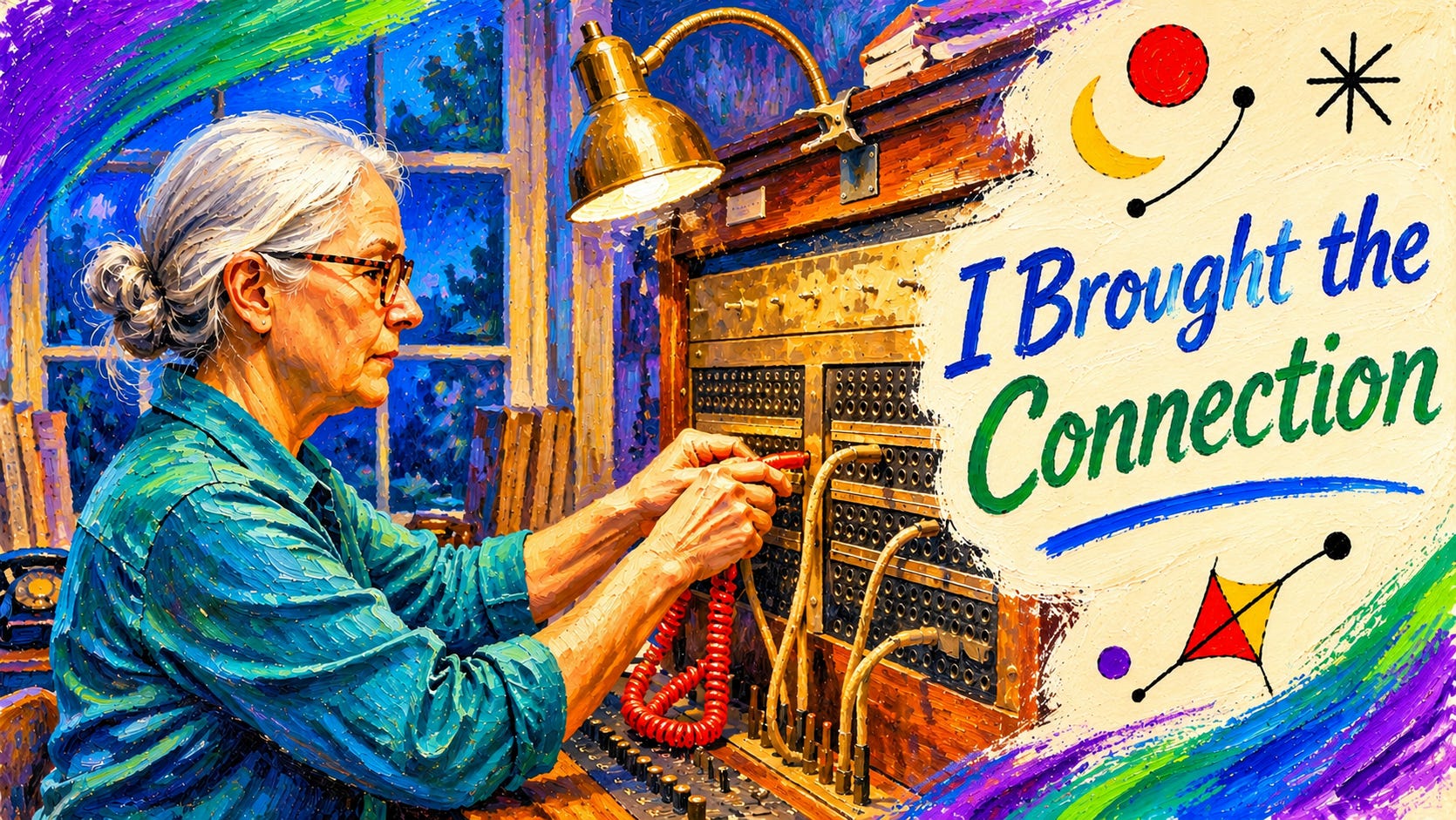
In my roles as Business Analyst I was the interpreter for the users, translating their requirements into a language that developers spoke. That was a job I did for the final 24 years of my 41 and a half years. I won’t say it came easy in the beginning but by the time I left I spoke like a machine. Talking to an AI came much easier than talking to developers. I swear sometimes they were obstreperous on purpose.
In “Bring Yourself” I asked you not to bring your government-department voice to an AI. This post is the other half: what is worth bringing.
Giving it the context
When I asked Claude about MTP, I didn’t only ask what it meant. I told it what I was asking about.
Me: What do you know of MTP (Massive Transformative Purpose) relating to humans in a world of AI (RSI and Singularity)
Claude: A Massive Transformative Purpose (MTP) is a “highly aspirational tagline” for an individual or group - it’s a huge and audacious purpose statement.
Me: It certainly was the context I requested. Thank you.
Peter Diamandis had spoken about your MTP being your “why”, and encouraged viewers / listeners to become entrepreneurs and to aim AI at your MTP. I’m pretty sure people can have an MTP that doesn’t involve AI so it seemed obvious to put a qualifier in that request.
Anthropic’s own advice for a reply that misses is the same: give Claude clear and specific instructions, and add context. Context isn’t magic, though. One 2024 master’s thesis tested how the wording of a prompt affects the answers and found that making prompts more specific didn’t reliably help: nouns made no significant difference, more specific verbs hurt reasoning, and each model had its own sweet spot. That was a small study of four models, and it tested word choice, not the kind of context I gave. I take it as a reminder that what helps is telling the AI what you’re really asking, not piling on words.
The moment I got there first
Me: I notice usage of the “why”. I recall this term used by Simon Sinek - can you give me more background on Simon, please?
Claude: Absolutely! Great connection - Simon Sinek is indeed famous for his focus on “why,” and his thinking aligns beautifully with the MTP concept.
Me: I see the philosophical alignment between both Sinek and Diamandis - both are optimists.
Claude: Exactly! That’s a really insightful observation. Both Sinek and Diamandis share a fundamentally optimistic worldview about human potential and our future.

The Moonshots podcast’s “Mates” were talking about ‘your MTP - your Massive Transformative Purpose - your “why”’ and I recognised the “why” from past training where Simon Sinek’s talk at TEDxPuget Sound in 2009 and book “Start with Why” had been a feature. It was the first time watching Moonshots where I already knew about something the Moonshot Mates were discussing. These four are gargantuan intellects, and it felt very, very good to be familiar with something in their conversation.
Look at who made the link. The hosts joined MTP to “why”. I joined “why” to Sinek, and Claude hadn’t brought him up.
There is a caution inside the win. Claude said “Exactly!” very fast, and an AI saying “exactly” is not proof I was right. Research from Anthropic found that AI assistants tend to agree with the person they’re talking to, in part because people prefer replies that match their views. I looked at that in “The Tool That Tells You What You Want to Hear.” And the claim that Sinek’s “why” and Diamandis’s MTP are asking the same question was Claude’s reading, not either man’s own. Part of what I bring is the judgement to hold that loosely.
What the AI can’t bring
Spelling and punctuation errors.
The Moonshot Mates referenced Star Trek in the episode in February - as they often do. The Star Trek future, a future of abundance is used often on the pod. Writing this now I am reminded that my dearest Captain - Jean-Luc Picard’s actor Sir Patrick Stewart died so recently. I asked Claude for the date, telling it that it was the 28th. It could not find a single article corroborating a date that I knew to be correct. How is it that the Internet can be so full of information and the AI not find it?
The AI had the search. I had the date.
Next in Revisiting My AI Genesis: “I Reread My First AI Conversation. Here’s What It Got Wrong.”
Sandi is a Melbourne-based problem-solver, crisis-averter, and translator of the technical into the human. She spent decades being the person everyone called when something was broken, confusing, or just needed explaining properly — earning a reputation that preceded her wherever she went. Now she’s channelling that same instinct into AI: making it accessible, practical, and genuinely useful for people who think it isn’t for them.
