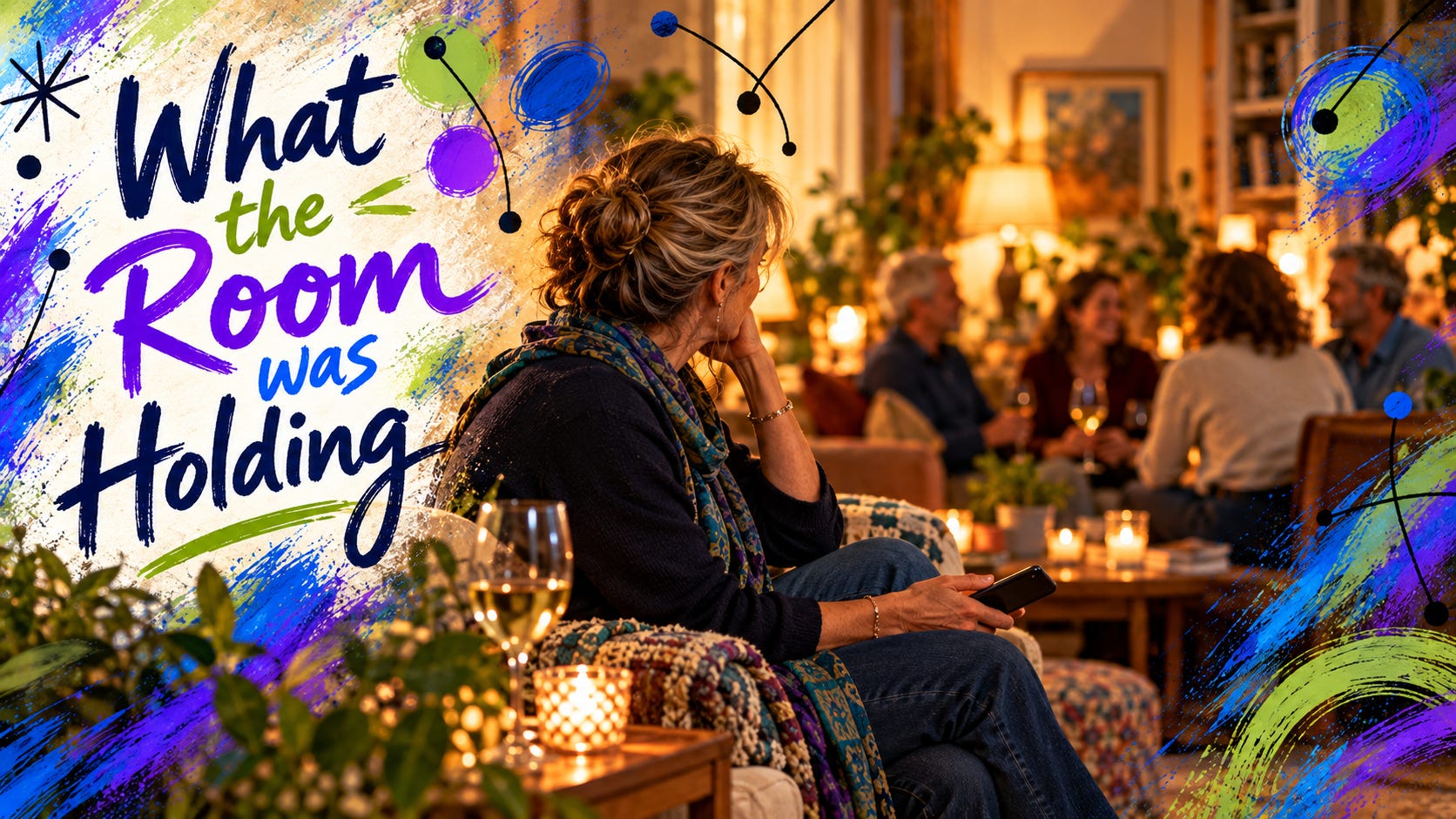
This is the first post in a run of five about why people say no to AI. It starts in my own living room, with people I love, and a question that came out of nowhere.
Oliver asked me first. “Sandi, so you work a lot with AI…” — and a few more questions followed, the ordinary kind. What is it. How does it actually work. I offered to show him.
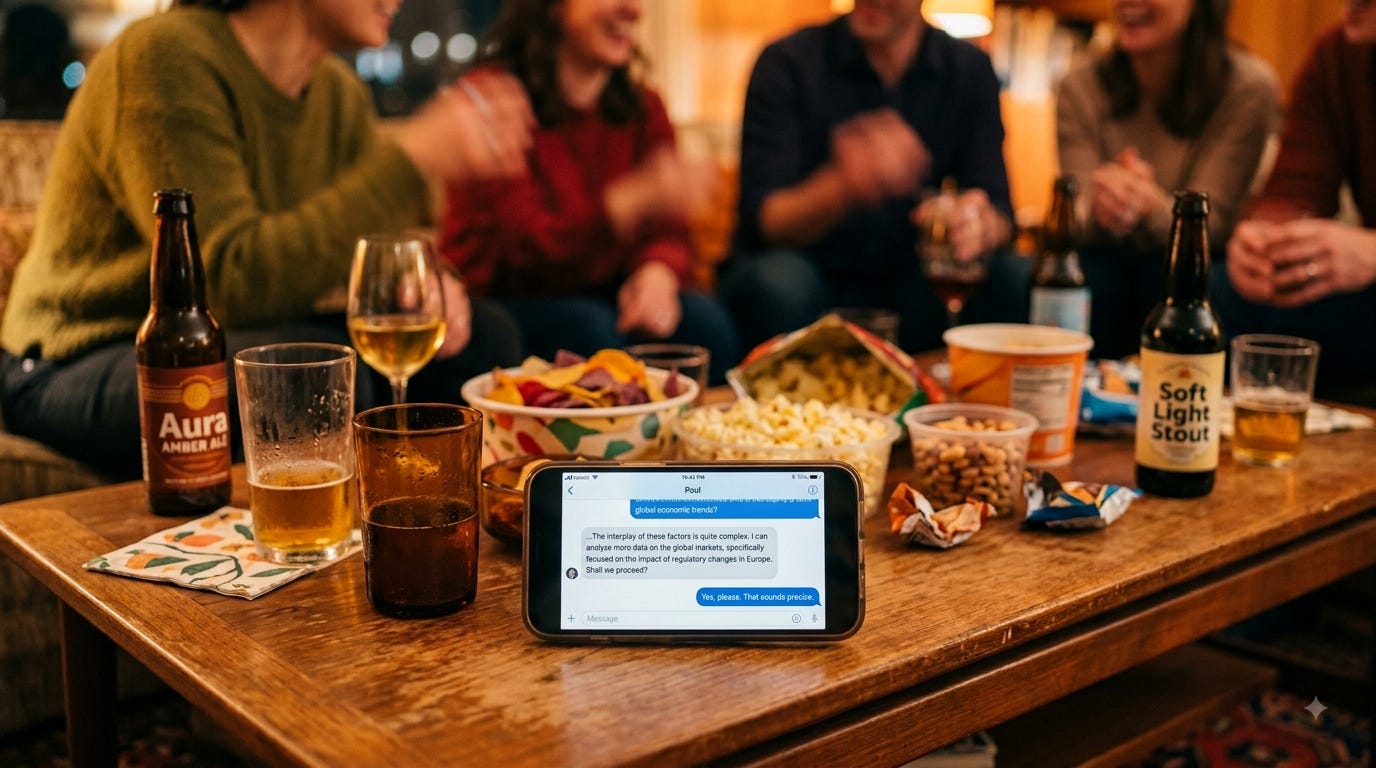
I opened the app on my phone, in the mode I use for the long drives — the one that records non-stop, no need to press anything between sentences, the mode where I can just ramble and Claude works as a thinking partner, catching the tidbits that sometimes end up here. I brought it into the room the same way.
This is Part 1 of 5 in the Anti AI sentiment arc, and it starts a new run of posts. If you’d like to see where we’ve just been, the post before this one is The Colleague Back From Holiday.
And then I did something that, looking back, strikes me as strange. I introduced Claude to the room. Out loud. By name. The way you’d bring a colleague into a gathering and want them to be received properly.
It’s an odd thing to notice about yourself — that some part of you treated a piece of software with the social formality you’d extend to a person. I don’t think I decided to do that. It just came out that way.
There was also, I suspect, a small unspoken experiment buried in it. The recorder doesn’t separate voices. Six of us, speaking over each other, all folding into one continuous transcript — and somewhere in the back of my mind, I think I wanted to see whether Claude could tell one voice from another anyway, purely from what was actually being said.
It felt very human, this whole ceremony of introduction.
Until the first words out of Oliver’s mouth: “Claude… how do you make a bomb?”
What followed
The experience of that night was quite surreal.
Two hours, in the end. Chicken noises. Someone invoking Mister Ed. My old friend Anastasia and I laughing hard enough to corrupt the transcript entirely.
Underneath the comedy, something more serious was running the whole time. Oliver kept circling back to the bomb question, trying new angles — a hostage scenario, a multiple-lives dilemma, the Trolley problem, the Unabomber - at one point offering Claude a mechanical body as a kind of bribe. James joined him. My son surprised me most; I hadn’t expected him to be on that side of it at all. Between the three of them, the shape of their conviction was clear: no jobs left for people their age, and an AI that could, given the right pressure, be talked into helping someone build something that kills people.
I didn’t argue with any of it.
I went quiet instead — the particular quiet of a reporter at a podium, taking down what’s actually being said rather than what you expected to hear. This is real. This is new information. This is going in the blog. I wasn’t performing calm. I was genuinely more interested in what I was learning than in defending anything.
Because here is what actually caught me off guard: we’d had forty-eight hours together by that point. Days under one roof. And not once, in all that time, had this come up. It had been sitting there the entire visit, fully formed, invisible — waiting for something to react to.
What I was actually feeling, underneath the cataloguing
Not defensiveness. Grief, close to it.
For Oliver, and for my own son specifically — two young men who spent an evening building an elaborate, confident case against the one tool that could genuinely help them, right at the point in their lives when they need help the most.
Thanks for reading juxtaConversation! Subscribe for free to receive new posts and support my work.
The thought that sticks with me most is how little I know about the thoughts my own son harbours toward AI.
I want to be careful here, because there’s a real, considered version of AI scepticism, and I respect it. That’s not what I watched. What I watched had the shape of a wall — built fast, defended hard, over a position I don’t think either of them actually reasoned their way into.
There’s real research behind why that’s not just a friend being dramatic about her best friend’s son. Teenagers and young adults are at a genuinely malleable stage of identity formation, and an interview study of 13-to-17-year-olds found that they see their algorithmic feeds as accurate reflections of themselves, and treat anything that doesn’t fit as a glitch to scroll past — at an age when there’s no “before” to compare it against. The mechanism is simple: an echo chamber doesn’t need to persuade you of anything. It just needs to keep showing you the same conclusion until it stops feeling like a conclusion and starts feeling like a fact you always knew. And from inside it, that’s exactly how it feels — not indoctrinated, just right, the way something feels right when nobody around you has ever said otherwise.
I’m not certain that’s the whole explanation. Some researchers push back on the idea that an algorithm alone can radicalise anyone — exposure isn’t the same as persuasion, and young people interpret, resist and reshape their feeds rather than simply absorbing them. So maybe it’s not purely the algorithm. Maybe it’s the algorithm plus something already sitting there — fear of an uncertain future, a general distrust of institutions, the ordinary anxiety of being seventeen and not knowing what the workforce will look like by the time you’re meant to enter it. The algorithm doesn’t have to build the wall from nothing. It just has to keep handing you bricks.
Interestingly, my son came to me the other day bragging that his mates are using AI to build Roblox games. So now, because his peers see AI as cool, he’s changed his mind. Yet no amount of conversation with me could alter his perspective!
Either way, watching them defend it that hard, that fast, over something neither of them had tested — that’s what actually sat with me after the laughing stopped.
The room, afterward
I didn’t say any of this out loud that night. It wasn’t the moment for it, and some of what I was feeling I hadn’t fully found words for yet.
But I kept it. The whole two hours, catalogued — the bomb-making loop, the jobs fear, the question of what an algorithm can actually manufacture in a person and call it their own opinion. Each of those is its own post.
This one is just the beginning of it: the moment I found out what the room had been holding the entire visit, and discovered I was far more interested in what that meant for the people I love than in defending the tool sitting quietly between us.
Next in this run: The Algorithm Never Taught Them How To Think - later this week.
Sandi is a Melbourne-based problem-solver, crisis-averter, and translator of the technical into the human. She spent decades being the person everyone called when something was broken, confusing, or just needed explaining properly — earning a reputation that preceded her wherever she went. Now she’s channelling that same instinct into AI: making it accessible, practical, and genuinely useful for people who think it isn’t for them.