

I was in the middle of a conversation with Claude when I noticed something odd.
Tucked into the visible thinking before the response — the scratchpad where the AI works things out before it speaks — was a word I didn’t recognise. Not a made-up word. Not a hallucination. A real word, clearly doing real work. Just not a word I’d ever had occasion to encounter.
sed.
I did what any reasonable person does when they see something unfamiliar in a context that’s supposed to make sense. I got quizzical.
It turns out sed is a command-line text processing tool. Unremarkable, by the standards of software. Except for one detail: it has been running quietly in the background of computers everywhere since 1974. Over fifty years. Completely unbothered by the passage of time, the rise of the internet, the invention of the smartphone, and the arrival of large language models. Just finding text, replacing it, and getting on with its day.
And right there, in the middle of asking “what on earth is that word,” I found myself looking at the whole argument from a completely different angle.
Because here is the thing that the fear of AI quietly glosses over:
We’ve been living with artificial intelligence for fifty years. And for almost all of that time, we were completely unbothered by it.
The spell-checker that’s been catching your typos since the 1980s? That’s AI. The autocomplete that finishes your sentences in Google? AI, since 2004. Netflix knowing you’d love that documentary before you’d heard of it? AI. Your bank flagging a suspicious transaction before you noticed it yourself? AI. The GPS rerouting you around the traffic jam in real time? AI. The spam filter quietly intercepting two hundred pieces of rubbish every week so you never have to see them?
AI. All of it. For decades.
We used these things without drama. Without protest. Without a single LinkedIn post about the existential implications. They slipped into our lives and made things easier and we got on with our day, much like *sed*.
The technology we’re now treating as a civilisation-threatening force didn’t arrive last Tuesday. It’s been here the whole time. We just didn’t know what to call it.
And then it got a name. A proper, capitalised, headline-friendly name. Artificial Intelligence. And suddenly the thing that had been running quietly in the background of everything we touched became the subject of parliamentary inquiries, opinion columns, and very concerned dinner party conversations.
The robot vacuum incident
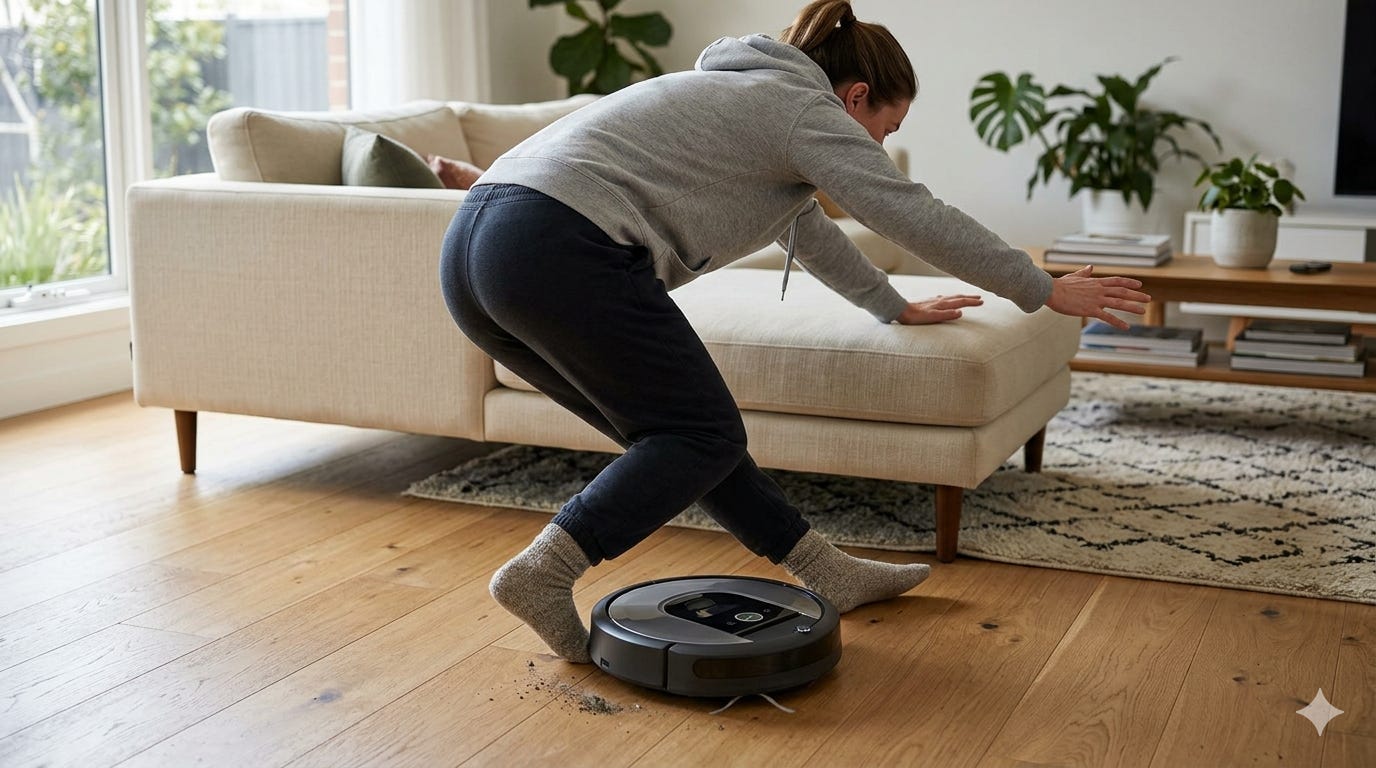
A month ago I visited a friend who owns a robot vacuum. I’d heard of them, of course — I’m not completely out of touch — but I’d never actually seen one operating in the wild. It came zooming out from somewhere, swooshed purposefully up and down the room, navigated around the cat bowls without a second thought, and made a beeline directly for my feet.
I will admit I was a complete silly little girl about it. All “eek” and “oh my” and backing away from a machine the size of a dinner plate.
My friend thought this was hilarious.
What I didn’t say — what I only realised later — was that the thing terrorising my ankles was running on artificial intelligence. It always was. I just never called it that, and so it never frightened me.
The irony of being unbothered by AI for years and then squealing at a robot vacuum is not lost on me.
So what’s actually different now
Honestly? It talks back.
For all those decades, AI was invisible. It worked in the background, beneath interfaces, underneath the things we used. It made our tools smarter without making itself known. And because it was quiet — because it didn’t have a face or a voice or a tendency to ask clarifying questions — we never had to decide how we felt about it.
Now it has a face. It answers questions, writes sentences, holds conversations, and occasionally makes jokes that are funnier than they have any right to be. Now it’s visible. And visible things get opinions formed about them.
Some of those opinions are “this is going to destroy everything.” Some are “this is going to save everything.” And a surprising number are “I tried it once, got something useless back, and decided it wasn’t for me.”
All three miss the point.
What the archaeological dig turned up
The truth is considerably less dramatic, and considerably more useful.
This is a tool. A remarkable one — more capable, more flexible, more conversational than anything that came before it. But a tool nonetheless. And like every tool that’s come before it — the spell-checker, the GPS, the robot vacuum, the fifty-year-old command-line utility doing its quiet work in the background — it does what you ask of it, within the limits of what it knows, and it gets better the more clearly you communicate what you need.
What’s actually new isn’t the technology. It’s the access. For the first time, the intelligence that used to live deep inside systems and servers and algorithms is sitting right there in your pocket, available to anyone with a question and a few minutes to ask it well.
The archaeological dig, if you’ll forgive the metaphor, has finally broken through to the good layer. The one where ordinary people get to use the tools that used to be reserved for specialists. We’re not discovering something new. We’re brushing the dirt off something that’s been here all along and finally being introduced properly.
Your robot vacuum didn’t replace you.
It just stopped you having to vacuum as often.
This is the same principle, applied to thinking.
The spell-checker didn’t make you a worse writer. It caught the typos so you could focus on the words that mattered. And this — whatever you want to call it, AI, Claude, the thing everyone’s talking about — isn’t here to replace you either. It’s here to catch the things you’d otherwise have to carry alone.
The word that started all of this
I went back and looked up sed properly, as one does when a fifty-year-old Unix utility sends you down a philosophical rabbit hole at eleven o’clock on a Tuesday night.

Stream editor, it turns out. Reads text. Transforms it. Outputs the result. Has been doing this, reliably and without complaint, since Gerald Weinberg and Lee McMahon wrote it at Bell Labs in 1974. It does not know about the AI debate. It does not have opinions about Terminator 2. It has never read a LinkedIn post about the future of work.
It just does its job. Quietly. In the background. The way AI has always done its job, right up until the moment we started calling it by its name.
We’ve been here before. We just didn’t notice we’d arrived.
The thing you’ve been putting off isn’t what you think it is. It’s not an evil robot. It’s not a threat. It’s not something that requires a technical background or a leap of faith you’re not ready to make.
It’s just the next step. And the next step, as it turns out, is one you’ve been taking for fifty years.
Sandi is a Melbourne-based problem-solver, crisis-averter, and translator of the technical into the human. She spent decades being the person everyone called when something was broken, confusing, or just needed explaining properly — earning a reputation that preceded her wherever she went. Now she’s channelling that same instinct into AI: making it accessible, practical, and genuinely useful for people who think it isn’t for them.