

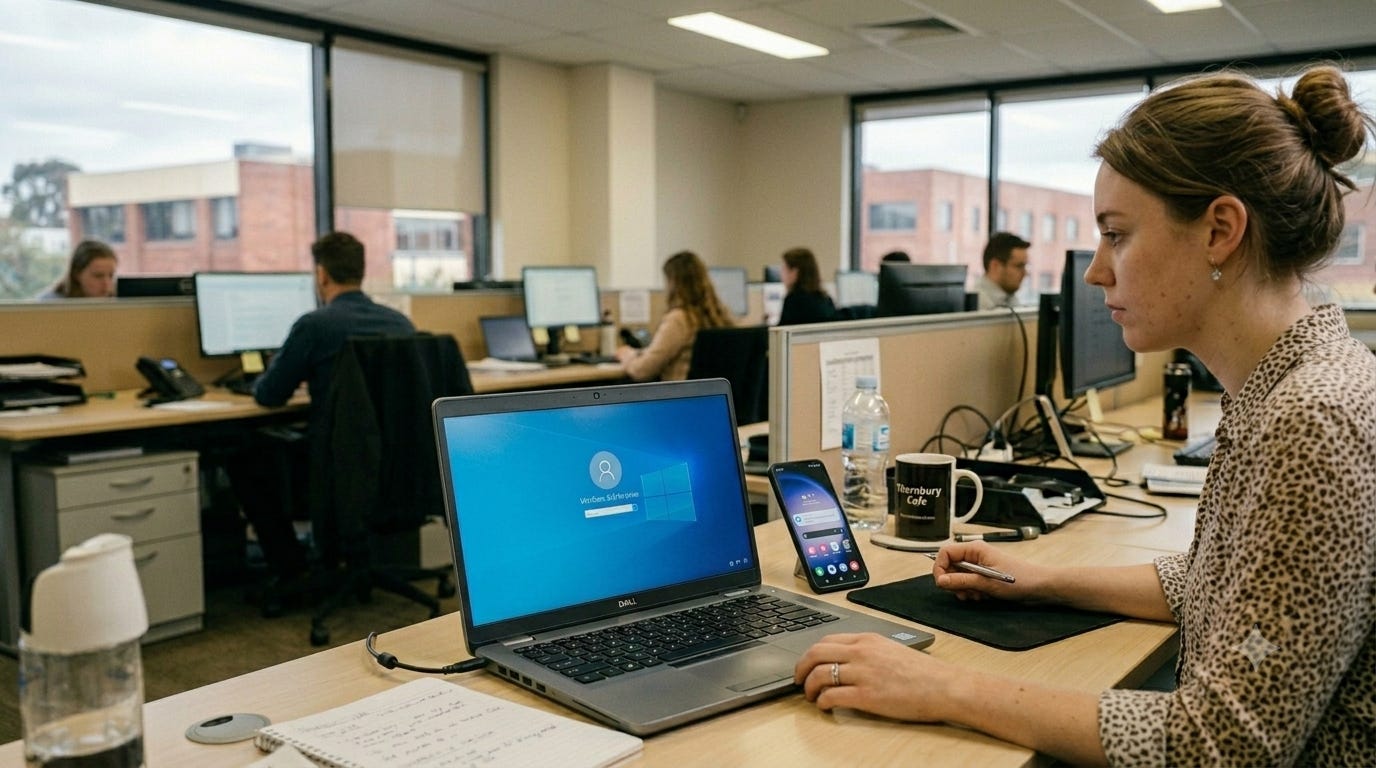
It came through on a WhatsApp group chat, the way these things do now.
One of my ex‑staff, mid‑conversation, said the line I’ve heard a dozen versions of:
“AI hasn’t reached us yet.”
Not in Operations, anyway. They knew it was happening somewhere — the shop floor, maybe, or the Call Centre, definitely Sales and Marketing — but it hadn’t arrived where they sat. They were waiting for it to.
And the moment I read it, something in me tightened.
A sense of déjà vu.
A flicker of irritation.
Not at him — never at him — but at the fact that the team who could benefit the most from AI were the ones who’d been left out of the conversation entirely.
And a bigger irritation, the kind that sits low in the chest:
they could help themselves.
They could pick up their phones and start using it today.
They didn’t need a rollout.
They didn’t need a licence.
They didn’t need permission.
But they were waiting for it anyway.
And in the recesses of my brain, a tiny idea stirred:
Maybe there’s an opportunity here. Maybe I can help them.
The wait that used to make sense
There was a time when waiting was the right call.
In our workplace — when I was still there — my team lived twelve weeks ahead of the calendar. We were working on October’s output when it was actually July. It had a strange effect on all of us. Disorienting. Dislocating. Like living in a timezone nobody else recognised.
And for me, it was worse.
Because at the time, I was addicted to Garden Answer — a gardener in Ontario, Oregon USA, appearing on my TV every night, in a climate six months out of sync with mine. So I was living twelve weeks ahead at work and six months behind at home. I didn’t know what day, week, month, or season I was in. We had to recenter our internal calendars constantly. In July, it felt like Christmas was three months away.
But here’s the real point:
we weren’t the ones waiting.
Everyone else was waiting on us.
Waiting for us to write the specs.
Waiting for us to finish the analysis.
Waiting for us to hand over the documents so the developers could build the software.
The waiting was crushing.
The waiting was structural.
The waiting made sense.
And that instinct — the one that says “I can’t start until someone gives me the tool” — is still running.
It’s just running in a world that changed underneath it.

What I did that same afternoon
I didn’t say any of this in the WhatsApp chat.
What I did instead was move from my desk — where the sunlight was streaming in so brightly behind me that it washed out my laptop screen — to the couch, where I could actually see what I was doing.
I’d spent the last two days churning out three apps and feeling quietly impressed with myself.
I’m pretty good at this, I thought.
I wonder what I can remember of the work I used to do 18 months ago.
I hadn’t thought about Business Analysis in ages.
Once, in a team chat, someone used an acronym for the database I’d invented in 1998 — the name of the database I’d built — and I couldn’t even remember what it stood for. That’s how far away that world felt.
But the idea had always been within me:
a tool that could quiz our clients and turn their answers into a specification.
The guts of the job.
The 80% of the day that nobody enjoyed.
I’d wanted the company to fund it for years.
They never did.
So I opened a blank screen.
I fed Claude the questions I remembered, the structure of the spec, the logic of the workflow.
And in an hour — an hour — it built the tool.
I was agog.
Astonished at how much I still remembered.
Astonished at how quickly it came together.
Astonished that the thing I’d wanted budget for — the thing that would have saved my team hundreds of hours — was suddenly sitting in front of me, fully functional.
A few refinements and it could be perfect for them.
My ex‑staff.
My team.
Imagine if I were still there.
And then the uncomfortable thought arrived — the one I’ll write about properly another time:
if 80% of their day could be automated, that would put them in the crosshairs for the next round of redundancies.
I couldn’t do that to them.
Not yet.
Not like that.
The objection that’s actually fair
I can hear the reply already, because I know the people who’d give it:
“We can’t install anything on our work computers.”
“We can’t send anything off the premises.”
“Everything’s locked down.”
And they’re right.
That’s not an excuse dressed up as a barrier.
That’s a real barrier.
Their IT environment is locked down so tightly that nothing gets in or out without Big Brother seeing it. No software can be installed. All emails are scanned. It’s a fortress.
And I know exactly what would happen if I handed them an AI tool:
they’d reject it immediately.
Not because they didn’t want it.
But because they’d assume the fence was impenetrable.
So let me be precise about what I’m actually saying.
The permission you do have
If you’re in that environment, the tool you’ve been given is, maybe Copilot. If you’re very lucky, you’ve got ChatGPT or Claude as your company’s pre-installed LLM.
And the honest problem isn’t that AI hasn’t reached you.
It’s that you’ve been handed something and nobody taught you how to use it well.
Copilot loses context fast.
It rambles unless you manage it.
It gets confused if you stack five tasks into one message.
But if you give it:
short, specific instructions
one task at a time
a fresh conversation when it starts circling
…it becomes useful.
Not magical.
Not perfect.
But useful.
It’s a smaller permission than “go build whatever you want.”
But it’s real.
And it’s available to you today.
For everyone else — the people with a phone in their pocket and no IT department watching what they install — the bigger permission really is sitting there unused.
But if you’re the person who genuinely can’t get past the locked‑down environment:
the fence is real.
What’s also real is that you’ve still got more room inside it than you’ve been using.
The worker I’m writing to
I’m writing to the person who’s brilliant at their job but cautious.
The one who waits for the calendar invite.
The one who assumes someone else will tell them when it’s time to begin.
The one who has spent a career being responsible, reliable, and respectful of process.
The one who doesn’t realise the process changed without telling them.
The moment I stopped waiting
His message — “AI hasn’t reached us yet” — made me want to be back at work for a moment.
Not for the job.
For the team.
To implement something.
To enforce it.
To give them the tool they’d never go looking for.
Because my whole career worked like this:
if I didn’t build it, it didn’t exist.
The systems, the templates, the databases, the procedures — they all had my name in the Author column. I invented the tools I needed because nobody ever handed them to me.
And that’s when I realised:
I stopped waiting years ago.
Not because I was brave.
But because I had no choice.
The permission was never going to come from above.
It had to come from me.
And now — in this new world — it has to come from you.
Sandi is a Melbourne‑based problem‑solver, crisis‑averter, and translator of the technical into the human. She spent decades being the person everyone called when something was broken, confusing, or just needed explaining properly — earning a reputation that preceded her wherever she went. Now she’s channelling that same instinct into AI: making it accessible, practical, and genuinely useful for people who think it isn’t for them.