


I knew.
That’s the thing I want to tell you first, before I tell you about the failures and the false starts and the projects that went nowhere. I knew. Not what I was going to build. Not what AI was going to do for me specifically, or how, or when. But I knew — with the particular, maddening, unshakeable certainty of someone who has been watching something for a long time — that there was something in it for me.
I just couldn’t find it.
You might know this feeling.
It’s not the feeling of someone who doesn’t get it. It’s almost worse than that. The person who doesn’t get it has a simple problem — they need to be shown something that works. Your problem is more complicated. You’ve already seen enough to be convinced. You’ve read the articles, watched the demos, nodded along to the use cases. You understand, in principle, what this technology can do. You believe, somewhere in the back of your mind, that it can do something for you.
You just can’t see what it is yet.
And that gap — between the certainty and the clarity — is its own particular kind of anguish.
Peter Diamandis is one of those people who talks about the future with the particular conviction of someone who has spent decades making it happen. He runs Moonshots, a podcast about thinking big — about using exponential technology to solve problems at scale, about the possibility that ordinary people with the right tools can build things that would have been impossible a decade ago. One of his recurring themes is this: everyone should become an entrepreneur. Not as a lifestyle brand. Not as a hustle culture prescription. As a genuine belief that the moment for it is now, and the tools are here, and the only thing standing between most people and building something is the decision to begin.
His comment sections are instructive.
Alongside the people who’ve been lit up by what he’s saying, there’s always another group. People who watched the whole thing — ninety minutes, a hundred and twenty, right to the end — and still came away unconvinced that it applied to them. Not hostile. Not dismissive. Thoughtful, often. Articulate. People who engaged seriously with the ideas and still couldn’t find the bridge between what he was describing and anything that felt possible in their own lives. I don’t have any ideas. I wouldn’t know where to start. That’s fine for some people but I’m not that kind of person. I’m worried about my livelihood, not my moonshot.
These are not people who rejected the message. They received it. They just couldn’t find themselves in it.
I recognise them. I was one of them, in my own way, for longer than I’d like to admit.
Because here’s the thing about the gap between certainty and clarity: it doesn’t feel productive. It feels like being stuck. It feels like watching everyone else find their thing while you circle the same territory, picking things up and putting them down, starting projects with genuine enthusiasm and abandoning them with genuine embarrassment. It feels like evidence that maybe you were wrong about yourself — that the thing you were so sure was possible for you is actually, quietly, not.
That feeling is lying to you.
I spent months in that gap.
Not passively. Not waiting for inspiration to arrive. I was trying things — launching things, building things, abandoning things with the particular sheepishness of someone who had been very confident about them three weeks earlier. MemoryViz on Copilot, which had a good name and a plausible premise and quietly fell apart when the technology couldn’t do what I needed it to do. GardenDesignr on Replit, which taught me something about what I didn’t want to build. WholeCity on Base44, which went somewhere genuinely unexpected before it went nowhere at all.
None of them were the thing.
And after each one, the same cycle: the deflation, the brief wondering whether I’d been wrong about the whole enterprise, and then — always, stubbornly, unreasonably — the return of the certainty. There’s something here. I haven’t found it yet. I need to try something else.
I want to be honest about what that period felt like, because I don’t think it gets talked about enough.
There’s a version of the AI origin story that goes: I had a problem, I found a tool, it worked, here’s my workflow. Clean. Efficient. Slightly tedious to read. That’s not this story.
This story is messier. It’s the story of someone who was convinced before she was competent, who kept starting things without knowing where they were going, who accumulated failed experiments like a person who buys running shoes every January — always genuinely intending to run, always slightly surprised when she doesn’t. It’s the story of the wandering that happens before the destination reveals itself. And I’m telling it because I suspect you might be in it right now, and I want you to know that the wandering is not the problem.
The wandering is the work.
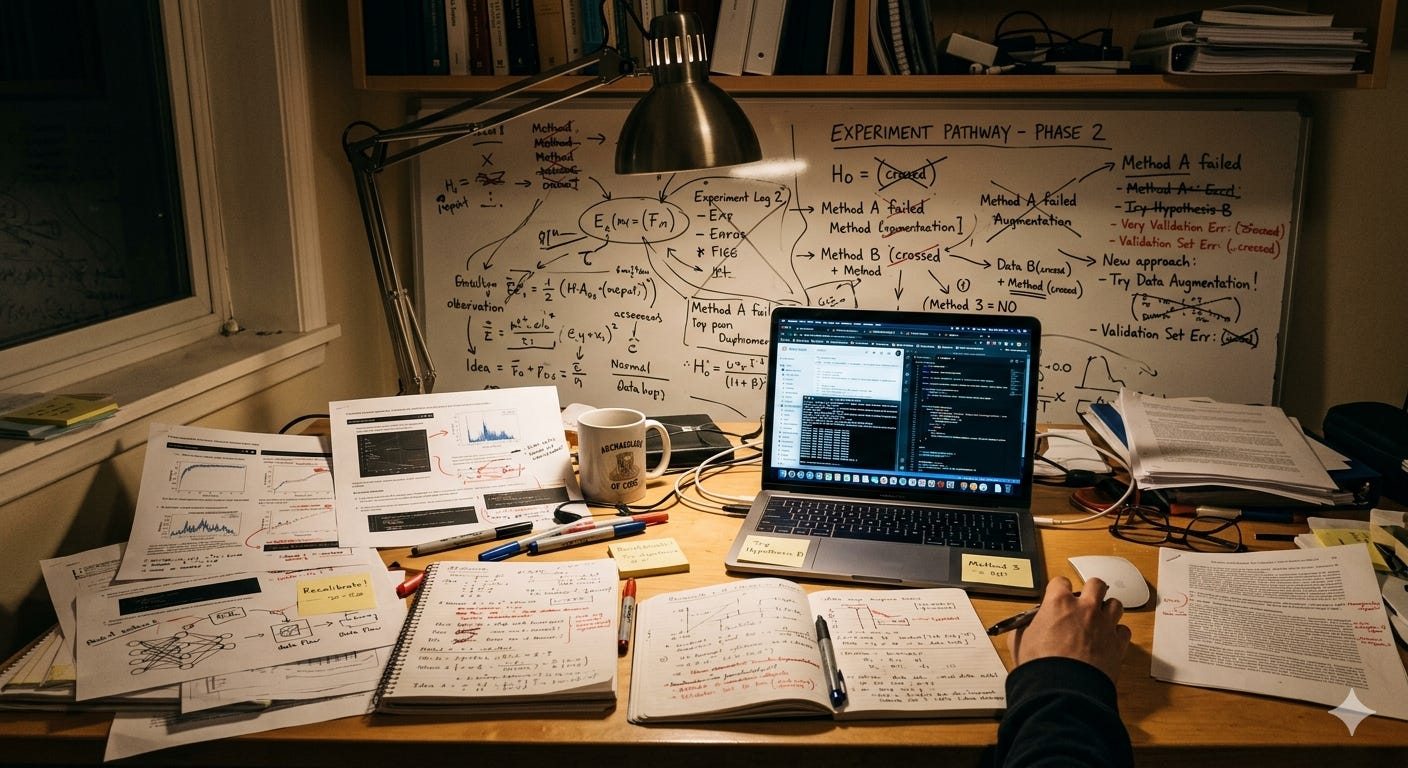
Here’s what I know now, looking back at those months of unglamorous, unstrategic, completely necessary experimentation: I wasn’t failing to find the thing. I was becoming the person who could recognise it when it arrived.
Every project that didn’t work taught me something about what I actually needed. Every false start narrowed the field. Every abandoned experiment left a deposit — a small, specific piece of knowledge about what I wanted to build, what I was capable of building, what kind of problems actually interested me enough to solve. I didn’t know I was collecting those deposits. I thought I was just failing, repeatedly, with enthusiasm.
But the deposits were real.
And to the person in Peter’s comment section — the one who watched the whole thing and still couldn’t find themselves in it — I want to say this directly, and I want to say it warmly, because I am not here to shame anyone for where they are:
The ideas don’t arrive before the trying. They arrive because of it.
You don’t need to know what you’re building toward before you start. You need to start in order to find out. Pick something that interests you, even vaguely. Build something small, even badly. Ask AI to help you with something, even if you’re not sure it’s the right something. Notice what feels interesting and what feels like a chore. Notice what makes you want to keep going and what makes you want to close the laptop.
You are not wasting time. You are doing the work that comes before the work.
The right idea is already somewhere in you. You just haven’t wandered close enough to recognise it yet.
The deposits were real for me too.
Because when the right idea finally showed up — in a kitchen, with a pantry full of ingredients and the eternal question of what to make with what was already there — I recognised it immediately. Not because it was obvious. Because I had done enough wandering to know what I was looking at.
That’s the story I’m going to tell you next.