

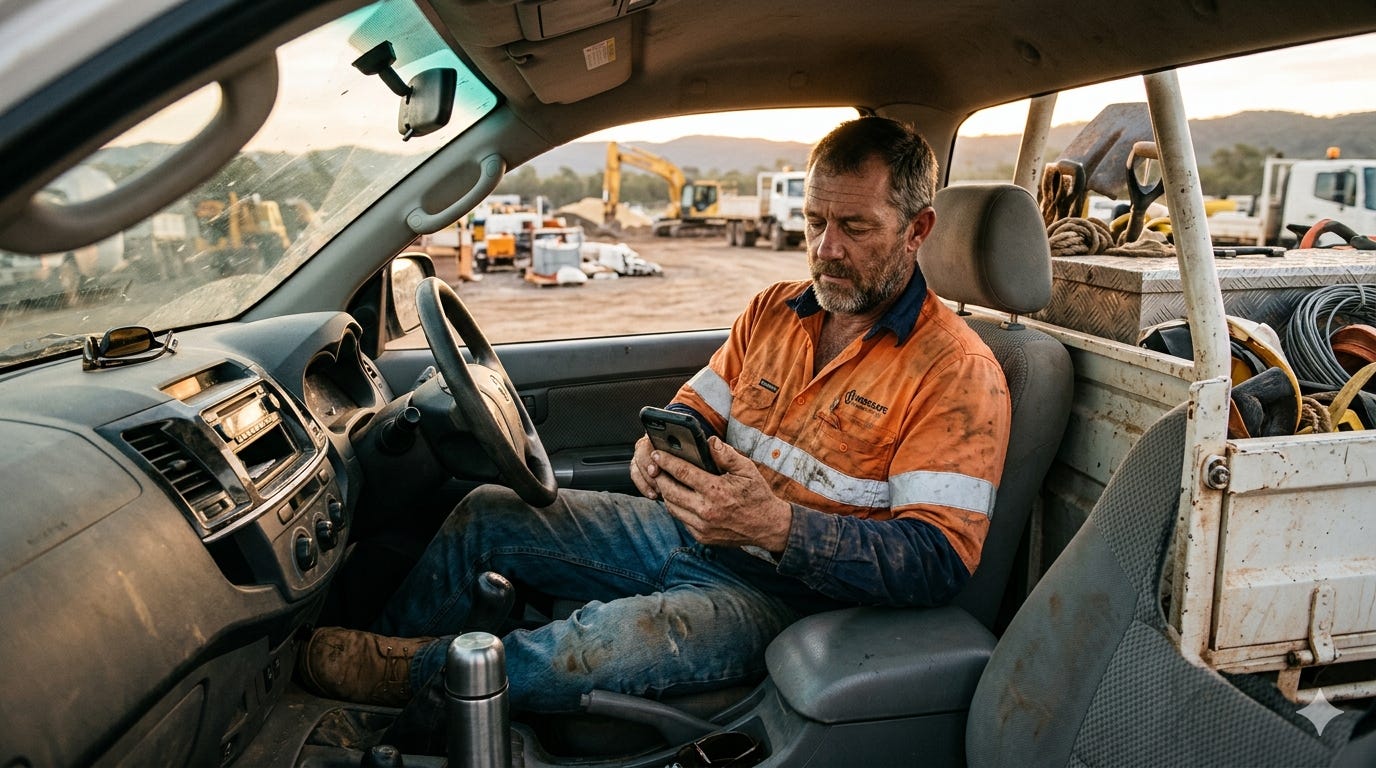
A few years ago I hired a man to fix some things around the house.
He arrived punctually. He was methodical, careful, and paid attention to detail in a way that most tradies don’t. He measured twice. He considered things. He approached each task with the particular precision of someone who understood structures from the inside out.
What he didn’t have yet was the muscle memory. The shortcuts that come from years of doing the same thing until the hands know before the brain does. The confidence that lets a good carpenter look at a corner and just know.
He and his wife had arrived from India not long before. In Chennai, they had both been architects. Trained, qualified, practiced. Here, urgently needing work, they had taken what was available. He had become a carpenter. She helped where she could.
I paid for him to learn.
I don’t say that unkindly. I say it because it’s true, and because understanding it took me longer than it should have. The stairs into my outdoor deck went up slowly and methodically and with the attention to detail of someone who understood load-bearing structures in theory and was working out the practice in real time. In my backyard. On my dollar.
I didn’t get what I paid for. Neither did he get much of an education — trying to learn by himself, without the right resource at the right moment, without anyone to show him which corner to cut first.
The wall
The hardest part wasn’t the stairs in the deck.
It was the wall. The wall that opened up to reveal a cupboard under the stairs inside the house.
He removed it. That part went fine — walls, it turns out, come down more easily than they go up. What was left was an unfinished opening that sat there for eighteen months while I decided I wasn’t willing to pay any more of my hard-earned money for the education of a man who, through no fault of his own, hadn’t yet learned the trade I’d hired him for.
Eighteen months.
The wall didn’t get finished because the communication broke down somewhere before the wall came down. I had spoken my requirements. He had interpreted them. Somewhere between my words and his understanding, a gap opened up that neither of us had the tool to close.
A mood board would have done it. A simple visual — here is what I am imagining, here is the finished thing I am paying for — would have taken ten minutes and saved nine months of an unfinished opening and a relationship that ended in mutual frustration rather than mutual satisfaction.
I could have made that mood board. He could have made that mood board. Neither of us thought of it, or knew how, or had the tool sitting ready in our pocket.
We do now.
What AI could have done
When my architect turned carpenter was standing in front of my deck, about to cut the first corner of the stairs, not quite sure of the sequence — AI could have found him the right YouTube video. Not a general carpentry tutorial. The specific one, for the specific problem, at the specific moment he needed it. The foreman he didn’t have, available on demand, in his pocket.
When I was trying to explain what I wanted from the wall — AI could have helped me build a mood board in ten minutes. Images, dimensions, finishes, the feeling of the finished space. Something we could both look at and agree on before anything came down.
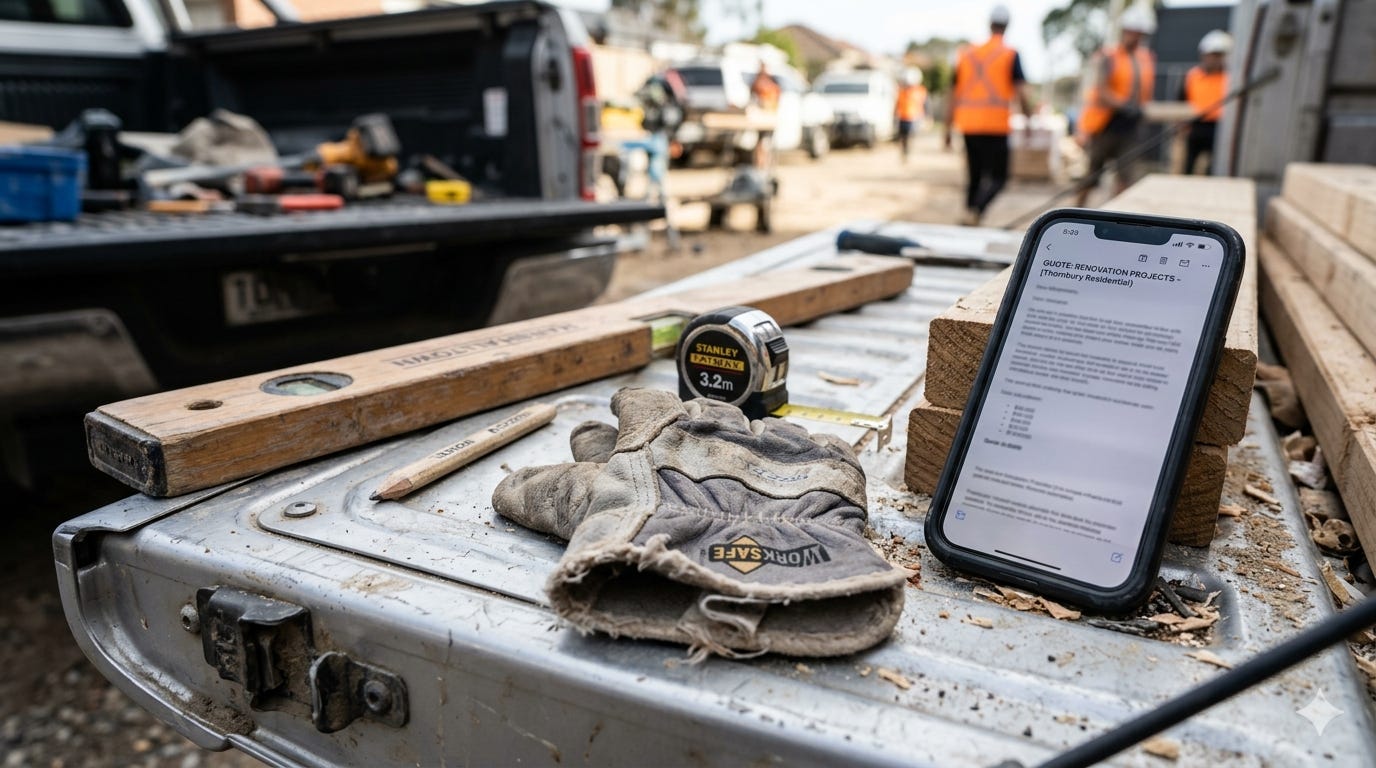
And when he got home at the end of a long day of slow, methodical, confidence-building work — AI could have written the quote. Answered the email. Sent the invoice. Followed up the appointment he’d forgotten to confirm. Done the ten administrative things that kept him from spending that hour watching the tutorial that would have taught him the corner he was going to need to cut tomorrow.
He was an architect. He had the eye, the precision, the structural understanding. What he didn’t have was the trade knowledge, the business systems, or the tool that could have bridged both gaps while he was building the skills to close them himself.
The business nobody signed up for
Here’s the thing about running a trade that nobody tells you when you start.
The work is the part you’re good at. The business is the part that will quietly eat you alive if you let it.
The quotes that take too long to write because you’re not sure of the format. The invoices that go out late because by the time you’ve finished the job you’re too tired to sit down and do the paperwork. The client email that needs to sound professional when what you really want to do is get back to the thing you’re actually good at.
Every tradie is also a small business owner. Nobody asked them if they wanted that second job. It came with the first one, quietly, and it has been taking up hours ever since.
AI doesn’t make him a businessman. It handles the parts of the business that have been quietly costing him time and money and energy — so he can get back to the work. The actual work. The thing he came here to do.
My architect-turned-carpenter didn’t fail because he lacked intelligence or commitment or care. He had all three in abundance. He was a man in transition, doing his best with what he had, in a country that hadn’t yet given him the tools to do it faster or better or with more confidence.
I wish I’d known then what I know now.
Not about carpentry.
About what was sitting in both our pockets, waiting to be useful.
Sandi is a Melbourne-based problem-solver, crisis-averter, and translator of the technical into the human. She spent decades being the person everyone called when something was broken, confusing, or just needed explaining properly — earning a reputation that preceded her wherever she went. Now she’s channelling that same instinct into AI: making it accessible, practical, and genuinely useful for people who think it isn’t for them.