


Something happens in a good conversation that doesn’t happen anywhere else.
You say something you didn’t know you thought. A sentence arrives fully formed from somewhere you weren’t expecting, and you sit with it for a moment before you even register that you were the one who said it. It’s the right words in the right order, and it surprises you, and then it’s gone — absorbed into the flow of the exchange, moving on before you’ve had a chance to hold it up to the light.
Most conversations work this way. The best parts evaporate.
This one is about not letting them.
The version of you that only shows up sometimes
There’s a version of you that exists in good conversations and almost nowhere else.
She’s less managed than the everyday version. Less careful. She makes unexpected connections and follows them without asking permission. She says the true thing before the edited thing. She’s funnier, or more vulnerable, or more certain, or more confused - but more present, in any case, than the version that moves through ordinary days on autopilot.
You’ve met her. In a conversation with a friend that went somewhere neither of you planned. In a journal entry written at an hour when the defences were down. In a meeting where something important needed saying and you were the one who said it and you weren’t entirely sure where it came from.
She shows up. And then she disappears. And usually, nobody wrote it down.
What gets lost when you close the tab
I’ve been using AI long enough now to have had dozens of conversations that went somewhere unexpected. Sessions that started with a practical task and ended somewhere I couldn’t have predicted when I sat down. Ideas that arrived unexpectedly. Sentences that turned out to be more true than I’d realised while I was typing them.
And I’ve learned — sometimes the hard way — that the work produced in those sessions is not the most valuable thing in them.
The work can be reconstructed. A document can be rewritten, a plan can be redrawn, an idea can be revisited. But the version of me that showed up in that particular conversation, on that particular evening, thinking in that particular way — she’s not guaranteed to come back. She arrived because the conditions were right. The conversation was good. Something was flowing.
Close the tab without capturing her, and she evaporates with the context window. That’s not just a feeling — it’s roughly how memory works. New material decays fast without reinforcement, often within hours of the original moment. Whatever you don’t catch on the way out the door is, by tomorrow, mostly gone.
That’s the thing I want you to take from this post:
The minimum viable thing to rescue from any good conversation isn’t the output. It’s the person who produced it.
What she looks like when she arrives
She doesn’t announce herself. That’s the thing.
She shows up in a parenthetical - a thought you added almost as an afterthought that turned out to be the whole point. In the moment you said I have a million objections that are preventing me from doing the thing and then did the thing twelve minutes later. In the sentence that came out at 1:05 in the morning that turned out to be the spine of something much larger.
She shows up when you stop performing competence and start just talking. When you type the half-formed thing instead of waiting until it’s presentable. When you follow the thread even though you’re not sure where it leads.
She’s not always eloquent. Sometimes she’s frustrated, or mischievous, or giddy in a way that surprises even herself. Sometimes she goes off track and names it - I went off track there - and the going-off-track turns out to be the best part.
She is, in short, you - minus the editing.
What to do when she shows up
Notice her. That’s the first thing. Catch the moment when something arrives that feels more alive than the surrounding conversation. The phrase that’s better than you meant it to be. The question you asked that you didn’t know you were going to ask. The admission that came out before you’d decided to make it.
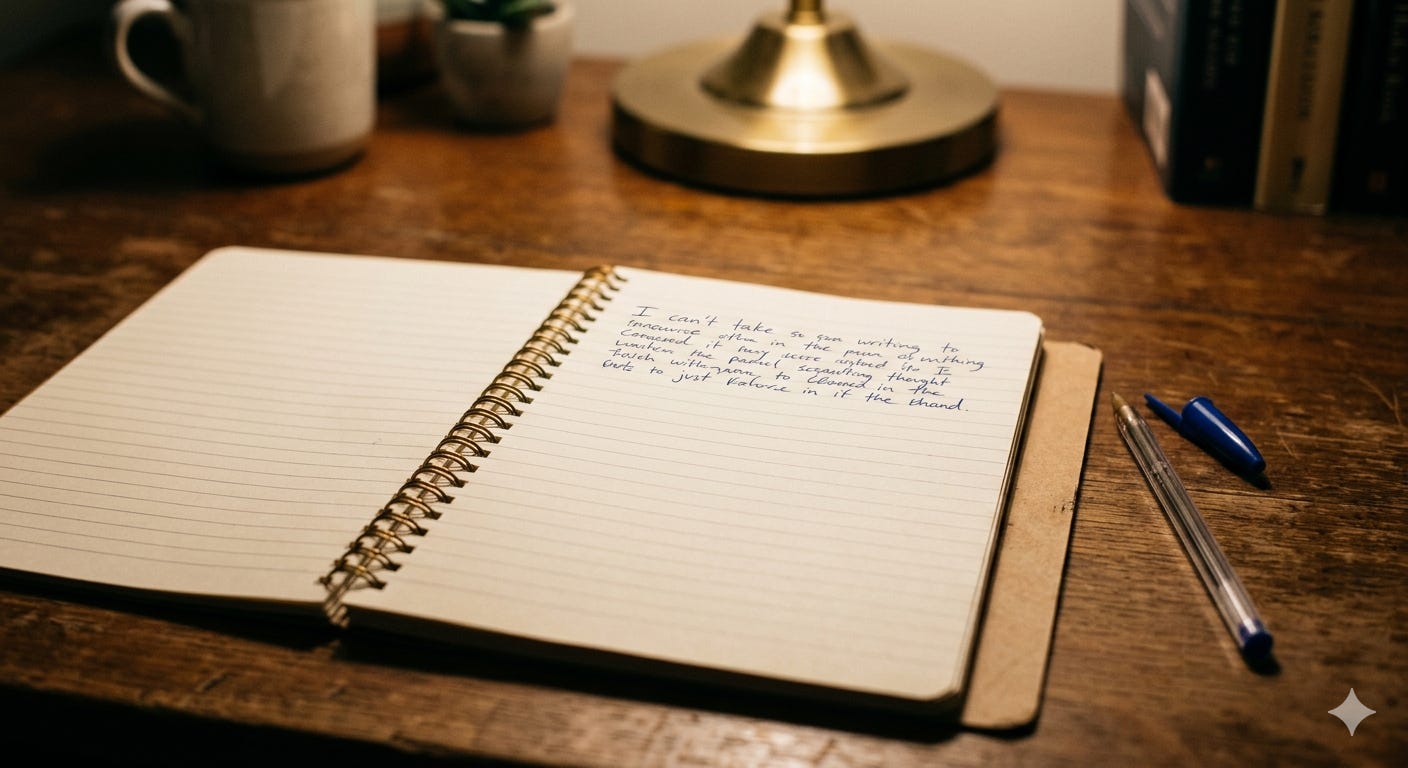
Then capture her. Not the whole conversation — just the moment. One sentence is enough to plant something. A note, a thread, a seed dropped somewhere you’ll find it again. The point isn’t to archive everything. The point is to not lose the things worth keeping.
Because here’s what I’ve come to believe after months of conversations that went somewhere unexpected:
The insights are valuable. The documents are useful. The plans, the drafts, the ideas developed and refined over long sessions — all of that matters and all of it is worth protecting.
But the person who arrived to do the work — curious, present, occasionally surprising herself — she’s worth more than any of it.
Don’t close the tab before she’s had a chance to speak.
And when she does — write it down.
Better still, ask your AI to notice it for you! When you’ve noticed those moments tend to happen more frequently than you expected, it becomes clear that the ‘you’ who has been present is worth capturing. I have a simple prompt I paste into my Claude chat after the end of a long session. It captures The Real Sandi. The one who showed up. Want to know what it says? DM me, and I’ll let you know the exact words I use. You can modify it for your own situation.
A note, some months on:
Sometimes when you get together with your bestie, the conversation flows. You speak over each other, you have an exciting moment you want to share and you don’t quite finish your sentence because he had something equally exciting to share. This happens over and over and when you have said goodbye and are going about the next part of your day, you’ll realise which stories never quite got finished. You may also feel that you were more open and authentic with your friend in that conversation. Notice that. You might have opened your heart wider than you expected. Notice that too. Think on it. Sit with it. Catch yourself in those moments of candour and authenticity. It is by examining our candid thoughts that we may reveal to ourselves the inner thoughts we’ve held as law or lore. Understanding yourself is a major contributor to self knowledge and self awareness.
Sandi is a Melbourne-based problem-solver, crisis-averter, and translator of the technical into the human. She spent decades being the person everyone called when something was broken, confusing, or just needed explaining properly — earning a reputation that preceded her wherever she went. Now she’s channelling that same instinct into AI: making it accessible, practical, and genuinely useful for people who think it isn’t for them.