


A quick orientation if you’re new here: I build small apps with Claude, and I keep a change register for every modification I make. This post is about the part of that process that looks like inefficiency and isn’t.
A quick bit of context, for anyone arriving here cold: I build small apps with Claude, and I keep a change register for them — a running record of every modification, called a CR, short for Change Request. The tool that holds it is something I built called CR Tracker. And “Yol”? That’s the name I ended up giving Claude, somewhere around the day CR Tracker itself was built, because the speed and precision of the collaboration reminded me of the one human developer I’d ever worked with who moved that fast without losing the thread.
With that out of the way — here’s the screen I fill in every time I raise one of these CRs.
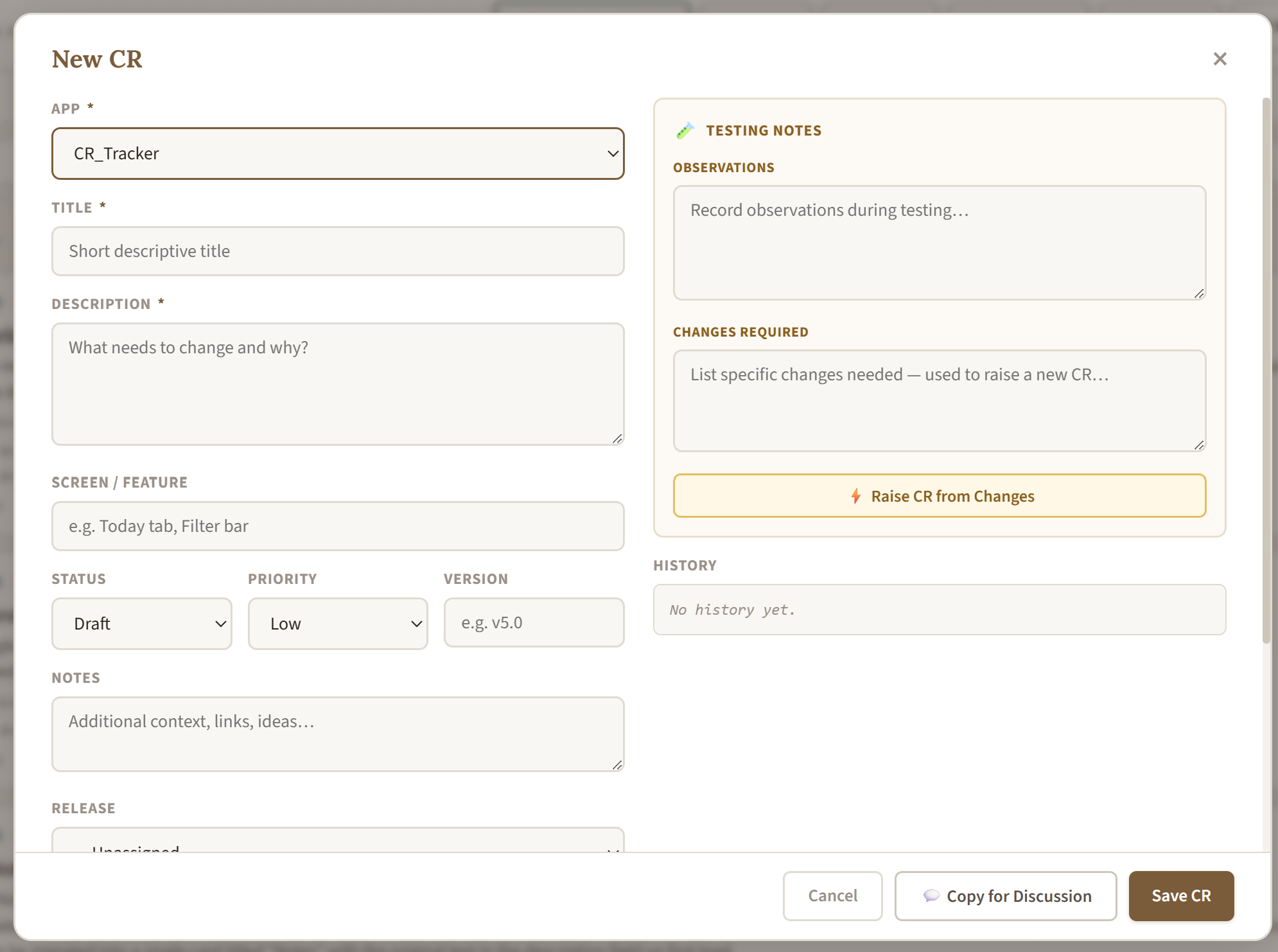
Eleven fields. App, title, description, screen or feature, status, priority, version, notes, release, discussed with Yol, Yol notes. Some are dropdowns. Some are free text. None of them populate themselves.
Yol drafts the content. I paste it in, one field at a time, cutting and reshaping the block of text as I go, making sure each field contains exactly what it’s supposed to contain and nothing it isn’t.
It takes a few minutes. It is, objectively, a manual process in a world that has automated far more complex things.
I have been asked, more than once, why I don’t just have Claude format the output to match the fields exactly. Drop it straight in. Skip the copy-paste entirely.
The honest answer is: because the copy-paste is the point.
The jobs we want to solve
There’s a particular category of task that sits in the back of every productive person’s mind. The niggly ones. Too small to be interesting, too important to be careless about. The ones where your brain is just alert enough to resent them.
We’re conditioned, especially now, to see these tasks as problems to be solved — friction to be removed, inefficiency to be automated away. That’s a real promise, and I’m not dismissing it. But I want to make a case for some of the friction.
Not the friction that’s bureaucracy for its own sake. That’s worth eliminating, and good riddance to it. I mean the friction that’s quietly doing something else entirely.
What the copy-paste moment actually is
When I paste Yol’s draft into the first field and start editing, something happens that wouldn’t happen if the fields populated themselves.
I read it. Actually read it. Word by word, field by field, checking that what’s proposed is what I actually want. That the title captures the right thing. That the description says what needs to change and why, in language that will still make sense six months from now.
This requires the particular quality of attention that accuracy demands — the calm, the focus, the willingness to slow down. And in that slowing down, I find out whether Yol gave me what I wanted.
Sometimes it’s exactly right, and the copy-paste is quick and confirming. Sometimes there’s a sentence that looked fine at a glance and turns out, on careful reading, to be almost right — which is a different thing from right. I’d have missed all of that if the fields had populated themselves.
The friction is the review. Remove it and you don’t save time. You just move the error downstream, where it will cost you more.

The slop problem nobody talks about
There’s a term circulating in AI circles: slop. Content that’s technically coherent, superficially competent, and essentially hollow.
Here’s the uncomfortable reality: a 2026 survey found that more than one in three workers rarely or only occasionally review AI-generated output before using it — and 15% almost never do. That’s not a fringe behaviour. That’s the majority workflow.
Slop happens when the human leaves the room. Not when they use AI — that distinction matters. It happens when they use AI without staying present. When they accept the output without reading it.
Only 17% of adults say workplace AI is reliable without human oversight. The rest require either light review or dedicated oversight to trust what comes back. The copy-paste moment is how I stay in the room — and how I stay in the category of people who actually trust what they’re sending out.
What you lose when you optimise it away
Here’s the part I find most interesting, and most under-discussed.
A World Economic Forum piece published this year argues what it calls the oversight paradox: as AI gets better, humans who let it do more of the cognitive work gradually lose the competence needed to catch when it’s wrong. The practice of reviewing is what keeps you capable of reviewing. Remove it — skip the copy-paste, let the fields auto-populate, approve without reading — and you don’t just risk slop today. You risk not being able to recognise slop tomorrow.
The eleven fields are not a burden. They’re eleven moments to stay present to my own work — including the two fields that exist specifically to record that conversation: discussed with Yol, Yol notes. The whole register, in a sense, is built around the fact that this is a collaboration, not a handover. Yol drafts. I read, and decide, and keep the record of both.
I used to tell my staff something similar about their own copy-paste moments — the reformatting, the checking, the small acts of accuracy that felt like chores. This is a gift, I’d say. It teaches you to take stock. The ones who took it seriously — who stopped seeing accuracy as an obstacle and started seeing it as a practice — were the ones whose work was worth trusting. Not because they were more talented. Because they were more present.
The question worth asking
Before you automate the niggly task — the copy-paste, the small act of accuracy that irritates you — ask what it’s actually doing.
Is it just friction for its own sake? Automate it.
Or is it the moment you find out whether the work is actually yours — and the practice that keeps you capable of knowing the difference?
The friction isn’t the problem. The friction is how you know you’re still in the room.
Sandi is a Melbourne-based problem-solver, crisis-averter, and translator of the technical into the human. She spent decades being the person everyone called when something was broken, confusing, or just needed explaining properly — earning a reputation that preceded her wherever she went. Now she’s channelling that same instinct into AI: making it accessible, practical, and genuinely useful for people who think it isn’t for them.