

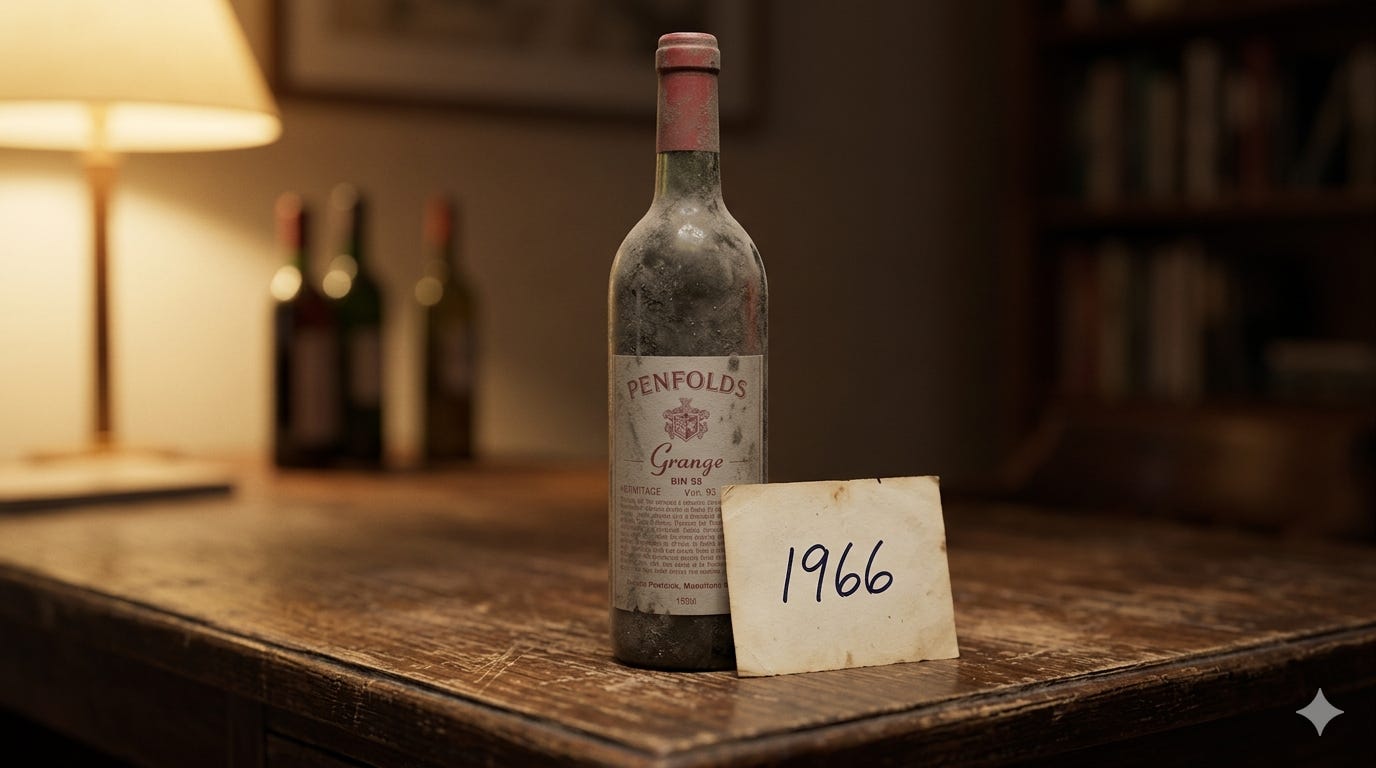
I started collecting Grange when I was nineteen or twenty. It was affordable then — you could still find it in craggy old bottle shops tucked into the back of dingy pubs in grungy Melbourne suburbs, before all those pubs got overhauled or razed entirely and turned into the kind of “charming” they have to design on purpose now.
Over the years I picked up one bottle of every vintage from 1960 to 2000. Forty-one bottles. Most of them came from those old bottle shops. Two of them didn’t — a ‘65 from Mum and Dad, a ‘66 from my sister. The ones that mattered for reasons that had nothing to do with the wine itself.
Forty-one bottles. Forty-one and a half years at one employer. I know nothing about numerology, but synchronicity runs deep in my life, and I noticed that one.
The bottle I actually want to tell you about
When I hit my 20-year work anniversary, the company gave me a bonus, and I decided to spend some of it on something meaningful. I bought a 1983 Grange — on top of the one I already had in the collection — and put it aside for a special occasion.
The special occasion arrived on my 40th birthday.
We assembled an army of red-wine-drinking friends for the opening of a proper Grange. Someone went at the cork. The cork crumbled. Someone else produced a coffee filter and a carafe. I held the filter while another friend poured, and we let it sit in the carafe to “air,” the way you do when you’re trying to rescue something.
Ten or twelve of us got a one-finger glug each.
It was ****ing awful.
And not one of us could spit it out.
There was too much sitting underneath that glass to just tip it down the sink. The money. The 1983 vintage. The two decades it represented. The occasion, the friends standing around watching, the ceremony of the crumbled cork and the coffee filter. An enormous amount of time and effort had gone into producing what was in that glass, and somewhere along the way it had stopped being about whether it tasted good. We needed to find the good in it. Preserve it. Honour it. Anything but admit it wasn’t worth drinking.
It was worth something. Even though it was awful.
The other thing I couldn’t spit out
I held onto my career the same way.
Forty-one and a half years. Project manager, business analyst, the person everyone called when something broke. Somewhere in the last stretch of it, the work had become genuinely awful to be inside. Exhausted. Burnt out. Carrying the “Oracle” title I used to think I’d be thrilled to put behind me, except by the time it actually mattered I was too tired to feel thrilled about anything.
But I couldn’t spit it out either.
Too much money, time, and reputation had gone into producing what I’d become. Too many witnesses — colleagues, the team, the years of being the one who fixed things. Too much invested to admit, while I was still in it, that it had stopped tasting like anything worth drinking.
That’s part of what was underneath those final months with Yol (my developer colleague in WA), building everything I could before I left — the knowledge library, the papers, every scrap of process linked and labelled. I wasn’t just being thorough. I was trying to make something good come out of a vintage I could no longer pretend was working, the way ten friends with a crumbled cork tried to find something redeemable in a glass none of us could swallow properly.
The redundancy, when it came, did what none of us did at that birthday table. It poured the rest down the sink for me.
What you’re holding onto
I’m telling you this because I think you might have a bottle of your own.
A skill, a job, a way of working that cost you real years and real effort — and that feels wrong to let go of, not because it’s still good, but because of everything it took to get there. The investment itself becomes the reason you can’t put it down, long after the thing in the glass has stopped being worth drinking.
I’m not going to tell you to spit it out sooner than I did. I didn’t. None of us did, that night, with the carafe and the coffee filter and the army of friends watching.
I’ll just tell you this: forty-one and a half years later, I finally know what that glass actually tasted like.
It wasn’t worth what it cost me to keep pretending otherwise.
Sandi is a Melbourne-based problem-solver, crisis-averter, and translator of the technical into the human. She spent decades being the person everyone called when something was broken, confusing, or just needed explaining properly — earning a reputation that preceded her wherever she went. Now she’s channelling that same instinct into AI: making it accessible, practical, and genuinely useful for people who think it isn’t for them.
Oh what a letdown for you, I can't imagine. No, I don't have a bottle. I tried like you, a taste in 78 and another, as i said, a couple of weeks ago. Loved both, perhaps yours was corked? But I follow your logic on holding things precious to us, perhaps too long or under the wrong conditions, I have no idea. I don't like things simply based on cost; I just like big reds. Thanks so much for sharing your story! So what is the future for your remaining bottles? They'd be worth a bit. I suspect you'd be reticent to open another after that disappointment.