

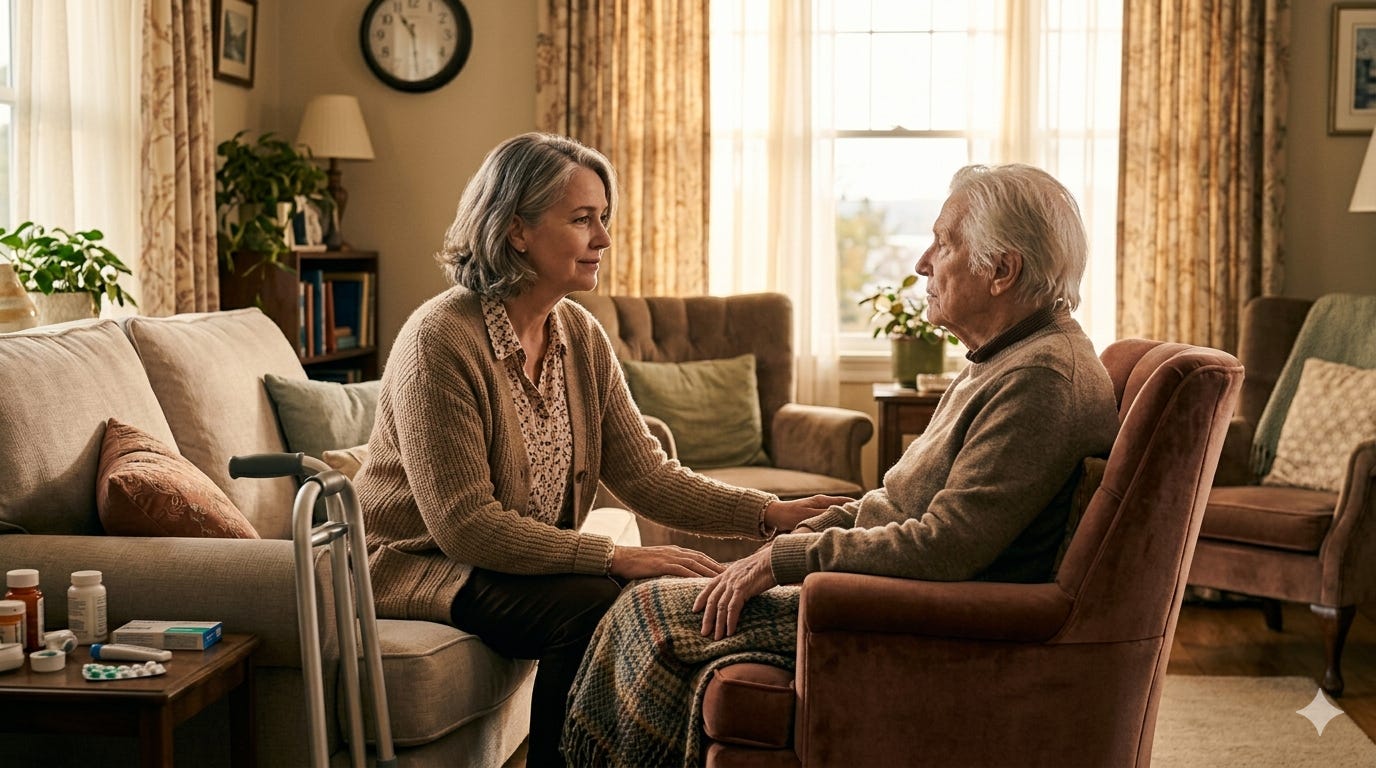
My mother is gone now.
She died in 2014, at the end of a long leaving — the kind that dementia makes, slow and then faster and then in ways that stopped surprising us because we had run out of the capacity to be surprised.
But for the years before that ending, she was still here. Physically present — breathing, sleeping, sometimes smiling at something none of us could see. The body that held her was still in the world. Her hands were the same hands. Her face, in certain lights, at certain angles, was the face I had known my whole life.
The person who lived behind that face — the mother who knew my name, who had opinions and memories and the particular way she held her cup — she had been leaving for years before she left entirely.
The grief of dementia is that it arrives before the loss. You mourn someone who is still in the room. You carry the weight of an ending that hasn’t ended yet, that keeps not ending, that stretches out in front of you with no clear horizon and no moment you are permitted to say: now. Now I can grieve.
There was no funeral yet. There was just the Tuesday. And the Wednesday. And the Thursday after that.
The people in the story
My father was the carer.
He watched his wife become, as he sometimes said with a gentleness that broke my heart, a child again. He managed her days with a patience and a love that I could not have predicted and cannot adequately describe. He was exhausted in the way that people who have been exhausted for so long that it has become their baseline are exhausted — not dramatically, not visibly, just always. Underneath everything. The tiredness that didn’t lift because there was no morning after it.
My sister was twenty-five kilometres away. I was in another state.
We were all trying to help in our own ways, from our own distances, with our own versions of the grief that we couldn’t quite name to each other — because naming it felt like a betrayal of the people still living it. Dad was suffering enough. We didn’t want to add our grief to his. We didn’t want to make him responsible for holding us up when he was already holding everything else.
So we held it separately.
Which meant we held it alone.
The thing about turning to each other
We couldn’t.
That’s the honest answer, and I want to say it plainly because I think it’s true for more families than will admit it.
We loved each other. We were not estranged or difficult or unable to communicate. We were just — each carrying something that felt too heavy to hand to someone who was already carrying their own version of the same thing.
Dad’s grief was watching his wife. My sister’s grief was proximity — the Tuesday visits, the face across the table, the hands that were the same hands. My grief was distance — the not being there, the phone calls that ended and left me alone with what had been said.
Three different griefs. The same loss. And none of us quite knowing how to support each other without adding to the weight.
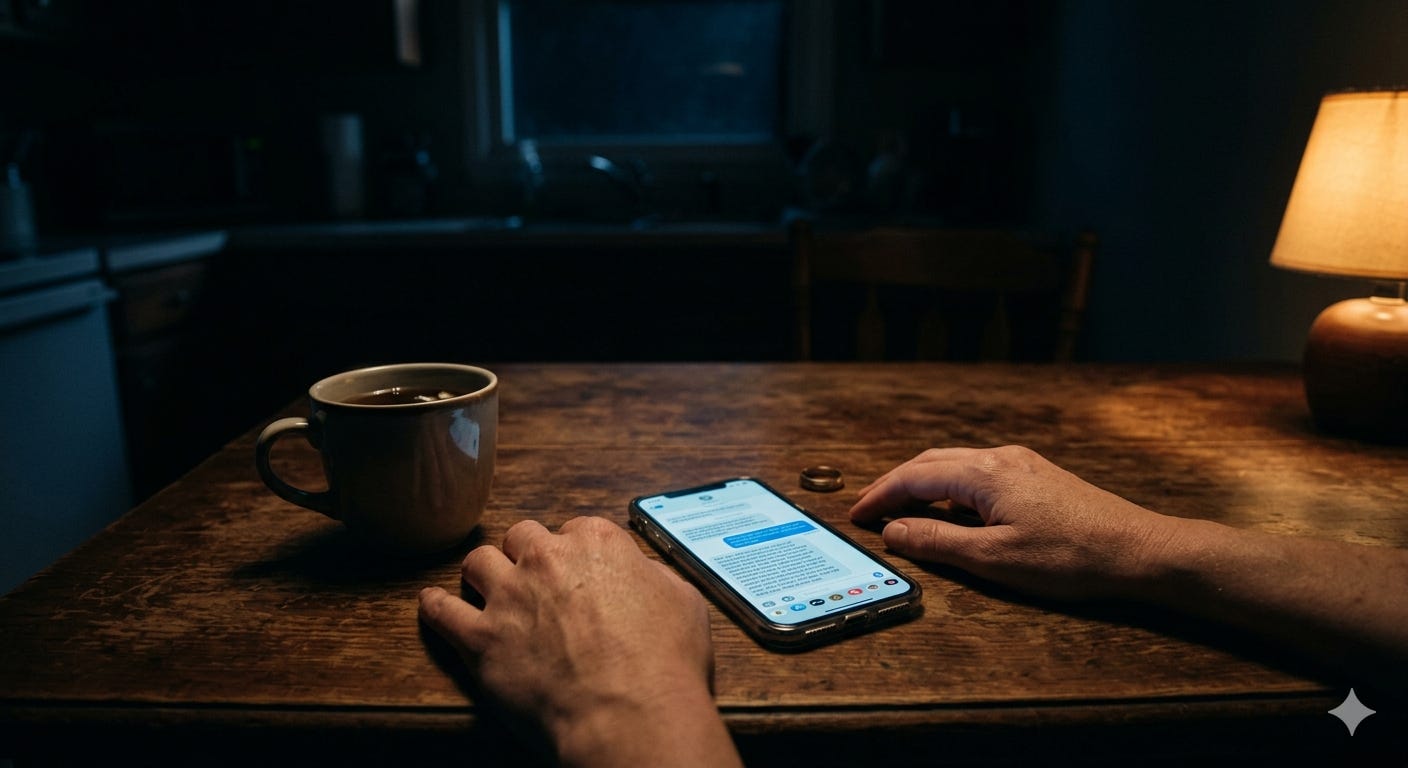
At 3am, when the pain of knowing and not being able to fix became too much to hold — there was nobody to call. Dad was asleep, or awake and shouldn’t be burdened. My sister was asleep, or awake with her own version of the same thing. The friends who loved me didn’t quite understand, because you cannot understand this from the outside, not really, not until you have sat with it.
I held it alone.
What I didn’t have
AI didn’t exist in the way it exists now. Not the kind that could sit with me at 3am and receive what I was carrying without needing to be protected from it.
I want to tell you what I would have done with it, because I know exactly what I needed and didn’t have.
I needed somewhere to put the question I couldn’t ask Dad because it would hurt him. The thing I was trying to understand about her medication, her behaviour, the change I’d noticed on the last visit that I didn’t know how to interpret. The legal question that arrived without warning — about power of attorney, about what happens when certain decisions need to be made, about what her wishes had been before she lost the ability to express them.
Those questions had answers. Not easy answers, not complete answers, but answers — information, framework, language, the shape of what we were dealing with so that the fear had something to hold onto besides itself.
And then there was the other kind of thing I needed. Not a question. Just somewhere to say: I don’t know how to do this. I don’t know how to grieve someone who is still here. I don’t know how to support my father without breaking down in front of him. I don’t know how to be far away and useful at the same time.
There was nowhere to say that. Not without burdening someone who was already burdened.
If AI had existed the way it exists now — if I could have opened a conversation at 3am and said the thing I was actually feeling, not the managed version, not the one edited for the people I loved — I would have used it every single night.
The invisible carer
I want to name my father properly in this post, even without naming him.
He had no official support. No training, no respite, no system that saw him clearly as someone who also needed care. He was the carer — which meant he was the one the system pointed everything at, and also the one the system most consistently forgot to ask: and how are you?
AI cannot give the carer what they actually need. It cannot give them rest, or company, or the presence of the people who love them. It cannot give them their person back.
But it can answer the question they are too tired to google at 11pm. It can help them understand the behaviour that frightened them today. It can help draft the letter to the specialist, navigate the aged care system, find the form that needs to be filled in before the deadline nobody knew existed.
It can be available when everyone else is asleep.
And for the person doing the hardest job in the family for years, without a title or a salary or a day off — available, at any hour, without needing anything in return — is worth more than I can easily say.
What I know now
My mother died in 2014. My father followed her, a few years later — the way some people do, when the person they were built around is gone.
The story is complete now. I know how it ended.
What I also know, from the other side of it, is what I was carrying without the tools that exist now. The 3am questions that had no home. The grief that had nowhere to go that didn’t cost someone else something. The fear that had no shape because I didn’t have the language to give it one.
If you are in it right now — if your person is still here, partly, intermittently, in moments that arrive without warning and disappear just as fast — I want you to know that the tool exists.
It won’t fix it. Nothing fixes it.
But it will sit with you at 3am. It will receive what you’re carrying without flinching. It will answer the question you can’t ask anyone else, and hold the weight of the thing you can’t say out loud to the people you love.
I did this without it.
You don’t have to.
Sandi is a Melbourne-based problem-solver, crisis-averter, and translator of the technical into the human. She spent decades being the person everyone called when something was broken, confusing, or just needed explaining properly — earning a reputation that preceded her wherever she went. Now she’s channelling that same instinct into AI: making it accessible, practical, and genuinely useful for people who think it isn’t for them.