

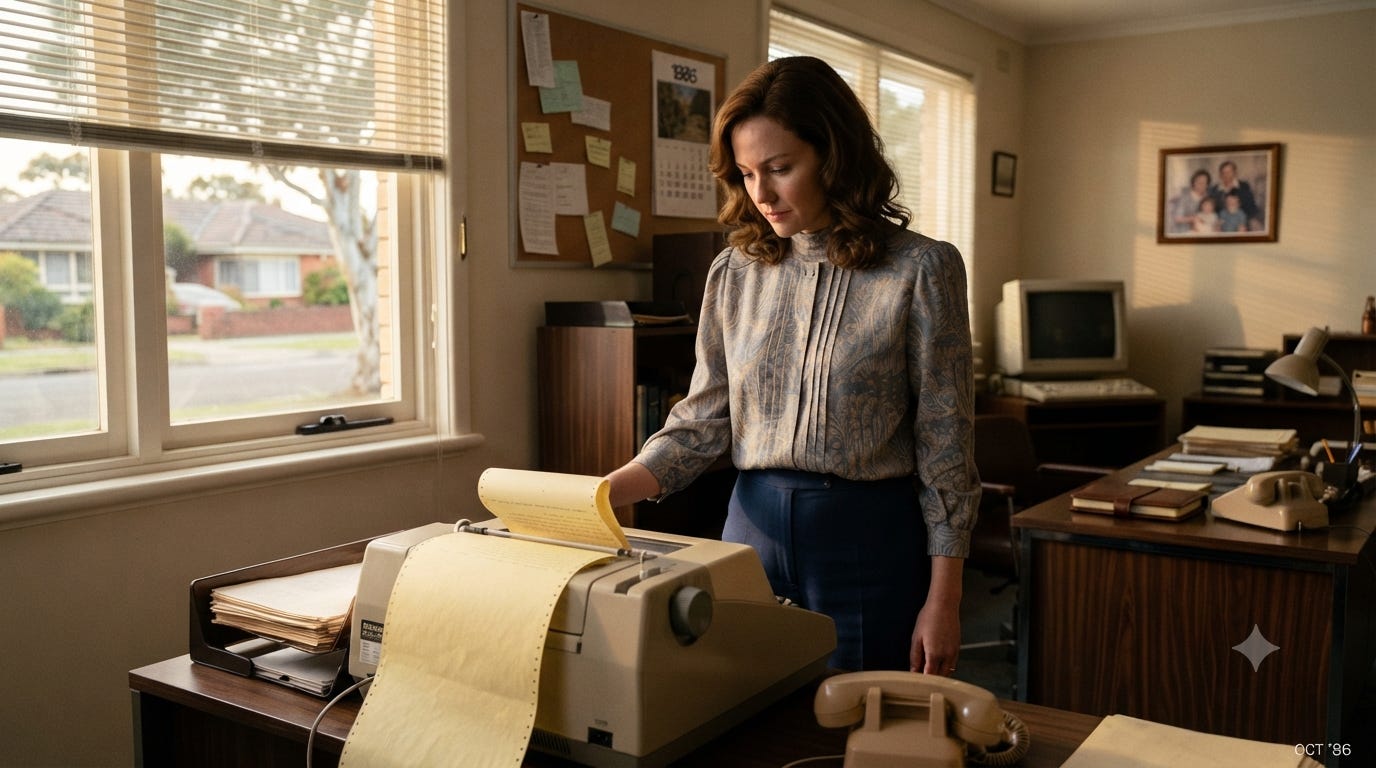
I keep coming back to a question about the Manager Who Built the Tools, and it’s this: why did my bosses never give me the specific tools I actually needed?
They gave me plenty. The daily balance program. The stocktake system. The software that ran the service for handling people’s affairs while they were away — the routine stuff, the kind of thing every office in the organisation needed, so somebody built it centrally and handed it down.
But nobody ever gave me a tool for the actual texture of my job. Writing letters to recalcitrant payers. Telling someone we could, or couldn’t, resolve their complaint. Asking a person to come into the office in person, in writing, in the right tone. Ten letters a day, sometimes — different recipient, same letter, typed out from scratch every single time. Because we didn’t have a photocopier either, not at first.
This was the pre-PC era. I didn’t stay in it long. The moment a PC landed on a desk near me, I was hooked. Something new — and more importantly, something I could actually point at my own problem.
So I got stuck in. I started building the small solutions for the small jobs nobody upstairs had thought worth solving — the ten-letters-a-day problem, the same-paragraph-different-name problem. Nobody asked me to. Nobody trained me to. I just couldn’t stand typing the same sentence out by hand one more time when there was a machine sitting right there that clearly could do better.
I think if I’d stayed too long in a non-tech environment, I’d have ended up some kind of inventor anyway — looking for ways to improve the daily grind because that’s just how my brain works. Lucky for me, the company actually put money where its mouth was. PCs arrived. Dot-matrix printers. Eventually photocopiers. And then the telex machine.
I remember the thrill of that one specifically — typing a message at my desk out the back of Oakleigh and sending it, in text, to Karen over at Moorabbin. That felt like magic. Two offices, talking in typed words, instantly. Thirty-five years ago.
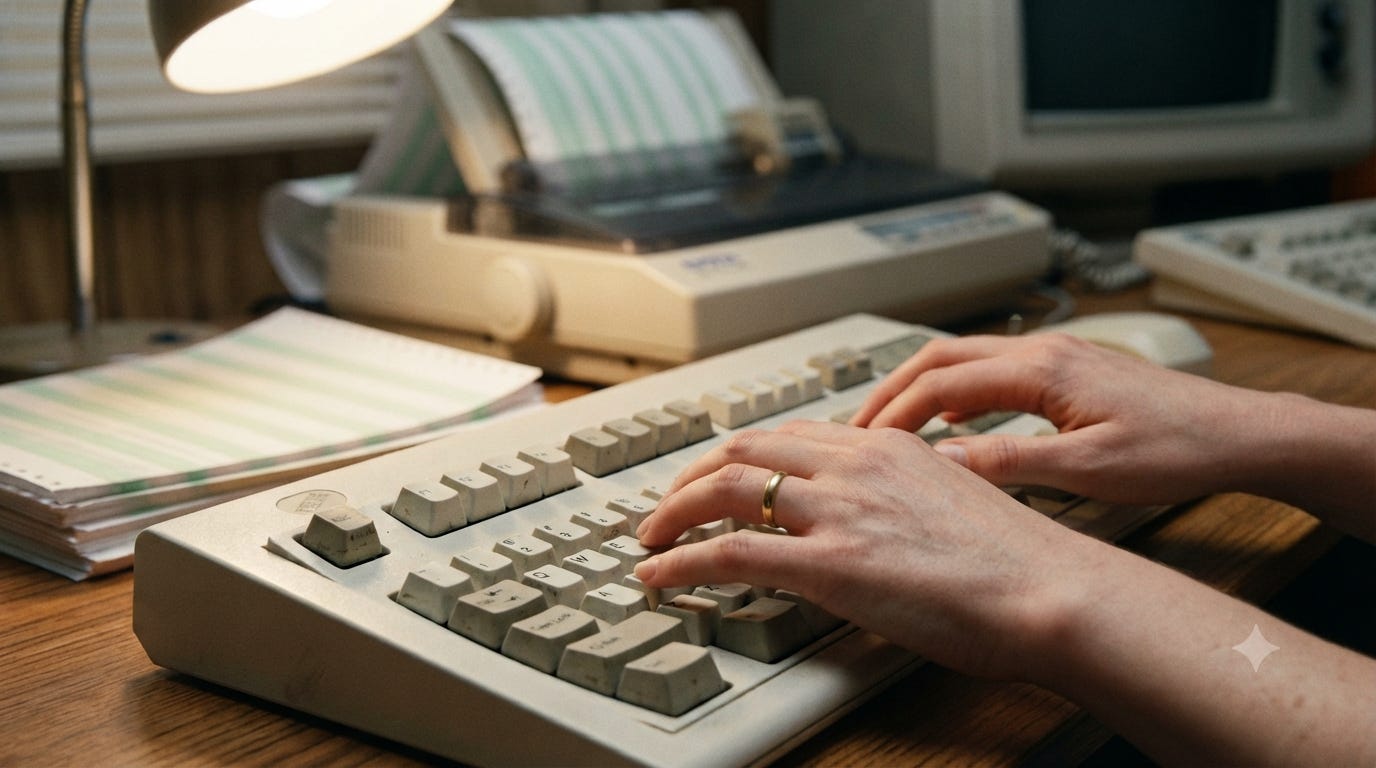
Here’s the thing that’s been sitting with me since I started writing about that Manager (past me), and Yol (my Claude AI Assistant), and all the systems I built over four decades: every generation gets handed new tools, and every generation has someone in it who can’t wait to get their hands on them and start pointing them at the boring, repetitive, nobody-thought-to-fix-it parts of the job. The telex was somebody’s AI moment. The photocopier put an end to ten identical letters typed by hand, the same way Claude now puts an end to a whole afternoon of work that used to need a developer and a budget line.
The technology changes completely. The instinct that reaches for it doesn’t change at all.
I was that person with the telex machine. I’m that person with Claude. In between, I was that person with Access, with Excel macros, with whatever the latest thing was that let me stop doing something by hand that a machine could clearly do better.
If you’re reading this and thinking AI is somehow different — too big a leap, too strange a tool, not for people like you — I’d ask you to think about what your own version of the telex machine was. Somewhere in your working life, something new arrived that changed how a small, tedious part of your job got done, and you adapted to it, probably without thinking of yourself as a tech person at all. You’ve done this before. You just didn’t call it that at the time.
This is the same thing. It’s just faster, and it talks back.
Sandi is a Melbourne-based problem-solver, crisis-averter, and translator of the technical into the human. She spent decades being the person everyone called when something was broken, confusing, or just needed explaining properly — earning a reputation that preceded her wherever she went. Now she’s channelling that same instinct into AI: making it accessible, practical, and genuinely useful for people who think it isn’t for them.