

I want to tell you about a Friday afternoon that started with a question about AI image tools and ended with me genuinely reconsidering how I’d been teaching people to use them.
A friend had been showing me results from Gemini — Google’s AI — and I was curious. So I sat down and typed out a description of my courtyard.
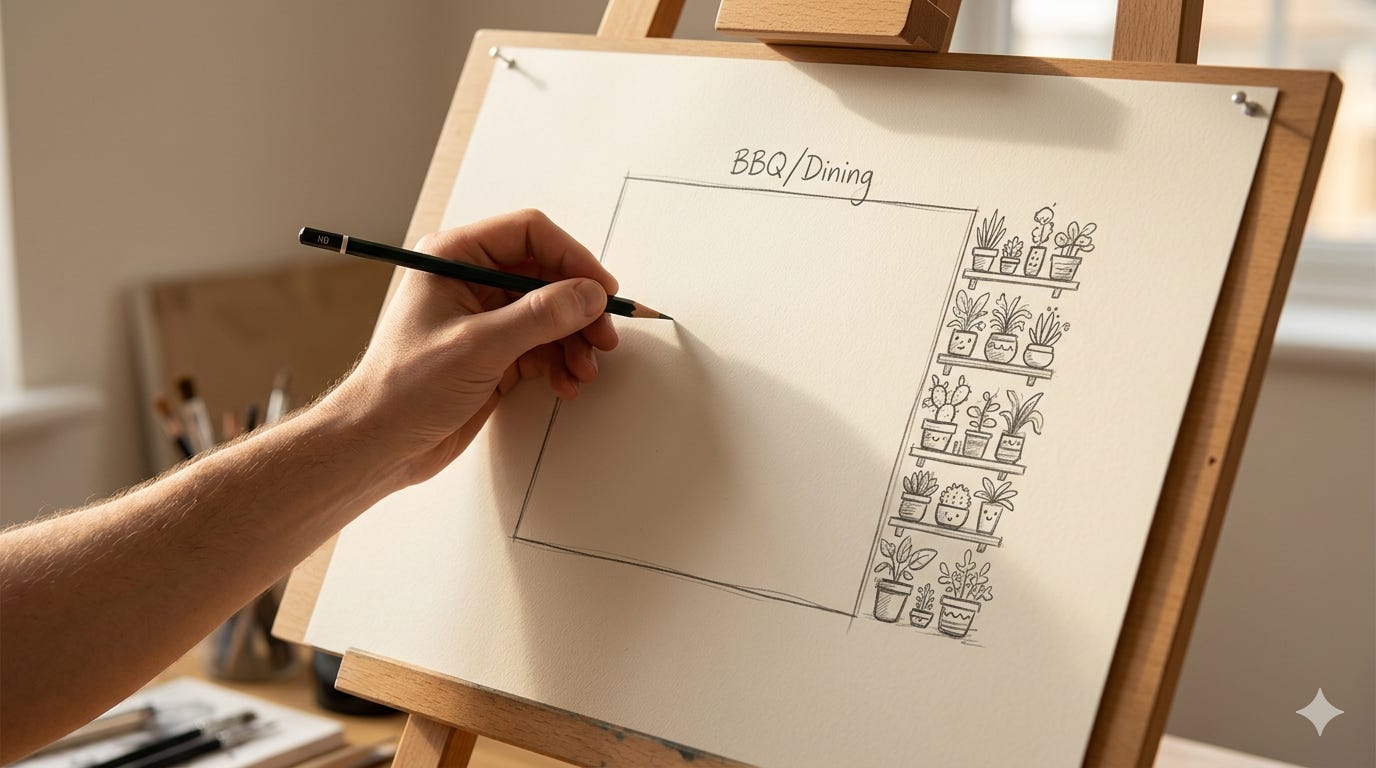
Not a quick one-liner. A proper description. The L-shape of the space. The long arm open to the southern Melbourne sky. The shelving units along the fence packed with cacti and succulents in everything from terracotta pots to old baking tins. The glimpse around the corner into the shaded entertaining area — BBQ, dining table, a vertical wall of tropical plants catching the light under the overhang.
I typed it out the way I’d describe it to a friend who’d never seen it. And then I pressed enter.
What came back stopped me in my tracks.

The image was beautiful.
Warm timber fencing. Strings of pearls draping over shelf edges. Flowering cacti. Agaves on the ground. The BBQ just visible around the corner, the tropical wall garden behind it. Even the gravel path. Even the cantilevered upper storey.
It had read my description and rendered it — not generically, but specifically. The colourful pots in all shapes and sizes. The lush plants some flowering, some draping. The L-shape captured in the perspective of the image itself.
I sat there for a moment just staring at it, mouth agape!
So what actually happened?
Here’s the thing I want you to notice — because this is the lesson buried inside that pretty picture.
The image was good because the description was good.
I didn’t type “show me a courtyard with plants.”
I gave it context. I gave it geometry. I gave it specificity. Kitchen-grade baking dishes and tin cans. Lush and draping and some flowering. A glimpse. A BBQ. A wall garden of tropical plants.
Every detail I included, the AI used. Every detail I left out, it would have guessed — and guessed generically.
“It’s just a conversation” means: say what you actually mean. All of it.
Most people, when they first try AI image tools, type something like “garden with plants” or “outdoor entertaining area.” And they get a result that looks like a stock photo. Nice enough. Nothing like what they had in mind.
And then they conclude that AI image generation is overrated.
It’s not overrated. It’s underprompted.
The comparison that made it click
For fun, I also asked Claude — the AI I use every day — to render the same scene. Claude can’t generate photographs; instead it builds images out of code, using geometric shapes and mathematical paths. The result was charming in its own way. Rooftop string lights as glowing circles. Strings-of-pearls as dotted curves. A shelf of cacti as coloured rectangles with spiky paths.
It was, as Claude cheerfully acknowledged, “charmingly lo-fi by comparison.”
But here’s what struck me: both results were directly shaped by my description. The Gemini image was photorealistic and gorgeous because it had a great image generation model to work with. The Claude SVG was geometric and hand-drawn-feeling because that’s what Claude builds from. But in both cases, the specificity of my language was the ingredient that made it more than generic.
The tool matters. But the conversation matters more.
What this means for you
If you’ve tried AI image generation and felt underwhelmed, I want to gently suggest: go back and look at what you typed.
Was it a noun? Or was it a scene?
Was it a label — “garden,” “kitchen,” “office” — or was it a description? Colours, textures, relationships between things, the quality of the light, what’s in the foreground and what’s just glimpsed in the background?
The AI is not a mind reader. But it is an extraordinarily good listener. Give it something worth listening to.
Describe it the way you’d describe it to someone who’s never been there but really wants to picture it.
That’s it. That’s the whole technique. No special syntax. No prompt engineering certification required. Just the same instinct you’ve been using since you were old enough to tell a story.
One more thing
I’ve been saying for a while that AI is just a conversation. That the barrier most people hit isn’t the technology — it’s the belief that you need to approach it differently to how you’d approach talking to a person.
That Friday afternoon in front of my courtyard description reminded me why I believe that so strongly.
I described a place I love. An AI listened. And then it showed me what it had understood.
That’s not magic. That’s just a good conversation.
Sandi is a Melbourne-based problem-solver, crisis-averter, and translator of the technical into the human. She spent decades being the person everyone called when something was broken, confusing, or just needed explaining properly — earning a reputation that preceded her wherever she went. Now she’s channelling that same instinct into AI: making it accessible, practical, and genuinely useful for people who think it isn’t for them.