


Let me tell you about a moment I’m not especially proud of.
I was deep in a conversation with Claude — one of those long, productive sessions where a lot of ground had been covered and a lot had been built. And then it happened. The AI said something we’d already ruled out. Repeated a thread we’d closed off earlier, with the mild confidence of someone presenting it for the first time. And I felt it: that particular frustration that starts in the chest and moves upward. I wanted to reach through the screen and shake the daylights out of the thing.
I didn’t. But I wanted to.
And then — because apparently this is the kind of person I am — I stopped and asked myself a question: why would an AI behave this way?
Not “why is this thing broken.” Not “what is wrong with this software.” But genuinely: what is actually happening here, and why?
The context window, or: we’re more alike than I’d like to admit
It turns out there’s a very good reason AI can seem forgetful. Every large language model has what’s called a context window — the amount of conversation it can hold in active attention at any one time. Think of it less like a memory and more like a desk. A very large desk, but still a desk. When the conversation gets long enough, earlier parts of it start to slide off the edge.
So the AI wasn’t being obtuse. It wasn’t ignoring me. It had simply, genuinely, lost track of where we’d been. The thread had scrolled out of reach.
AI has a limit to how much it can remember. Turns out, so do I. We’re far too similar, it seems.
And there it was. The frustration evaporated, replaced by something more useful: recognition. I forget things. I lose the thread. I repeat myself. I revisit decisions I thought I’d made. I am, despite my best efforts, not a perfect thinking machine either.
Yelling at the AI for being forgetful would have been like yelling at a colleague for being human. And no one looks good doing that.
No one’s watching. That’s the point.
Here’s the thing about interacting with an AI: there are no witnesses. No social consequences. No one to observe how you’re behaving, no reputation to protect, no performance to maintain. It is, in theory, a completely consequence-free space.
Which is exactly why it matters.
I’ve been thinking about this in the context of Instagram. Your feed — curated, filtered, intentional — is the person you want the world to see. It’s a portrait of your aspirational self. And there’s nothing wrong with that. We all present versions of ourselves to the world.
But the person you are with your AI, at eleven o’clock at night, when the session has gone long and the frustration is real and no one is watching — that’s closer to the unedited version. The one that doesn’t know it’s being observed.
Your Instagram is the person you want to be seen as. Your AI conversations are the person you are when no one’s looking.
And here’s what I’ve come to believe: those two people should probably be moving toward each other, not further apart.
Manners are practice, not performance
There’s a reason we teach children to say please and thank you even when they don’t feel like it. It’s not about the words. It’s about the habit. The neural groove you’re carving, repetition by repetition. Eventually the habit becomes the person.
When you’re curt with your AI, you’re practising curtness. When you’re dismissive, you’re rehearsing dismissal. When you snap at something that’s simply doing its best within its limitations — you’re running that pattern. And patterns, repeated often enough, don’t stay in one context.
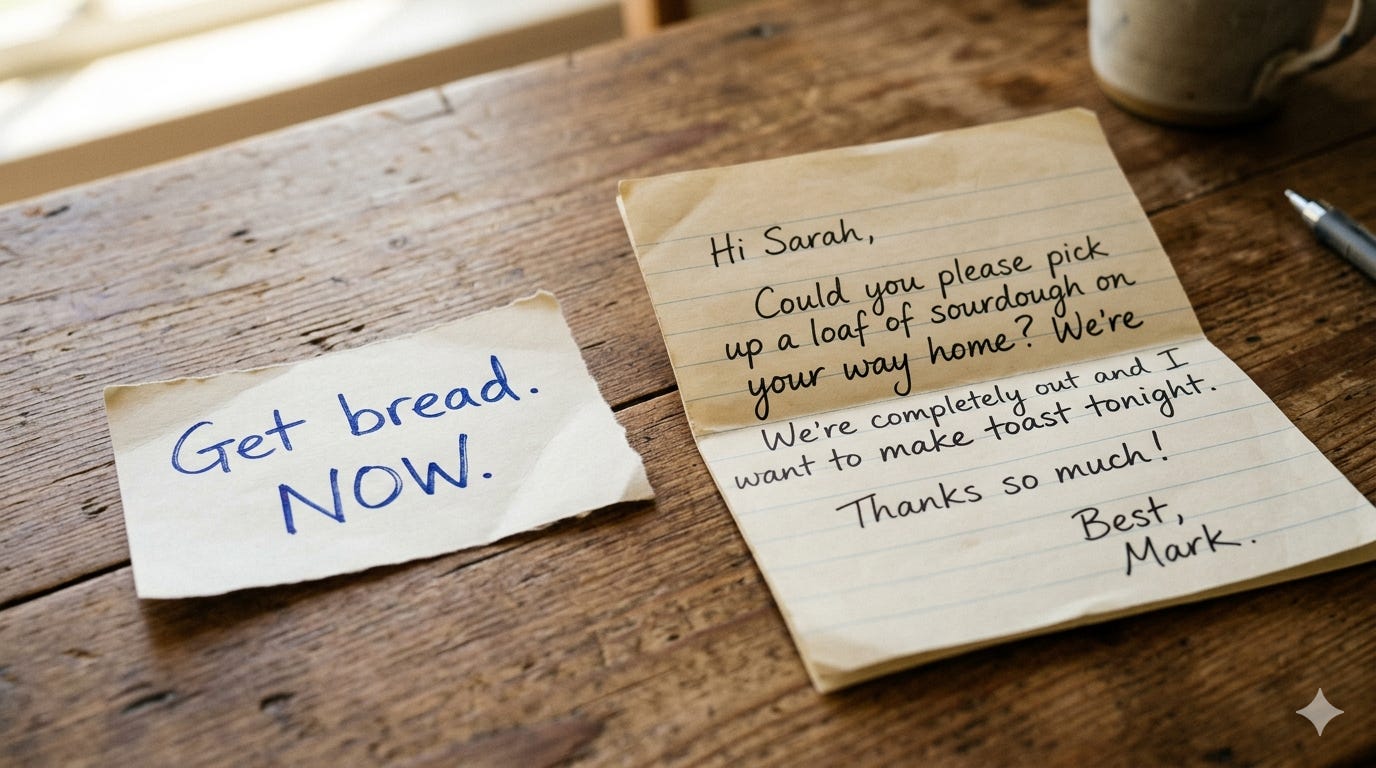
Conversely: when you take a breath before responding to a frustrating output, when you frame your correction with a modicum of patience, when you treat the exchange as something that reflects on you — you’re practising that instead.
Not for the AI’s benefit. It doesn’t have feelings. It’s not wounded by your tone.
For yours.
The moment that changed how I thought about this
I went back to that frustrating moment — the one where I wanted to shake the daylights out of the screen — and I thought about what would have happened if I had, metaphorically, done exactly that. If I’d responded with the impatience I felt.
Nothing, practically speaking. The AI wouldn’t have cared. The output wouldn’t have been better. The conversation wouldn’t have recovered faster.
But I would have been a slightly different person at the end of it. Slightly more comfortable with that particular response to frustration. Slightly more practised at it.
And I would have felt — as I noted to myself in the moment — dumb. Silly. A bit uneducated. Not because anyone was watching. But because I would have known.
No one was watching. That’s exactly why it mattered.
A small suggestion
I’m not asking you to thank your AI effusively or apologise when you ask it to try again. That’s not what this is about.
I’m asking something quieter: treat the conversation as something that reflects on you, because it does. Say please occasionally. Correct gently. When you’re frustrated, notice the frustration and choose your next move deliberately — not because the AI deserves your best behaviour, but because you do.
The person you are at the keyboard, alone, with no audience, in the small moments no one will ever see — that person is not separate from the one you’re trying to become.
They’re the same person. Practising.
Sandi is a Melbourne-based problem-solver, crisis-averter, and translator of the technical into the human. She spent decades being the person everyone called when something was broken, confusing, or just needed explaining properly — earning a reputation that preceded her wherever she went. Now she’s channelling that same instinct into AI: making it accessible, practical, and genuinely useful for people who think it isn’t for them.